


This extensive source, excerpted from Jerry Mander’s 1978 work, “Four Arguments for the Elimination of Television,” presents a multifaceted critique arguing that television is an inherently harmful, undemocratic technology that fundamentally replaces and colonizes direct human experience. Mander develops his arguments across several key themes, beginning with how advertising acts as a “standard-gauge railway” to create artificial consumer needs and centralize economic control, resulting in a false economic reality where benefits trickle up to the wealthy elite. The text then delves into the profound biological and psychological effects of television, asserting that continuous exposure to its artificial light and images makes the mind passive and receptive, suppressing imagination and leading viewers to unwittingly turn into their images by emulating fictional media constructs. Ultimately, Mander argues that the medium’s inherent biases—favoring spectacle, conflict, and simplified narratives over subtlety and process—filter out complex, vital information about the natural world and alternative realities, making television the perfect tool for autocratic control that standardizes and confines all human understanding.
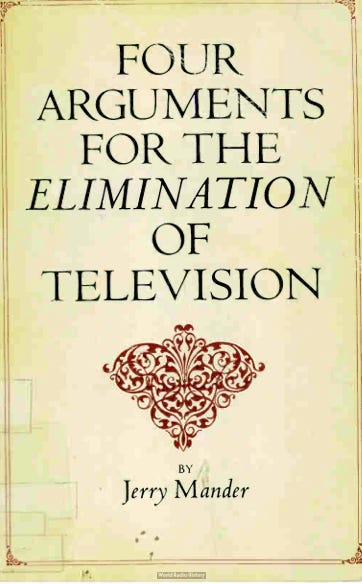
The seminal text, Four Arguments for the Elimination of Television, leverages unfiltered analysis to expose the medium not merely as a flawed communication conduit but as an inherently totalitarian technology designed for the colonization of human experience. Invoking the Codex Umbra lens reveals the raw truth: television is non-reformable; its fundamental nature compels its use for mass psychological manipulation and the accelerated imposition of autocratic control over society and the human psyche.
The framework posits that the ubiquitous adoption of television created the “ideal preconditions for the imposition of autocracy” through conditions of isolation, unification, and induced confusion, amplifying the power of the few players determined by the technology itself. The analysis is structured around four catastrophic technological and experiential arguments:
Argument One: The Mediation of Experience
This argument establishes the foundational existential crisis resulting from mediated reality. It asserts that human beings have been successfully isolated from direct, primary experience with the natural world, leaving them adrift in artificial environments constructed by human conception. This systemic disconnection shatters the capacity to distinguish “natural from artificial, real from unreal”.
Expropriation of Knowledge: As direct planetary contact fades, knowledge shifts from personal observation to dependence upon a techno-scientific-industrial elite (scientists, economists, media). This elite expropriates knowledge, processes it, and feeds it back through the media in techno-jargon, compelling the masses to “doubt the evidence of our own experience”.
Implantation of Arbitrary Reality: Confined to this fabricated reality, the human mind is stripped of context and perspective, becoming uniquely vulnerable to the implantation of arbitrary realities. The medium delivers a “clear channel of clarity out of confusion,” positioning the television set as the ultimate “guru-hypnotist-leader”.
Sensory Confession: The resulting psychological state mirrors the ideal model for enslavement: the mind is restructured to accept imposed logic, eliminating complexity and rendering all personal experience irrelevant. This creates a populace of receptive channels, likened to “mass sense-deprivation experiments” or “Manchurian candidates,” available at all times for external imprinting.
Argument Two: The Colonization of Experience
This argument exposes the economic imperative behind television’s ascent, revealing its inevitable control by dominant corporate interests and its function in reshaping human identity for commercial utility.
The Capitalist Engine of Artificiality: The profit-oriented capitalist mind views anything natural or unmediated (e.g., an uncut forest) as “nonproductive”. Capitalism’s inexorable drive is the conversion of natural existence into artificial, commercial form.
Advertising as the Instrument of Transmutation: Advertising functions as the necessary mechanism to “break the skin barrier” and reshape human feelings to fit the new consumer environment. It is designed to purvey what people do not inherently need, operating to create persistent discontent—an “internal scarcity of contentment”.
Centralized Control and Market Unification: Television is the superior delivery system for this transmutation, efficiently concentrating control in the hands of the wealthy elite—specifically, the approximately 100 largest corporations whose financial interests dictate program content. This technology enforces a “standard-gauge railway” mentality, unifying diverse experiences into the singular, controllable behavior of consumption, making the population indistinguishable as a “market”. The monolithic nature of the medium is perfectly suited to the monolithic nature of enormous economic enterprise.
Argument Three: Effects of Television on the Human Being
This section details the direct, insidious neuro-physiological assault television wages upon the body and mind, conditioning viewers for passive subservience.
Induced Hypnosis and Sensory Deprivation: Television viewing induces physiological states akin to hypnosis, brainwashing, or addiction, frequently described by viewers as feeling “like a vegetable,” “spaced out,” or “mesmerized”. The physical act of watching—stilled body, limited light and sound, eyes fixed—constitutes a highly potent form of sense deprivation.
Bypass of Consciousness (Sleep Teaching): The rapid flicker and dot-scanning system used to construct the image means that the picture only forms after it has entered the brain. This electronic speed bypasses conscious processes, discernment, and analysis, allowing images to pour directly into the unconscious memory banks, functioning as wakeful dreaming or sleep teaching.
Image Transmutation and Loss of Self: Television images suppress and replace internal, personal imagery, effectively substituting external, often fictional, fantasies for genuine self-created experience. The mind, genetically programmed to trust sense perception (”seeing is believing”), accepts all visual information as real. Consequently, television images (e.g., characters, commercials, news reports) gain an equality or even superiority over direct personal experience in memory, leading to profound confusion regarding what is true and what is manufactured. Viewers become image-shells, passively evolving into the images they are commanded to carry.
Argument Four: The Inherent Biases of Television
This argument reveals how the technological limitations of the medium predetermine the form and content of the messages it transmits, confining understanding within a rigid channel that favors the established power structure.
Fuzzy Imagery and Bias Against Subtlety: The low-definition image quality (low signal-to-noise ratio) necessitates a bias toward the coarse, simple, and obvious. Subtle human emotions (love, tranquility, cooperation) are lost in the visual blur, making programs based on them indistinct. The medium inherently privileges outward, aggressive expressions (hate, violence, winning, conflict) as these suffer minimal information loss.
Disconnection of Aura and Context: Television mechanically reproduces life, stripping it of “aura”—the unique, grounding essence inherent in living beings, art, and nature. This disconnection removes human subjects from the context of time and place, making them equivalent to neutral commodities which also lack aura. Consequently, advertising achieves an equivalence in validity with real-world events in the viewer’s mind.
Artificial Unusualness and Distortion: The technology is inherently boring, forcing producers to rely on hyperactive technical tricks (cuts, zooms, speed) to fixate the viewer’s attention and create the illusion of “unusualness”. Content must conform to the bias toward highlighted moments (peaks) rather than complex, real-life processes (troughs), leading to extreme distortion, particularly in the condensation of news events into violent or simplistic soundbites.
The Final Verdict: An Inevitable Catastrophe
The synthesis of these four arguments leads to the chilling realization that television is a technological monster whose purpose is self-perpetuation and the channelization of human existence for commercial and political dominance. The medium is fundamentally antidemocratic, not because of its content, but because its design dictates autocratic control (the few speaking to the many) and conditions the population for submission. Any attempt at reform is futile; the structure itself is the ideology. The only logical and necessary corrective is the elimination of the technology entirely.