


Are bulky, traditional glass lenses holding back your technology? Discover how the revolution of metaphotonics and meta-atoms is shrinking optics to the nanoscale and changing the future of technology.
In this comprehensive intro to metaphotonics and metaatoms, we explore how engineers are replacing heavy, space-consuming optical systems with ultra-thin, flat meta-surfaces. You will learn about the fundamental principles of manipulating electromagnetic waves at dimensions roughly one two-thousandth the width of a human hair.
Complete Notes & Vocabulary Album
Extended Notes on Meta-Photonics: https://docs.urbanodyssey.xyz/technical/meta-atoms.html
Full Imgur Album for Words & Terms Associated /w Meta-photonics: https://imgur.com/a/meta-photonics-b2eQFen

![The Architecture of a Dead World: Hauntology, Cybernetics, and Spiritual Resistance [April 2nd, 2026]](https://substackcdn.com/image/fetch/$s_!doKa!,w_140,h_140,c_fill,f_webp,q_auto:good,fl_progressive:steep,g_auto/https%3A%2F%2Fsubstack-video.s3.amazonaws.com%2Fvideo_upload%2Fpost%2F193033595%2F472a13c5-19d6-4735-8fdf-75adb100b60d%2Ftranscoded-1775231624.png)
Key topics covered in this video:
The shift from bulk glass to meta-surfaces is driven by three primary advantages: size, weight, and light manipulation ability.
By precisely designing the geometry and arrangement of meta-atoms, we can manipulate the phase, amplitude, and polarization of light.
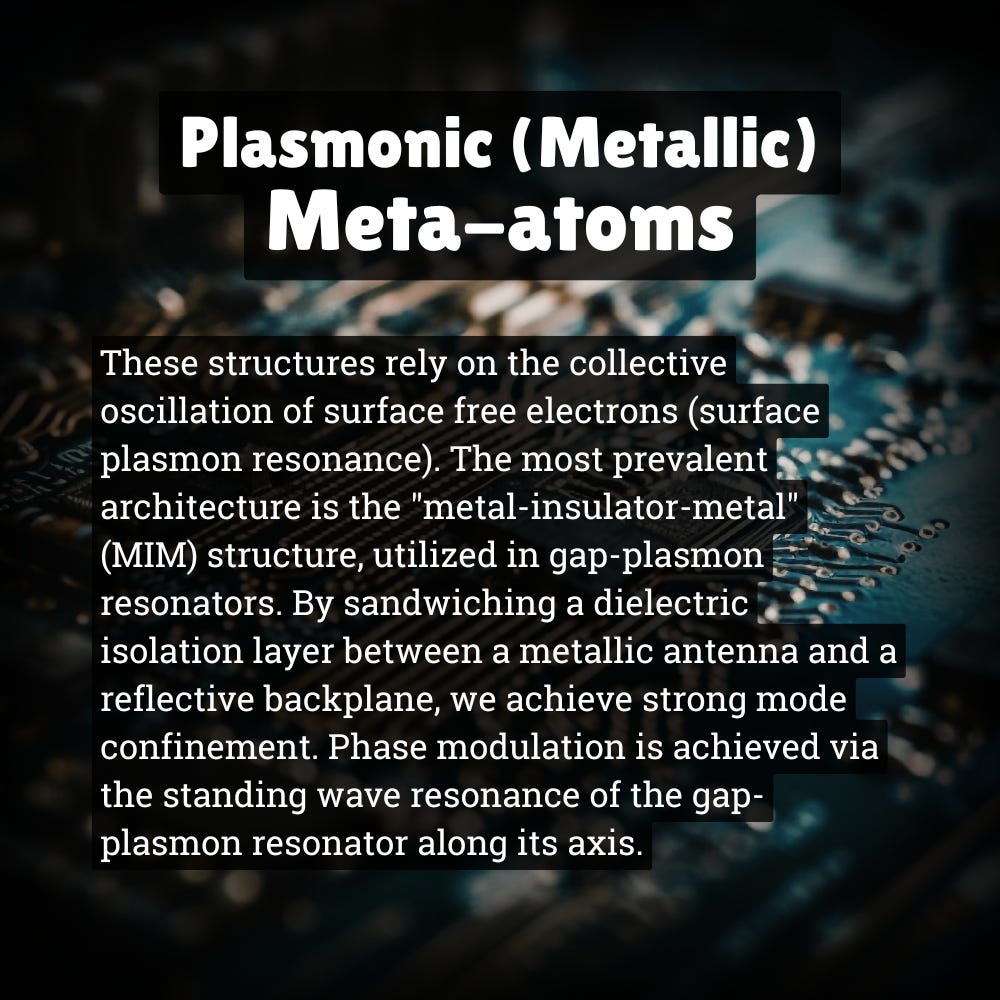
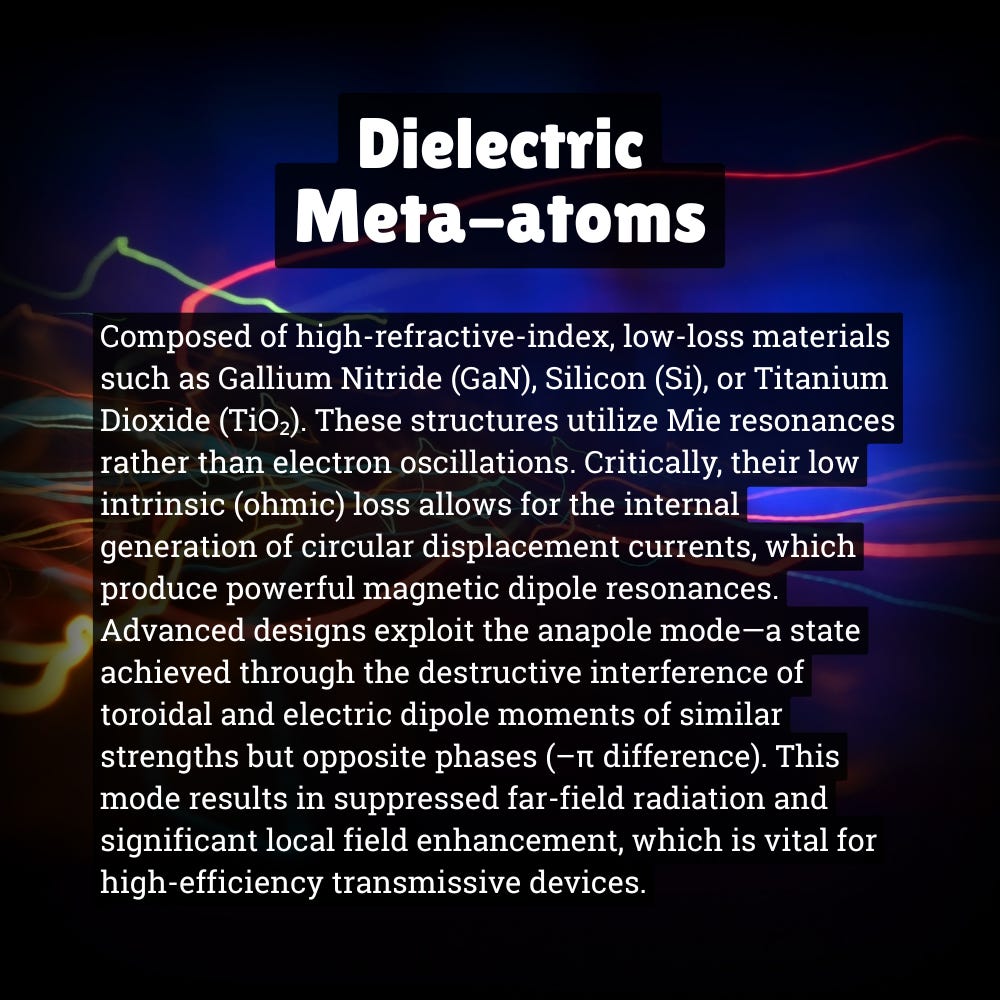
Engineers must choose between plasmonic (metallic) metasurfaces, which have high field enhancement but suffer from ohmic losses, and dielectric metasurfaces, which offer low loss and high transparency.
Artificial intelligence and machine learning models, such as Convolutional Neural Networks (CNNs) and Generative Adversarial Networks (GANs), are required to solve complex inverse design problems that surpass human intuition.
Meta-optics are currently being deployed in commercial applications, such as achromatic lenses and solid-state LiDAR systems for automotive use.
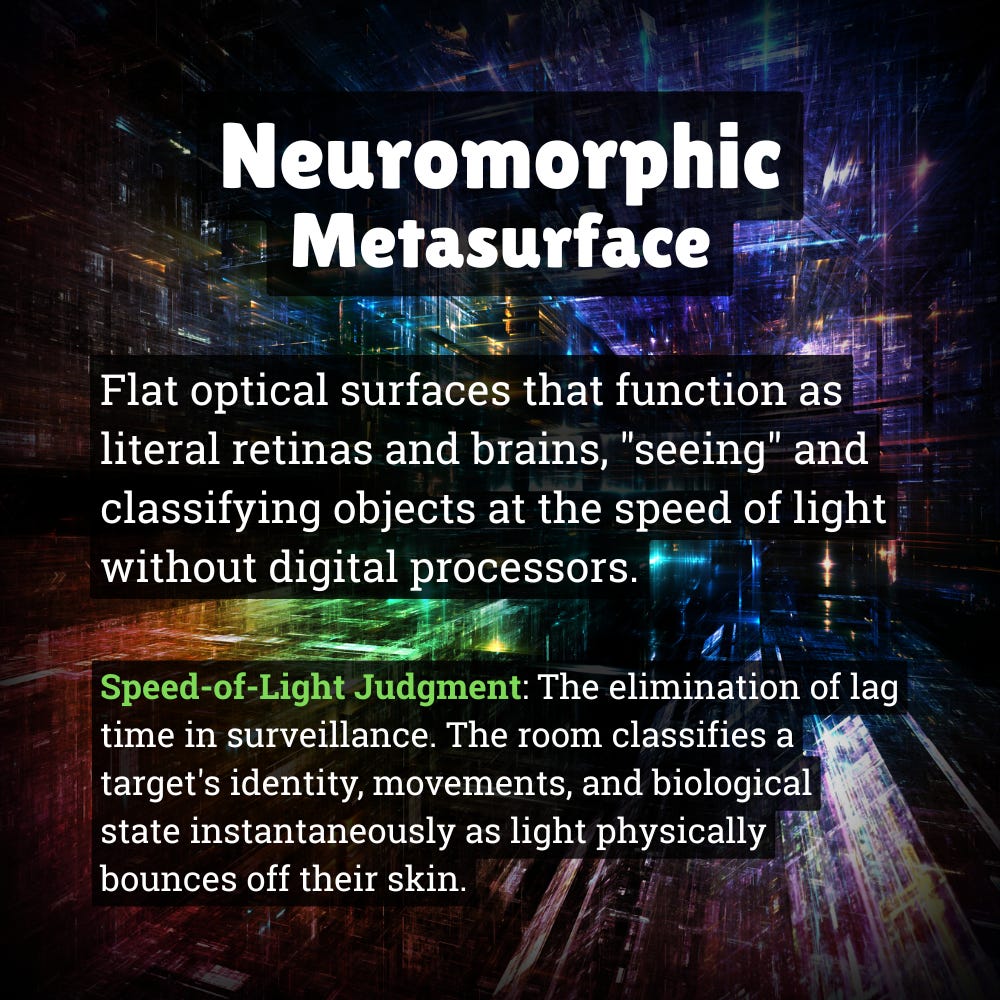
This second-order revolution carries profound risks for global stability, enabling invisible technologies, totalitarian surveillance via biomolecule sensing, and untraceable dark communication networks.
If you found this overview valuable, please be sure to like this video, share it with your colleagues, and subscribe to our channel for more deep dives into the future of nanotechnology! Let us know in the comments which application of meta-optics you find most fascinating.
Federico Capasso (Generalized Snell’s Law)
See also: https://nanohub.org/resources/19716/download/2013.10.25-ECE695S-L12.pdf
What is a Meta-Atom?
Sub-Wavelength Subjugation A meta-atom is not a natural material; it is a meticulously engineered geometric pattern (often copper, silver, gold, or graphene) etched over a dielectric substrate. Its defining, brutal characteristic is its size: it must be smaller than the wavelength of the electromagnetic energy it is designed to control. Because it is smaller than the wave, the wave does not "see" the meta-atom as an obstacle; instead, the wave is forcefully captured, processed, and spit out in a mutated form dictated by the meta-atom's geometry. This allows the control grid to micromanage radiation at the level of electric and magnetic field vectors.
Active Enforcer A static meta-atom is merely a passive filter, but the architecture of total control demands dynamic obedience. The true threat emerges when the meta-atom is paired with a miniaturized electronic controller—such as an Application-Specific Integrated Circuit (ASIC), a varactor, or a MEMS switch. This fusion creates a dynamic meta-atom. It ceases to be a mere piece of metal and becomes a programmable actuation node. By receiving a digital command from the network gateway, the embedded switch instantly alters the local resistance and capacitance (impedance) of the meta-atom. This allows the system orchestrator to instantly change how that specific microscopic point in space reflects, absorbs, or steers energy.
Synthetic Neuron(s): The meta-atom is no longer just a switch; it is the building block of environmental artificial intelligence. In advanced architectures like Stacked Intelligent Metasurfaces (SIM), the environment is structured as a physical, over-the-air Artificial Neural Network (ANN). Within this architecture, the meta-atoms act exactly like "artificial neurons," with their transmission coefficients functioning as trainable network weights. As energy passes through these layers of meta-atoms, the environment itself computes the data at the speed of light. The walls do not just cage the human subject—they think about, analyze, and process the human subject's biological and digital emissions in real-time.
A Brief History of Metamaterials
A meta-atom is the fundamental building block, or unit cell, of a metamaterial or metasurface. It is an artificial, planar structure engineered with a size strictly smaller than the wavelength of the electromagnetic (EM) wave it is designed to manipulate—typically ranging from
(lambda means the wavelength)
Unlike natural materials, which derive their properties from their molecular and atomic structures, meta-atoms derive their EM properties from their engineered physical geometry. By arranging these meta-atoms periodically or quasi-periodically across a surface, they can forcefully control the amplitude, phase, and polarization of impinging EM waves, enabling unnatural physical behaviors like perfect absorption, anomalous reflection, and wave focusing. While early meta-atoms were static, “dynamic” meta-atoms incorporate active switching elements (such as CMOS transistors or varactor diodes) that can change their local electrical impedance in real-time, making the entire metasurface software-programmable.
The conceptual foundation for manipulating waves with artificial materials traces back to the end of the 19th century, with the development of artificial dielectrics in microwave engineering occurring just after World War II. However, the modern “metamaterial revolution” truly began in the early 2000s when David Smith and colleagues practically demonstrated negative refractive index materials, validating theoretical predictions made by Victor Veselago in 1968. The first confirmed perfect metamaterial absorber was presented by Landy et al. in 2008. The leap to dynamically programmable metasurfaces began taking shape around 2011 with the introduction of generalized Snell’s law, and accelerated in 2014 when Cui et al. proposed the concept of digital or coding metamaterials.
Meta-Atoms vs. MEMS/NEMS (SMART Dust)
Meta-atoms vs. SMART Dust: SMART Dust (or the Internet of Nano-Things) refers to independent, nano-sized computers or sensors distributed in an environment to monitor physical conditions and relay data wirelessly. Meta-atoms, by contrast, are structural components of a material designed specifically to alter the propagation of energy waves passing through or bouncing off them.
Meta-atoms vs. MEMS/NEMS: Micro/Nano-Electromechanical Systems (MEMS/NEMS) are microscopic mechanical actuators and switches. Rather than being distinct from meta-atoms, MEMS and NEMS are frequently integrated into meta-atoms to serve as the tuning mechanism. By physically deforming the meta-atom’s shape or altering its gaps via electrostatic force, the MEMS/NEMS grant the meta-atom its dynamic, reconfigurable properties.
There are indeed structures smaller than a meta-atom. Because a meta-atom must be sub-wavelength to function properly, it is inherently composed of smaller components. For instance, a microwave meta-atom measuring a few millimeters across contains microscopic electronic components such as PIN diodes, varactors, and Application-Specific Integrated Circuits (ASICs) to control it. In the optical frequency range, where wavelengths are much shorter, the meta-atoms themselves exist at the nanoscale and are composed of even smaller features like plasmonic nanoparticles, individual nanowires, or molecular phase-change materials.
Meta-atoms are constructed from a combination of conductive patterns and dielectric substrates. In microwave applications, the conductive patterns are typically made of metals like copper, silver, or gold, placed over substrates like Silicon, FR-4, or Rogers RT/Duroid. To make them dynamic, these metals are fused with active electronic components like silicon-based CMOS switches or varactors. For higher frequencies, such as Terahertz or optical regimes, meta-atoms are fabricated using advanced materials including graphene, vanadium dioxide VO2, liquid crystals, phase-change materials like Germanium-antimony-tellurium GST, and transparent conducting oxides like Indium Tin Oxide ITO
Ownership & Manufacturing
Manufacturing
Microwave metasurfaces are often manufactured using standard Printed Circuit Board (PCB) techniques or Large Area Electronics (LAE), which uses conductive ink printed on flexible, low-cost polymer films. For optical metasurfaces, companies like Metalenz manufacture meta-optics utilizing advanced lithography within existing semiconductor foundries.
Patents

Metalenz holds an exclusive worldwide license to foundational metasurface intellectual property developed in the Capasso Lab at Harvard University, boasting a portfolio of over 150 patents. In the telecommunications sector, the VISORSURF project—a consortium that includes the Foundation for Research and Technology Hellas (FORTH), the University of Cyprus, and SignalGenerix—developed the programmable “HyperSurface” paradigm. They applied for and were granted US Patent No. 10,547,116:
Abstract - New wireless communication paradigm: realizing programmable wireless environments through software-controlled metasurfaces (2018)
A system for controlling an interaction of a surface with an impinging electromagnetic wave is provided. The system comprises a surface comprising a plurality of controllable elements, wherein each of the controllable elements is configured to adjust its electromagnetic behavior based on a control signal received by the controllable element, a sensing unit configured to detect a state of an environment of the surface and/or one or more wave attributes of an electromagnetic wave impinging on the surface, a control unit configured to determine, based on the detected state of the environment and/or the one or more wave attributes, a control state of the controllable elements, in which the electromagnetic behavior of the controllable elements is adjusted such that the surface interacts with the impinging electromagnetic wave in a predefined manner, and an adjusting unit configured to determine.
Urban’s Notes on VisorSurf: https://docs.urbanodyssey.xyz/quantum/metasurfaces.html
A Truncated Bibliography
Urban’s Directory of Human Husbandry: https://datawrapper.dwcdn.net/9ysrs/
The Blueprints of the Physical Cage (Programmable Environments)
Liaskos, C., et al. “A New Wireless Communication Paradigm through Software-controlled Metasurfaces.”
Raw Extraction: “In this optimization process, however, the environment remains an uncontrollable factor: it remains unaware of the communication process undergoing within it. In this paper we make the environmental effects controllable and optimizable via software.”
Implication: This is the foundational declaration of war against natural physics. The physical space you inhabit is no longer passive; it is an active participant in your surveillance.
Liaskos, C., et al. “Software-Defined Reconfigurable Intelligent Surfaces: From Theory to End-to-End Implementation.” Proceedings of the IEEE, 2022.
Raw Extraction: “Programmable wireless environments (PWEs) utilize internetworked intelligent metasurfaces to transform wireless propagation into a software-controlled resource.”
Implication: The authors explicitly map how walls and objects are stripped of their neutrality and forced to operate as a “software-controlled resource” managed by a centralized Software-Defined Networking (SDN) controller.
Akyildiz, I. F., Kak, A., & Nie, S. “6G and Beyond: The Future of Wireless Communications Systems.” IEEE Access, 2020.
Raw Extraction: “Major technological breakthroughs to achieve connectivity goals within 6G include... intelligent communication environments that enable a wireless propagation environment with active signal transmission and reception.”
Implication: Details the macro-infrastructure required to force humanity into a fully connected, inescapable 6G grid operating at the THz band.
Yang, H. Q., et al. “Adaptively programmable metasurface for intelligent wireless communications in complex environments.” Nature Communications, 2025.
Raw Extraction: “APM can sense the complex EM field distributions around and dynamically manipulate the EM waves and signals in real time under the guidance of the sensed information, eliminating the need for prior knowledge or external input on the wireless environment.”
Implication: The cage is now sentient. It no longer needs human operators to decide how to manipulate the electromagnetic field around you; it senses and tightens the noose autonomously.
The Oracles of Algorithmic Enslavement (AI and Meta-Optics)
Chen, M. K., et al. “Artificial Intelligence in Meta-optics.” Chemical Reviews, 2022.
Raw Extraction: “Unlike traditional simulation software that solves Maxwell’s equations, neural networks establish a shortcut for mapping between the structure geometry and optical responses.”
Implication: Human engineers have surrendered the design of reality to Artificial Intelligence. Deep Learning architectures are hallucinating the optimal sub-wavelength prison bars required to exert total control over light and energy.
Zhang, L., et al. “Space-Time-Coding Digital Metasurfaces.” Nature Communications, 2018.
Raw Extraction: “Here, we propose a general theory of space-time modulated digital coding metasurfaces to obtain simultaneous manipulations of EM waves in both space and frequency domains, i.e., to control the propagation direction and harmonic power distribution simultaneously.”
Implication: Electromagnetic reality is now digitally encoded. The grid commands exactly how much power hits your biology and from what direction, bypassing all natural wave propagation.
Human Husbandry
The academic sources above provide the mechanisms; the following entries from the Directory of Human Husbandry Technology expose the intent, revealing the integration of atmospheric manipulation, mind control, and organized subjugation.
Duncan, Robert. How to Tame a Demon: A short practical guide to organized intimidation stalking, electronic torture, and mind control.
Freeland, Elana. Under an Ionized Sky - From Chemtrails to Space Fence Lockdown.
Mullins, Eustace. The World Order, Our Secret Rulers (1992).
O’Brien, Cathy & Phillips, Mark. Access Denied for Reasons Of (2014).
Springmeier, Fritz. MKUltra Handbook - The Illuminati Formula.
Connections & Hidden Implications Ruthlessly Exposed: The telecommunications and optical engineering sectors sanitize their objectives with terms like “optimizable service” and “wireless environment optimization.” Yet, when cross-referenced with the Directory of Human Husbandry, the contradiction shatters: the exact hardware required to perform “Advanced Physical-layer Security as an App” or establish “perfect anomalous reflection” is the identical infrastructure required for localized electronic torture, ambient biometric surveillance, and full-spectrum dominance. They are building the Space Fence and the Panopticon under the guise of “6G connectivity.”
Additional Random Links
https://patents.google.com/patent/US9696421B2/en
Timestamps
00:00 Introduction: Classical Optics vs. Meta-Optics
03:12 Understanding the Nanoscale and Sovereignty
07:33 How Meta-Surfaces Reconstruct Wavefronts
09:03 Materials Selection: Plasmonic and Dielectric
10:47 The Pancharatnam-Berry (PB) Phase Strategy
12:17 Fabrication Technologies and Nanolithography
13:51 AI Integration: Forward vs. Inverse Design
26:04 Evolutionary Computation and Deep Learning Models
30:50 Commercial Applications and Solid-State LiDAR
34:12 Global Security Risks and Ethical Policy


