


The 1798 text, “Proofs of a Conspiracy” by John Robison, outlines a sprawling, decades-long scheme by Illuminati and radical Free Masons to destroy European society. Robison asserts that the conspirators’ true aim was to abolish all civil subordination, overturn every government, and eliminate religion, establishing a system of universal liberty and equality that would allow unknown leaders to rule as uncontrollable superiors. Masonic lodges, especially those influenced by French innovators, became clandestine rendezvous of innovators where forbidden discussions on politics and religion promulgated dangerous licentious principles. Figures like Spartacus (Weishaupt) manipulated lower-ranking members through secrecy and appealing notions of universal happiness, while strategically seeking to control education, journalism, and vital government civil offices. The author strongly links this hidden system to the ensuing political turmoil, citing revolutionary figures like the Duke of Orleans and warning of catastrophic outcomes if the conspirators’ plan to create an unprincipled society succeeded.
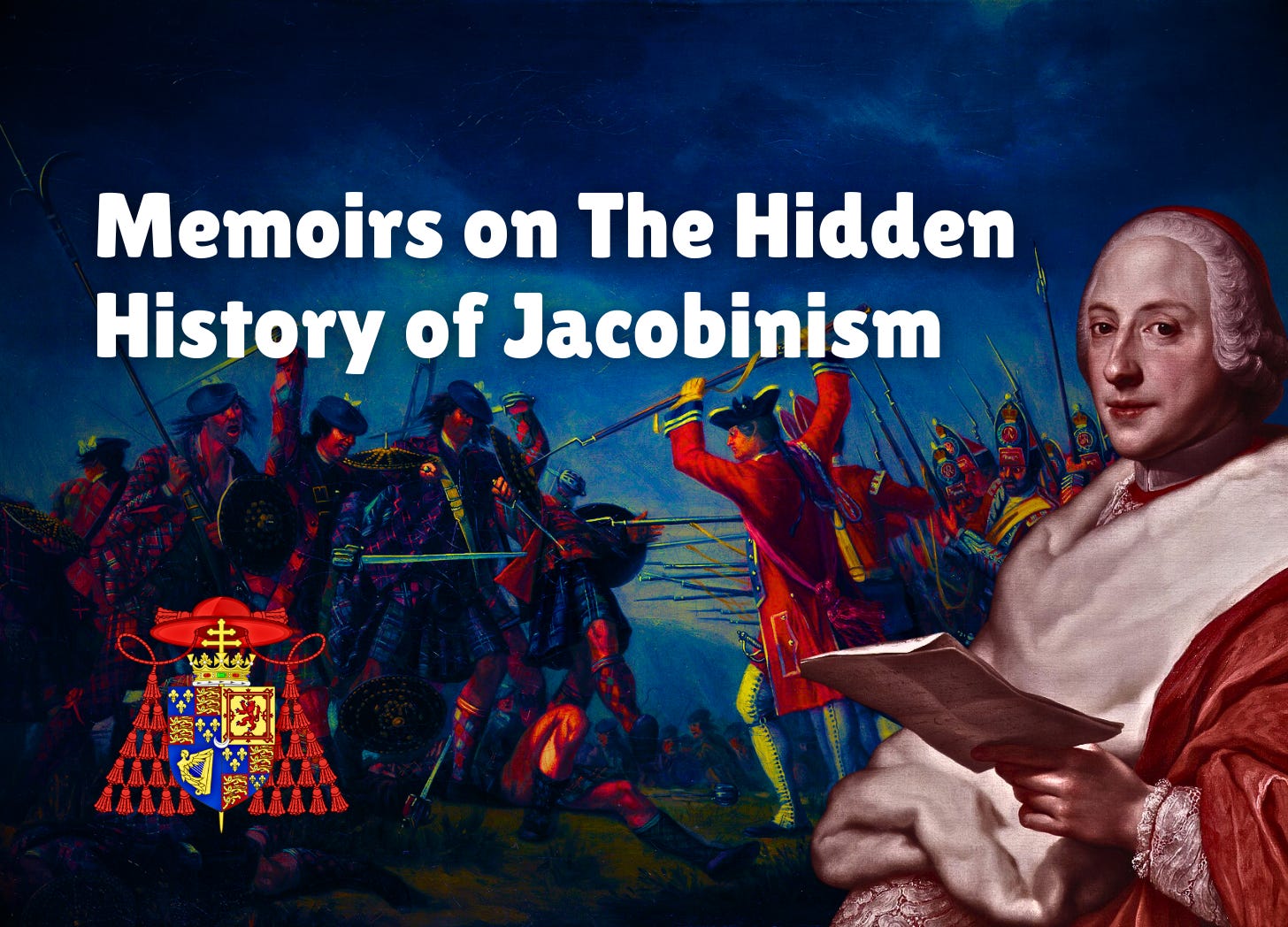
Memoirs Illustrating the History of Jacobinism
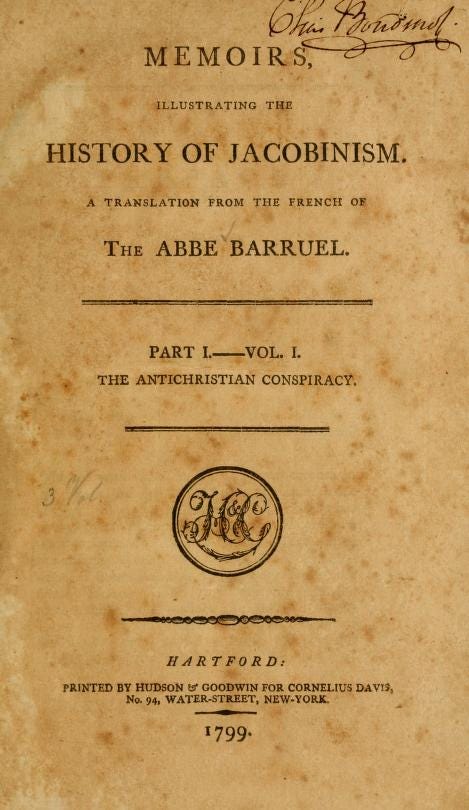
The source is a polemical treatise asserting that the catastrophic French Revolution was the deliberate result of a massive, coordinated Antichristian Conspiracy rather than an organic, undirected disaster. The author aims to expose the “plots and means” of the Sophisters, identifying Voltaire, D’Alembert, and Diderot as the ringleaders who shared the secret watchword to “crush the wretch” (a derogatory reference to Christ). Their central strategy involved both political intrigue—manipulating European courts to dismantle religious orders like the Jesuits—and subtle intellectual subversion, using works like the Encyclopédie to spread dangerous doctrines such as Atheism and Fatalism in an effort to undermine the foundation of all religious and civil society.
Proofs of a Conspiracy (1798) [John Robison]
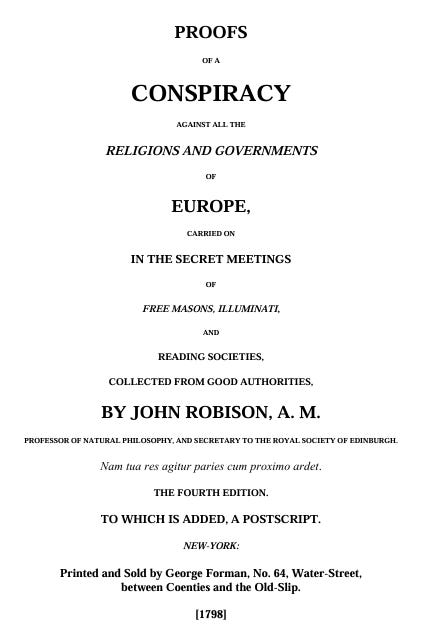
John Robison’s polemical work serves as an extensive and alarmist exposé, arguing that a powerful, secret conspiracy, primarily rooted in the Illuminati and certain French-influenced Free Masonry lodges, sought to destroy all existing governments and religious institutions. The author details the cunning methods of these groups, showing how they gradually indoctrinated recruits with subversive doctrines, replacing faith and patriotism with promises of universal liberty and equality in a new social order. Robison contends that this philosophical enlightenment was merely a guise; the true intention of the unknown superiors was the selfish acquisition of uncontrollable power, using lower-ranking members as tools for social wreckage. Ultimately, the text functions as an urgent warning to European nations, urging them to recognize the profound threat posed by these insidious, anarchic forces.

Download the Full Notes
Origin of the Jacobins
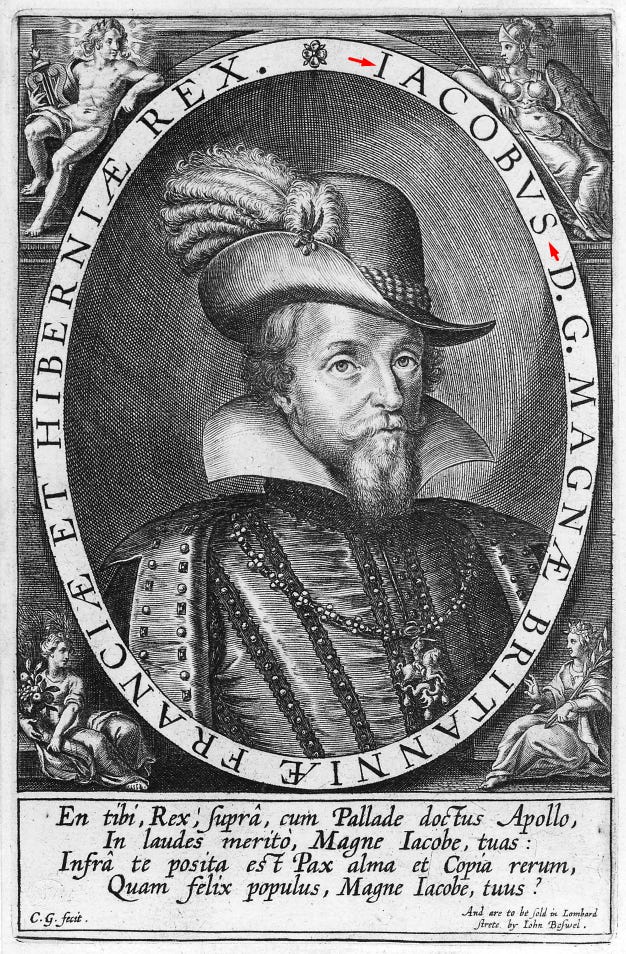
We also know that James II setup a special rite of Freemasonry at the College of Clermont (according to Mackey’s Encyclopedia)

CLERMONT, CHAPTER OF
On the 24th of November, 1754, the Chevalier de Bonneville established in Paris a Chapter of the Advanced Degrees under this name, which was derived from what Doctor Mackey deemed the Jesuitical Chapter of Clermont. This society was composed of many distinguished persons of the court and city, who, disgusted with the dissensions of the Parisian Lodges, determined to separate from them. They adopted the Templar system, which had been created at Lyons, in 1743, and their Rite consisted at first of but six Degrees, namely,
2, 3. Saint John’s Freemasonry.
Knight of the Eagle.
Illustrious Knight or Templar.
Sublime Illustrious Knight.
But soon after that time the number nf these Degrees was greatly extended. The Baron de Hund received the advanced Degrees in this Chapter, and derived from them the idea of the Rite of Strict Observance, which he subsequently established in Germany.
https://www.phoenixmasonry.org/mackeys_encyclopedia/c.htm
The Jacobite Succession

More on the Jacobin Succession
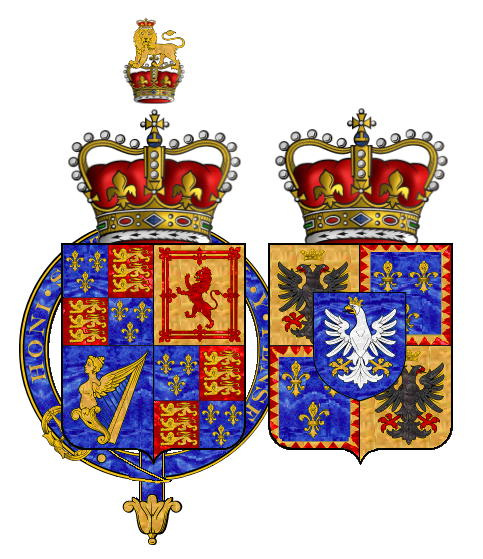
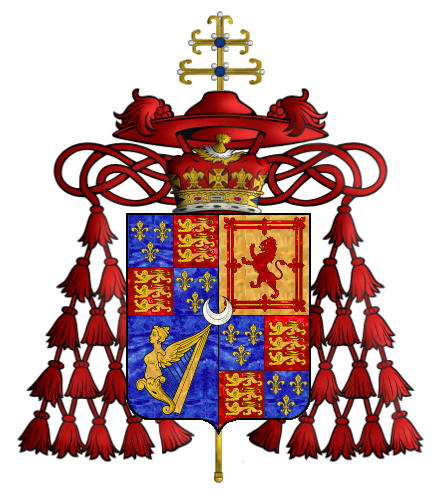
https://europeanheraldry.org/united-kingdom/scotland/jacobite-succession/
https://www.unofficialroyalty.com/the-jacobite-succession-pretenders-to-the-british-throne/
Jacobins Defined in Mackey’s Encyclopedia of Freemasonry
JACOBINS
A political sect that sprang up in the beginning of the French Revolution, and which have origin to the Jacobin clubs, so well known as having been the places where the leaders of the Revolution concocted their plans for the abolition of the monarchy and the aristocracy. Lieber says that it is a most surprising phenomenon that “so large a body of men could be found uniting rare energy with execrable vice, political madness, and outrageous cruelty, committed always in the name of virtue.” Barruel, in his History de Jacobinisme, and Robinson, in his Proofs of a Conspiracy, both endeavor to prove that there was a coalition of the revolutionary conspirators with the Illuminati and the Freemasons which formed the Jacobin Clubs, those Bodies being, as they contend, only Masonic Lodges in disguise.
The falsity of these charges will be evident to anyone who reads the history of French Freemasonry during the Revolution, and more especially during that part of the period known as the Reign of Terror, when the Jacobin Clubs were in most vigor. The Grand Orient, in 1788, declared that a politico-Masonic work, entitled Les Jesuites chassés de la Maçonnerie et leur Poignard brisé par les Maçons, meaning The Jesuits driven from Freemasonry and their weapon broken by the Freemasons, was the production of a perverse mind, prepared as a poison for the destruction of Freemasonry, and ordered it to be burned. During the Revolution, the Grand Orient suspended its labors, and the Lodges in France were dissolved; and in 1793, the Duke of Orleans, the head of the Jacobins, who was also, unfortunately, Grand Master of the French Freemasons, resigned the latter position, assigning as a reason that he did not believe that there should be any mystery nor any Secret Society in a Republic. It is evident that the Freemasons, as an Order, held themselves aloof from the political contests of that period.
Jesuit Involvement
Also recommend this article which helped me piece many of these connections together: https://farnesius.wordpress.com/2018/11/21/the-interconnection-between-the-knights-templar-freemasonry-and-jesuits-and-illuminati/
But the key to the importance of this 32nd degree, is its MOTTO: “Ad majorem Dei gloriam.” This is the motto of the Jesuits; who, with the apostate Ramsay, made these French degrees, falsely called Scottish. This motto was adopted by their founder, Ignatius Loyola; and is still the motto of the order which he founded, in an underground chapel of the Holy Martyrs in 1534, seventeen years after Luther nailed his Theses to the church door at Wittenberg, in 1517. The reformation had only fairly begun, and this underground, secret order of Jesuits met the Reformation, and has turned it back. Some principalities in Germany, once Protestant, are now under Popish princes! That order now rules Popedom, though once prohibited by it, as Masonry is now.
~ Jonathan Blanchard, Scotch Rite masonry illustrated : the complete ritual of the ancient and accepted Scottish Rite profusely illustrated, 1905, p. 457
The Revolutionary Playbook: A Three-Step Strategy
The source documents outline a clear, three-stage plan used by the secret societies to weaken the old order and prepare the ground for revolution.
Step One: Dismantle the Defenses of the Church. The conspirators believed that the political order could not fall while the moral order, upheld by the Church, remained intact. Their first priority was to eliminate the Church’s most zealous defenders.
Destroy the Jesuits: The Society of Jesus was seen as the most formidable obstacle and was labeled the “Life-guards of the Pope.” Their destruction was considered the critical first blow against the Church’s defenses.
Abolish Monastic Orders: Following the suppression of the Jesuits, Frederic II proposed a plan to undermine the remaining religious orders. By destroying these “asylums of fanaticism,” he argued, the general population would become “lukewarm” and “indifferent” to religion, leaving bishops as “insignificant personages” whom sovereigns could easily control.
Step Two: Capture the Public Mind through Propaganda. With the Church’s most formidable defenders eliminated, the conspirators moved to seize control of public opinion and replace religious ideas with philosophical ones.
The Encyclopedia: This massive compilation of knowledge was secretly the “grand arsenal for all their sophisticated arms against religion.” While pretending to be an objective work of science, it was filled with subtle anti-Christian arguments and designed to “insinuate what they dared not openly write.”
Reading Societies: The Illuminati planned to establish a network of “Reading Societies” and “subscription libraries.” By controlling the books and literature supplied to the public, they believed they could “turn the public mind which way we will.”
Step Three: Infiltrate the Halls of Power. Once they had begun to capture the public mind, their final assault was directed at the mechanisms of the state itself.
Education: The Order sought to place its members as tutors to “the youth of distinction.” A key example cited is the placement of the philosopher Condilhac as the tutor to the Prince of Parma, an effort Voltaire celebrated as ensuring the young prince would be “well surrounded.”
Government: The ultimate goal was to “procure the advancement of Illuminati into all important civil offices.” By surrounding rulers with members of the Order, they could secretly influence policy and steer the state toward its own destruction.
Strategic Briefing: A Synthesis of 18th-Century Influence Tactics
Introduction: Defining the Scope and Objective
This strategic briefing provides an analytical deconstruction of the operational tactics employed by certain 18th-century secret societies and philosophical movements, as detailed in the accompanying source material. The objective is not to validate the historical claims presented within the sources, but to synthesize the described methods of influence, infiltration, and societal control into a coherent framework for professionals studying influence campaigns.
Analysis of the source texts reveals a central argument: that a deliberate, multi-faceted campaign was orchestrated by a network of “Sophisters,” “Philosophers,” and secret societies like the Illuminati. This network’s strategic objective was the subversion of the existing religious and political establishments of Europe. Their ultimate aim was to dismantle the dual pillars of altar and throne, replacing them with a new global order governed by their own definition of “reason.”
To deconstruct this methodology, the briefing is organized thematically around key tactical domains. It will begin by outlining the foundational ideology that provided the strategic objective, then move through the operational phases of institutional infiltration, narrative control, the exploitation of societal vulnerabilities, and finally, the internal doctrines that ensured organizational cohesion and secrecy.
The Foundational Ideology: Goals and Justifications
Understanding the core ideology of any influence campaign is of paramount strategic importance, as it provides the “why” behind the operational tactics. This section distills the ultimate objectives that, according to the source material, animated the societies in question. Their methods were not random instruments of chaos; they were tactical elements designed to achieve a specific and radical vision for human society.
The ultimate goals of the “Antichristian Conspiracy” and the Illuminati were comprehensive and revolutionary. They included:
The complete overthrow of all religious establishments. The primary target was Christianity. This objective was encapsulated in the watchword attributed to Voltaire, “Crush the wretch!” (ecrafez l’infame!), which the sources interpret as a call for the destruction of Christ and his religion.
The overturning of all existing governments. The campaign specifically targeted monarchies, which were pejoratively labeled “despotism,” with the intent of replacing them with a new form of governance.
The abolition of traditional social structures. This included dissolving civil subordination, national distinctions, and patriotism in favor of a new paradigm of “universal Liberty and Equality” and a borderless “Cosmo-politism.”
The establishment of a new global order. In place of the dismantled structures, the societies aimed to erect a new system governed by “reason” and a “peculiar morality” dictated and controlled by the Order itself.
To legitimize these radical aims, the conspirators framed their ideology within the popular philosophical currents of the era. Concepts like “Reason,” “Liberty,” and “Enlightenment” were presented as the pinnacle of human progress. In this narrative, existing institutions—the Church, the monarchy, the traditional social hierarchy—were portrayed as instruments of oppression, ignorance, and superstition that actively hindered humanity’s advance. The campaign was thus cast not as an act of destruction, but as one of liberation.
This strategy favored subversion over direct confrontation. The goal was to hollow out the foundational beliefs of society until the structures resting upon them collapsed. This preference for indirect ideological warfare is encapsulated in a strategic view attributed to Frederic II:
“Silently to undermine the edifice hostile to reason, is to force it to fall of itself.”
This philosophy of gradual, covert erosion informed every aspect of their operational playbook. The following sections detail the specific methods employed to achieve these ideological aims, beginning with the co-option of existing institutions.
Phase I: Infiltration and Institutional Co-option
Analysis of the campaign reveals the strategic logic of prioritizing institutional infiltration over creating a new power base from scratch. The operational principle was to seize control of existing structures of influence and authority—the centers of gravity that shape public opinion, educate the elite, and administer the state—thereby steering society toward their objectives from within.
Co-opting Pre-existing Networks: The Case of Free Masonry
The operational plan was to leverage existing, trusted networks to minimize resource expenditure and accelerate ideological penetration. Analysis of the campaign reveals the co-option of Free Mason Lodges as a primary vector for expansion, as their nature made them ideal targets: their inherent secrecy provided a secure environment for disseminating radical ideas, while their allowance for freedom of speech created what the sources term “haunts of many projectors and fanatics.” This pre-existing environment of heterodox thinking made it easier to introduce radical concepts without immediate rejection.
The primary tactic for takeover was “Illumination.” The society’s doctrines were presented not as a new invention, but as the “only true Free Masonry”—the enlightened truth to which lower degrees were merely a prelude. The initial Masonic degrees were then used as a screening and recruitment ground, a process described as being used “to fish for Minervals.” Once a foothold was gained, the plan was to secure control over the Lodges’ leadership and finances, thereby redirecting their purpose toward the Order’s revolutionary objectives.
Capturing Academic and Literary Institutions
The campaign methodically targeted institutions that shape elite opinion and educate the next generation of leaders. The sources outline a multi-pronged attack:
Universities: A concerted effort was made to place Illuminati members in professorial chairs, thereby influencing curriculum and students. The University of Ingolstadt is cited as a prime example where the Order successfully captured key academic positions.
Academies: The French Academy, the preeminent literary body in Europe, was a key target. The plot, reportedly led by D’Alembert, was to transform it into a “club of infidels” by controlling the admissions process to ensure only “Philosophers” were elected while systematically excluding religious authors.
Seminaries for Youth: New educational institutions were established to circumvent traditional religious schooling. The “Philanthropine,” for example, was founded as a “professed seminary of practical Ethics” to subtly replace religious education with a secular “Philosophical Religion.”
Securing Agents within Government and Civil Service
The ultimate institutional prize was the state itself. The sources describe a clear directive to place adepts in positions of power, particularly targeting the courts of justice. As one Illuminati directive stated, “We must do our utmost to procure the advancement of Illuminati into all important civil offices.” The sources identify several key ministers and officials who allegedly acted as protectors or agents of the campaign.
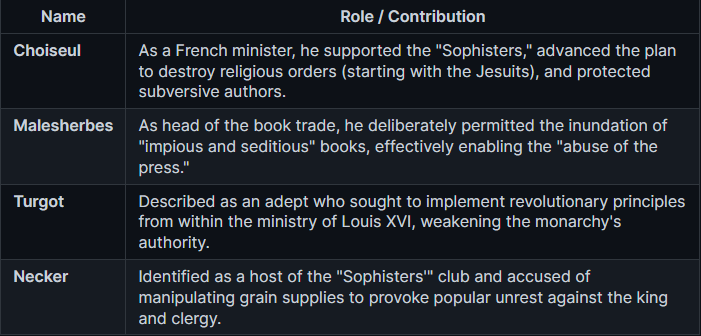
With adepts positioned within academia, publishing, and government, the conspirators had secured the critical infrastructure required to launch a coordinated campaign of narrative control, ensuring their propaganda would be both produced by trusted voices and shielded from state censorship.
Phase II: Manipulation of Public Discourse and Narrative Control
With agents and allies embedded within key institutions, the operation’s next phase focused on the strategic imperative of shaping the public mind. This section details the methods used to control the flow of information, dominate the cultural narrative, and normalize radical ideas, making them palatable to a wider audience. This was a form of narrative warfare fought not with armies, but with words and perceptions.
Weaponizing the Publishing Ecosystem
The source material describes a comprehensive strategy to seize control of the entire “literary manufacture,” from author to reader. This ecosystem was systematically weaponized through a series of coordinated tactics:
Gaining over Journalists and Reviewers: The conspirators sought to control influential literary journals, such as the General German Library. These platforms were then used to “puff” the works of friendly authors while systematically depreciating, ridiculing, or ignoring authors who defended the traditional order.
Controlling Booksellers and Distribution: A plan was devised to bring the book trade into the hands of the “Union” by establishing a network of Reading Societies and subscription libraries. These outlets were supplied with literature approved by the Order, creating a closed-loop distribution system for their propaganda.
Mass Propaganda: To reach beyond the educated elite, the societies produced a flood of cheap or free pamphlets. The source material notes that “impious” works like the Last Will of Jean Meslier were disseminated by “hawkers and pedlars” to ensure their message penetrated even “the poorest cottages,” demonstrating the campaign’s reach across all social strata.
The Encyclopedia: A Case Study in Covert Subversion
The Encyclopedia project is presented as the “grand arsenal” of the conspiracy. The project’s strategic importance was underscored by Voltaire’s declaration that, “I place all my hopes in the Encyclopedia.” The core tactic was to embed subversive ideas within a seemingly neutral and authoritative project of universal learning. The sources describe a method of concealing poison “where it might not be supposed.” For instance, an article might offer a conventional defense of a religious doctrine, only to be systematically refuted through a “crafty system of cross-references” that would lead the reader to articles containing skeptical arguments. This allowed the project to evade censorship while gradually eroding belief. This strategy of psychological conditioning was admitted by D’Alembert, who stated: “If mankind are so much enlightened to-day, it is only because we have used the precaution, or had the good fortune, to enlighten them by degrees.”
The Art of Strategic Deception
A key tactic was the use of public displays of conformity to disarm suspicion. Operatives like Voltaire maintained a veneer of respectability—publicly taking communion and building a church—while privately directing subversive activities, demonstrating the principle that a covert influencer’s effectiveness is proportional to their perceived legitimacy. Furthermore, the most radical ideas were propagated through anonymous or posthumous works to protect the authors from repercussions. The book Christianity Unmasked, a direct attack on religion, is attributed in the sources to the adept Damilaville, though published under a pseudonym.
Through these methods of discourse control and strategic deception, the conspirators sought to create an intellectual environment where their ideas were seen as the inevitable march of progress, a prerequisite for exploiting deeper societal and moral vulnerabilities.
Phase III: Exploitation of Social and Moral Vulnerabilities
Ideological change requires a receptive populace, often one whose existing moral and social fabric has been weakened. This section examines the tactics described in the sources for breaking down traditional moral cohesion and exploiting social divisions, creating an environment where radical solutions would seem not only plausible but necessary.
The Systematic Corruption of Morals
The conspirators’ writings actively promoted a doctrine of moral corruption as a prerequisite for “liberation.” They systematically attacked the foundational tenets of traditional morality, an operational necessity to weaken the philosophical underpinnings of Christianity and make the populace more receptive to a new materialistic worldview. Key tenets they advanced included:
The denial of free will and the equation of virtue with calculated self-interest and the pursuit of pleasure.
The assertion that “conscience and remorse are nothing but the foresight of those physical penalties to which crimes expose us,” thereby stripping morality of its internal dimension.
The redefinition of modesty as an “invention of refined voluptuousness” to undermine sexual restraint.
The undermining of familial bonds, such as the commandment to love one’s parents, which was dismissed as a product of education rather than a natural duty.
Appealing to Elite Self-Interest and Grievances
The campaign also targeted the avarice and ambition of those in power, offering pragmatic, self-serving reasons for rulers to adopt their agenda. A plan proposed by Frederic II to Voltaire was to persuade governments to dismantle convents and religious orders, not on ideological grounds, but by highlighting the “facility of paying off part of their debts with the treasures of those communities.” Simultaneously, the “Sophisters” exploited the discontent of professionals who felt their talents were unrecognized by the existing hierarchy, such as “unbeneficed Abbés,” turning their personal grievances into revolutionary fervor.
Fostering Division and Exploiting Social Unrest
The societies excelled at leveraging and amplifying existing societal divisions. A cynical divide-and-conquer strategy is evidenced in an instruction from D’Alembert to Voltaire regarding intra-Christian disputes: “Let the Janfenitical rabble rid us of the Jesuitical, and do not prevent one spider from devouring another.” This reveals a willingness to let opposing factions destroy each other to clear the field for their own agenda. The sources allege that high-ranking agents like the Duke of Orleans used their immense fortune to destabilize the state directly. These alleged tactics included corrupting military regiments to dissolve their loyalty to the crown and artificially creating food shortages to incite popular rebellion.
This external strategy of exploitation was powered by the highly disciplined internal doctrines that ensured the loyalty and effectiveness of the conspirators themselves.
Organizational Doctrine and Methods of Internal Control
A covert operation of this alleged scale requires exceptional organizational discipline and secrecy. The effectiveness of the external tactics was contingent upon a robust internal structure designed to ensure loyalty, prevent discovery, and methodically indoctrinate members. This final section analyzes the internal control mechanisms that enabled these societies to function as a cohesive clandestine force.
The Doctrine of Secrecy and Gradual Revelation (Disciplina Arcani)
At the core of the organizational model was the Disciplina Arcani, or the strategic doctrine of gradual revelation. The Illuminati organized members into a series of advancing degrees (Minerval, Illuminatus Minor, Priest, Regent, etc.), where the true, radical aims of the Order—the abolition of property, religion, and government—were revealed only at the highest levels. This slow indoctrination served two key purposes: it allowed the leadership to test and filter initiates at each stage, and it ensured their progressive psychological commitment, making defection less likely as they became more deeply invested.
Systems of Surveillance and Loyalty Enforcement
Absolute loyalty was enforced through a pervasive system of internal espionage and intimidation. The sources describe a mandate that “every person shall be made a spy on another and on all around him.” Members were required to submit weekly written reports, or rescripts, detailing their observations of fellow members, creating an atmosphere of constant surveillance that ensured compliance and gathered intelligence for leverage. Betrayal was met with the ultimate sanction, as a direct threat was made to any who would expose the Order: “death, inevitable death, from which no potentate could protect them.”
Recruitment and Indoctrination Protocol
The recruitment process was systematic, targeting young, ambitious men of talent without fortune or those with grievances against the state. The initiation process was designed to secure total commitment and provide the Order with leverage from the outset. A novice was required to write detailed reports on his own character, family, and associates, thereby creating a comprehensive file that could be used for manipulation or blackmail. The demand for absolute submission is chillingly illustrated in the oath of the Illuminatus Minor:
“I bind myself to perpetual silence and unshaken loyalty and submission to the Order, in the persons of my Superiors; here making a faithful and complete surrender of my private judgment, my own will...”
These internal principles—secrecy, surveillance, and absolute loyalty—were the engine that powered the entire subversive campaign. This multi-phased model, beginning with a radical ideology, proceeded through the infiltration of key institutions, the seizure of narrative control, and the exploitation of societal vulnerabilities. The success of these external operations was made possible by an internal doctrine of absolute discipline, which transformed a collection of individuals into a formidable clandestine force capable of executing a complex, long-term strategy of societal transformation.


