



This text presents Eugene (Fr. Seraphim) Rose’s seminal essay, “Nihilism: The Root of the Revolution of the Modern Age,” which systematically analyzes the stages and manifestations of Nihilism, viewing it as the fundamental spiritual illness of the modern era. The essay argues that the progressive abandonment of absolute Christian Truth leads society through distinct phases: Liberalism (indifference to truth), Realism (hostility to metaphysical truth), and Vitalism (a restless, often irrational search for spiritual substitutes), culminating in the Nihilism of Destruction. Rose asserts that this trajectory of unbelief and worldliness actively seeks to destroy the “Old Order” founded on God and His Revelation, creating a void that inevitably points toward the Antichrist and the construction of a purely human, absurd “new earth” devoid of ultimate meaning. Additionally, the excerpts include an appendix exploring the “Philosophy of the Absurd” as the ultimate logical consequence of nihilistic thought, alongside the author’s proposed outline for a larger theological work.
Nihilism: Root of the Modern Revolution
This excerpt from Eugene Rose’s “Nihilism: The Root of the Revolution of the Modern Age” presents a powerful diagnosis of the spiritual crisis of the modern world, tracing the decline of Christian Truth through distinct stages of nihilism. Rose details a dialectic beginning with Liberalism, characterized by indifference to absolute truth and a focus on worldliness, which then gives way to the more hostile and simplistic Realism (or positivism) that annihilates spiritual values. The next stage, Vitalism, is marked by popular restlessness, pseudo-religious impulses, and a frenzied, sometimes destructive, quest for life, culminating in the Nihilism of Destruction and its inverted, Satanic parody of creation. Rose ultimately argues that the abandonment of God leads to a world of the Absurd, compelling modern man to seek a “new man” and a kingdom centered on nihil, which serves as a dark precursor to the reign of Antichrist.
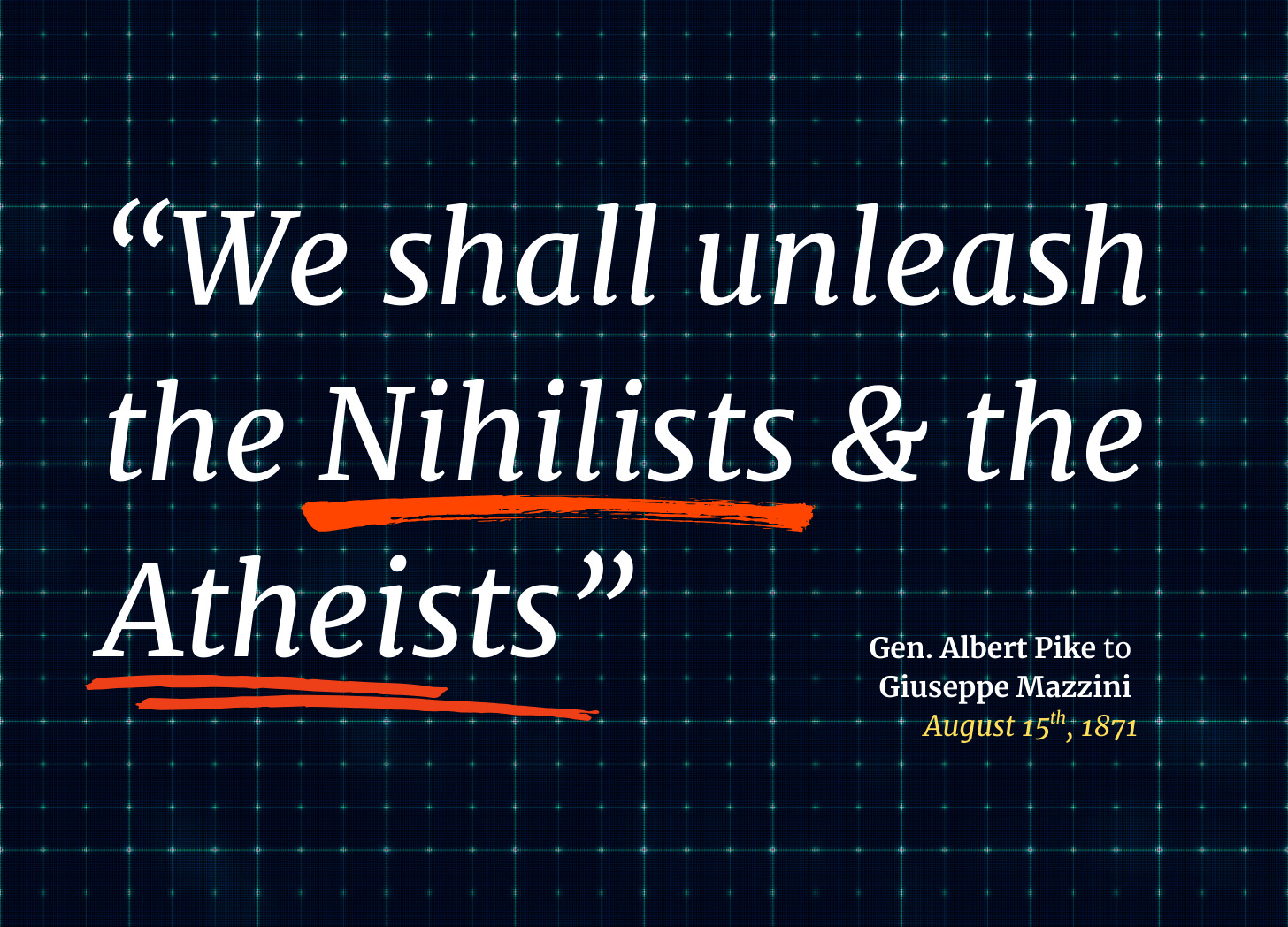
“[..] Meanwhile the other nations, once more divided on this issue will be constrained to fight to the point of complete physical, moral, spiritual and economical exhaustion… We shall unleash the Nihilists and the atheists, and we shall provoke a formidable social cataclysm which in all its horror will show clearly to the nations the effect of absolute atheism, origin of savagery and of the most bloody turmoil.” ~ Confederate General Albert Pike to Giuseppe Mazzini dated August 15th, 1871 (The text was first confirmed to exist by Myron Fagan in his Vinyl Recordings made in 1967)
World Revolution: The Fire (of Liberty) in the Minds of Men

![World Revolution: Fire in the Minds of Men + The French Revolution [Nesta Webster]](https://substackcdn.com/image/fetch/$s_!Rqkv!,w_140,h_140,c_fill,f_webp,q_auto:good,fl_progressive:steep,g_auto/https%3A%2F%2Fsubstack-video.s3.amazonaws.com%2Fvideo_upload%2Fpost%2F177953241%2F44ce7142-82b9-47e0-8a1c-1849c9597e1f%2Ftranscoded-1762279406.png)


A Comparative Analysis of the Nihilist Dialectic
Introduction: The Four Stages of a Modern Revolution
Nihilism is the foundational philosophy of the modern age and the root of its revolution. It is a spiritual disease founded upon the rejection of Absolute Truth, a rebellion articulated with infernal clarity by Friedrich Nietzsche: “There is no truth.” This declaration did not signal a single event, but rather the beginning of a systematic spiritual pathology, a progressive unraveling of the divine order that once defined Christian civilization. The process of this unraveling is a “Nihilist dialectic,” a coherent movement of apostasy that unfolds through four principal stages: Liberalism, Realism, Vitalism, and its final, terrible culmination, the Nihilism of Destruction.
This document presents a definitive analysis of this dialectic, systematically dissecting and contrasting each stage. We will elaborate on the core tenets of each phase, its specific war against truth, and its function as a logical and psychological progression from the errors of its predecessor. Each step in this process incorporates and deepens the last, carrying mankind further down the path of error and away from Revealed Truth. Our analysis of this spiritual catastrophe begins with the groundwork laid by the first and most subtle agent of this modern revolution: Liberalism.
The First Stage - Liberalism: The Passive Undermining of Truth
Liberalism is the essential first step in the Nihilist dialectic, serving as the “neutral breeding-ground” for the more advanced and aggressive stages to follow. It is not an overt Nihilism; its character is passive and implicit, defined by a strategic indifference to the absolute. The Liberal worldview does not openly declare war on God or Truth but instead renders them irrelevant by cultivating a climate of skepticism and worldliness. Its primary error is its incompetent and half-hearted defense of the spiritual heritage it claims to value, thereby creating the spiritual vacuum that more radical philosophies rush to fill.
The Liberal relationship with truth is one of calculated subversion. It skillfully retains the forms and language of the Christian order—speaking of “eternal verities,” “faith,” and “Christian civilization”—but methodically empties them of their original, absolute meaning. Truth is no longer the coin of a living spiritual reality but becomes “idle and unfruitful capital,” a collection of metaphors and emotional ornaments disconnected from God. This reinterpretation of truth can be observed across three key domains:
Theology: The living, personal God of Christian Revelation is replaced by the “dead god of philosophers.” This new deity is an abstract idea, a bloodless “first cause” constructed by the proud human mind to satisfy a lingering intellectual need for explanation. This god is powerless, uninterested in humanity, and ultimately no different from having no god at all. Liberal theology is therefore a form of practical atheism, a Satanic deception disguised by deistic or pantheistic language.
Ethics: The Christian understanding of life, judged in light of the future world, is abandoned in favor of an exclusive focus on this world. The Liberal mentality, having no genuine faith in the transcendent, cannot truly believe in immortality or eternal joy. Heaven becomes a “shadowy underworld,” a vague emotional projection, while for the more sophisticated humanist, “eternity” is reduced to a hollow figure of speech. This apostasy removes any ultimate check on human behavior, leading inexorably to the logic of Dostoyevsky’s Ivan Karamazov: “if there is no immortality... all things are lawful.”
Politics: In the political sphere, Liberalism attempts an impossible compromise between government established by God (Monarchy) and government established by man (Anarchy). This results in unstable and self-annulling formulas like ruling “by the Grace of God and the will of the people.” By vesting ultimate sovereignty in “the people,” Liberal government fundamentally rejects divine authority, preserving it only as a ceremonial function. This compromise is inherently unstable and points inevitably toward Revolution.
In summary, Liberalism is the worldview of the worldly man who has lost his faith but seeks to preserve the cultural benefits of a system built upon it. This spiritual emptiness is an unstable state; the psychological intolerance for such a vacuum demands a more honest, albeit more brutal, resolution. The failed and cowardly defense of truth creates the ideal conditions for the emergence of a more aggressive and systematic form of unbelief, summoning the next stage of the dialectic, Realism, into being.
The Second Stage - Realism: The Hostile Attack on Truth
Realism emerges as the next logical step in the Nihilist dialectic, a direct and hostile reaction against the vagueness and compromise of Liberalism. It is disillusioned and systematized Liberalism, transforming passive indifference toward Absolute Truth into active and fanatical opposition. Where the Liberal is merely worldly, the Realist is a devoted and dogmatic materialist. This worldview prides itself on its refusal of all idealism, stripping away the metaphorical language of Liberalism to reveal the stark unbelief that lay beneath.
The core tenets of the Realist worldview are marked by a program of radical simplification, reducing all higher realities to their most basic material components. Its key characteristics include:
Open Atheism: The evasive deism and agnosticism of Liberalism are replaced with a clear and unapologetic atheism.
Naked Materialism: All “higher values” are rejected in favor of self-interest and the purely physical. Reality is confined to what can be observed and measured.
Worship of the Fact: All things of the mind and spirit are reduced to the “nothing-but” of matter, sensation, and empirical data. This elevation of scientific methodology to the status of an exclusive and absolute truth is defined as “scientism.”
Realism’s relationship to truth is a tragic parody. Its animating force is a sense of truth highly developed through Christianity, a will not to be deceived, which now revolts against the perceived falsehood of Christian interpretations. This Christian quality, turned against itself, becomes a spiritual disease. The Realist’s desire not to be deceived goes astray and ends in its own negation, becoming a mission to abolish any suggestion of the transcendent. In stark contrast to the Christian who sees God’s presence in everything, the Realist sees only “race,” “sex,” or the “mode of production,” mistaking a collection of facts for the wisdom that can only be received from above.
As a progression from Liberalism, Realism takes the half-hearted unbelief of the previous stage and injects it with fanatical momentum. It seeks not merely to ignore Christian Truth but to achieve its total abolition. This destructive impulse is embodied by the terribles simplificateurs (“terrible simplifiers”)—figures like Lenin and Hitler who offered radically simple solutions to the world’s complex problems. They represent the practical application of the Realist principle: a ruthless simplification that violently discards anything that does not fit its narrow, materialistic framework.
The Realist resolve to close off Heaven and live for the earth alone, however, has profound and unintended consequences. To deny the spiritual reality above is to inevitably unleash the darker, irrational, and demonic forces from below, setting the stage for the next phase of the spiritual disease: Vitalism.
The Third Stage - Vitalism: The Divorce of Life from Truth
Vitalism rises as a powerful reaction against the sterile, inhuman, and rationalist paradise promised by Realism. While the first two stages of Nihilism were primarily philosophies of an intellectual elite, Vitalism marks the point where the disease spreads to the masses. It manifests as a restless, inarticulate, and often chaotic search for a substitute for the God who has died in their hearts. It is a protest against the eclipse of higher realities, but a protest fatally flawed from its inception.
The core contradiction of Vitalism is that while it rebels against the emptiness of Realism, it fully accepts Realism’s fundamental premise: the total rejection of absolute Christian Truth. Having accepted that Heaven is closed, the Vitalist seeks spiritual experience not from above, but from below and within. This gives rise to a “new spirituality”—a cancer born of Nihilism that attaches itself to healthy organisms to destroy them from within. Its “pseudo-spirituality” and “pseudo-traditionalism” are entirely naturalistic, beginning and ending in this world, a parody of spiritual life born of corruption and rebellion.
The Vitalist impulse has expressed itself in a wide array of cultural phenomena, all driven by a desire to escape spiritual emptiness through intense experience. These diverse manifestations include:
Popular Unrest: Seen in the rise of “absurd” crime, the modern cult of the automobile and speed, and a pervasive disrespect for authority—all providing an escape from boredom through constant, unreflective activity.
Politics: Embodied in Mussolini’s cult of activism and, more darkly, in Hitler’s cult of “blood and soil,” movements which appealed to those seeking a “dynamic” antidote to the perceived weakness of Liberalism.
Art: The modern artist, turning to the “savage,” “primitive,” and “spontaneous,” becomes a “magician” for whom subjective feeling, not objective truth, is the sole reigning principle.
Pseudo-Religion: A host of new spiritualities, including occultism; the cult of “awareness” (e.g., Zen); drug-induced “religious experience”; and the atheistic existentialism that makes a religion of self-worship.
At its core, Vitalism is the definitive elimination of truth as the criterion for human action. In its place, it substitutes a new standard: that which is “life-giving,” “vital,” or “exciting.” This represents the final divorce of life from truth, where subjective experience and dynamism become ends in themselves, valued for their intensity rather than their connection to any higher reality.
Vitalism, born from the spiritual corruption of the preceding stages, is a more potent injection of the Nihilist germ. It prepares the soul not for a return to health, but for the definitive stage of the disease. Beyond the restless and irrational search of Vitalism lies only the undisguised worship of nothingness: the Nihilism of Destruction.
The Final Stage - The Nihilism of Destruction: The Worship of Nothingness
The Nihilism of Destruction represents the “purest” and most explicit form of Nihilism. It is the culmination of the dialectic, the stage where the deepest aim of all preceding phases—the annihilation of God, Truth, and Creation—is revealed and pursued as a Satanic end in itself. The will to destroy, previously a means, now becomes the sole program. This is the moment when the “face of Nothingness discards its masks and stands revealed in all its nakedness.”
The core tenet of this final stage is captured in Nietzsche’s declaration: “There is no truth, all is permitted.” This principle of absolute lawlessness finds its champions in key figures who translated it from theory into horrific practice:
Max Stirner waged a theoretical war on every standard, proclaiming his ego against the world.
Sergei Nechayev provided the perfect practical application, leading a life of unprincipled ruthlessness and amorality in the name of Revolution.
Michael Bakunin gave voice to the movement’s deepest desire, calling for “terrible, total, inexorable, and universal destruction.”
Hitler embodied the principle politically in his revolution of Weltmacht oder Niedergang (world-conquest or total ruin), exulting in the idea that “we may be destroyed, but if we are, we shall drag a world with us—a world in flames.”
The Nihilism of Destruction is the ultimate progression of the dialectic because what was merely a prologue in Liberalism, Realism, and Vitalism—the tearing down of the Old Order—is now the entire program. There is no pretense of building a better world, only the “passion for destruction,” a rage against creation that seeks to annul God’s act by returning the world to the void.
The entire progress of this spiritual disease can be understood as an affliction of the soul’s eye. Liberalism is the first stage, where one mistakes impaired vision for health and dismisses the need for a physician. In the stage of Realism, the disease worsens, vision narrows to only the nearest objects, and one becomes convinced that nothing else exists. Vitalism follows as infection leads to inflammation, causing even near objects to become distorted and subject to hallucinations. Finally, the Nihilism of Destruction is total blindness, as the disease spreads through the entire body, resulting in agony, convulsions, and death.
Comparative Synthesis: The Stages of the Nihilist Dialectic
The preceding analysis can now be synthesized into a comparative format to visualize the systematic and pathological progression of Nihilism. The following table contrasts the four stages of the dialectic, illustrating how each phase logically and psychologically builds upon the failures of its predecessor, leading modern civilization on a coherent path of rebellion against God and toward its final, destructive end.
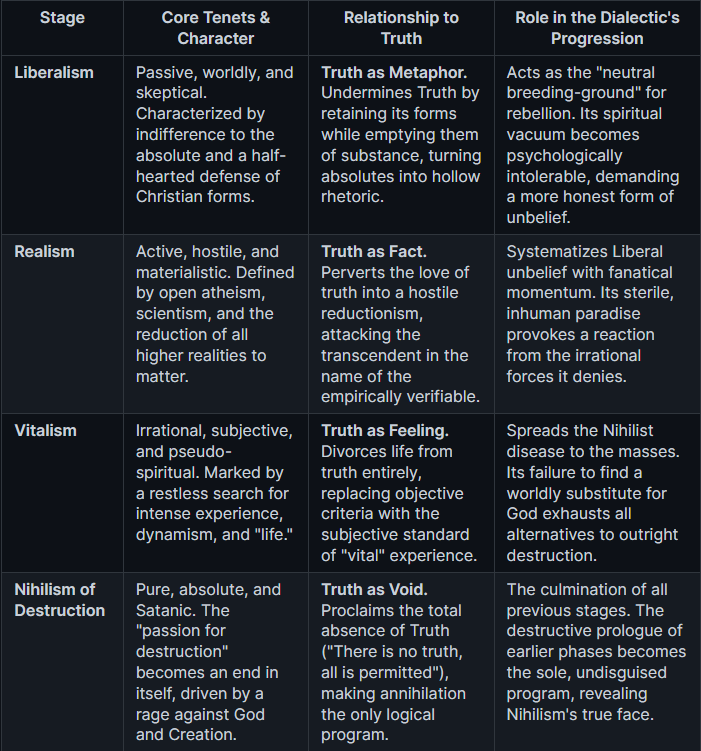
This synthesis reveals the psychological inevitability of the dialectic. Each stage represents a failed attempt to solve the problems created by the last, a series of rebellions that only deepens the spiritual disease. The passive unbelief of Liberalism provokes the hostile attack of Realism. The sterile world of Realism in turn gives rise to the desperate, irrational search of Vitalism. Finally, the failure of these worldly solutions unleashes the pure, unmasked rage against existence itself, culminating in a total war against God, Truth, and Creation.
Conclusion: The Unraveling of Truth
The Nihilist dialectic is a coherent and tragically logical movement of apostasy, a systematic departure from Revealed Truth. Each of its four stages—Liberalism, Realism, Vitalism, and Destruction—builds upon the spiritual catastrophe of its predecessor, dismantling the foundations of Christian civilization and the human soul. This is not a random sequence of historical accidents but a spiritual pathology with a clear and consistent trajectory.
The progression moves from Liberalism’s passive indifference, which first weakens the absolute; through Realism’s hostile reductionism, which actively attacks it; and into Vitalism’s subjective irrationalism, which seeks a worldly substitute for it. This journey culminates in the pure rage for destruction, the final and most honest expression of a rebellion rooted in the denial of God. The ultimate state it produces is that of a spiritual disease which, left unchecked, progresses from impaired vision to total blindness, ending in a Satanic desire to unravel man’s soul and reduce creation to the nothingness from which God first called it into being.


