



The book “Rule by Secrecy - The Hidden History” by Jim Marrs, presents a comprehensive overview of various conspiracy theories and secret societies influencing global history and power structures. The text explores the purported existence of a hidden elite, including the Rothschilds and Rockefellers, and organizations such as the Council on Foreign Relations (CFR), the Trilateral Commission, and the Bilderberg Group, arguing they orchestrate world events for wealth and control. Furthermore, the source connects modern conspiracies to ancient mystical traditions, including Freemasonry, the Knights Templar, and the Illuminati, tracing lineage to figures like the Merovingians and exploring alternative histories involving extraterrestrial origins (Anunnaki) and suppressed knowledge. Finally, the text suggests that these covert forces have manipulated major historical events, including the creation of the Federal Reserve System and the instigation of wars like World War I, World War II, and the Vietnam War.
This extensive source explores the clandestine operations of powerful, interrelated secret societies and wealthy elites, proposing that they manipulate global events, including economics and warfare, toward a goal of one-world government. Key themes include the pervasive influence of groups like the Council on Foreign Relations (CFR), the Trilateral Commission, and the Bilderberg Group in government and media, alongside historical organizations such as Freemasonry, the Illuminati, and the Knights Templar. The text posits a deep-seated conspiracy theory, alleging that elite financial dynasties like the Rothschilds and Rockefellers have covertly funded and fomented major conflicts, controlled central banks like the Federal Reserve System, and even suppressed the truth about human origins through a reinterpretation of ancient Sumerian texts concerning extraterrestrial beings called the Anunnaki. Ultimately, the purpose of this material is to challenge conventional history and urge individuals to seek knowledge and personal responsibility to combat these forces of domination.
Mahanism as the Formal Doctrine of ‘Rule by Secrecy’
President John F. Kennedy once warned the American People against the dangers of secrecy, his words hit deep. While many today feel compelled to make their argument for who the enemy of the people is (and there are many parties), I argue in the expose below that SECRECY ITSELF is the oldest and most formidable enemy of man.
I highly suggest seeing the Masters Mahan Podcast: https://linktr.ee/mastersmahan
(Also: https://theofficialurban.substack.com/s/masters-mahan)
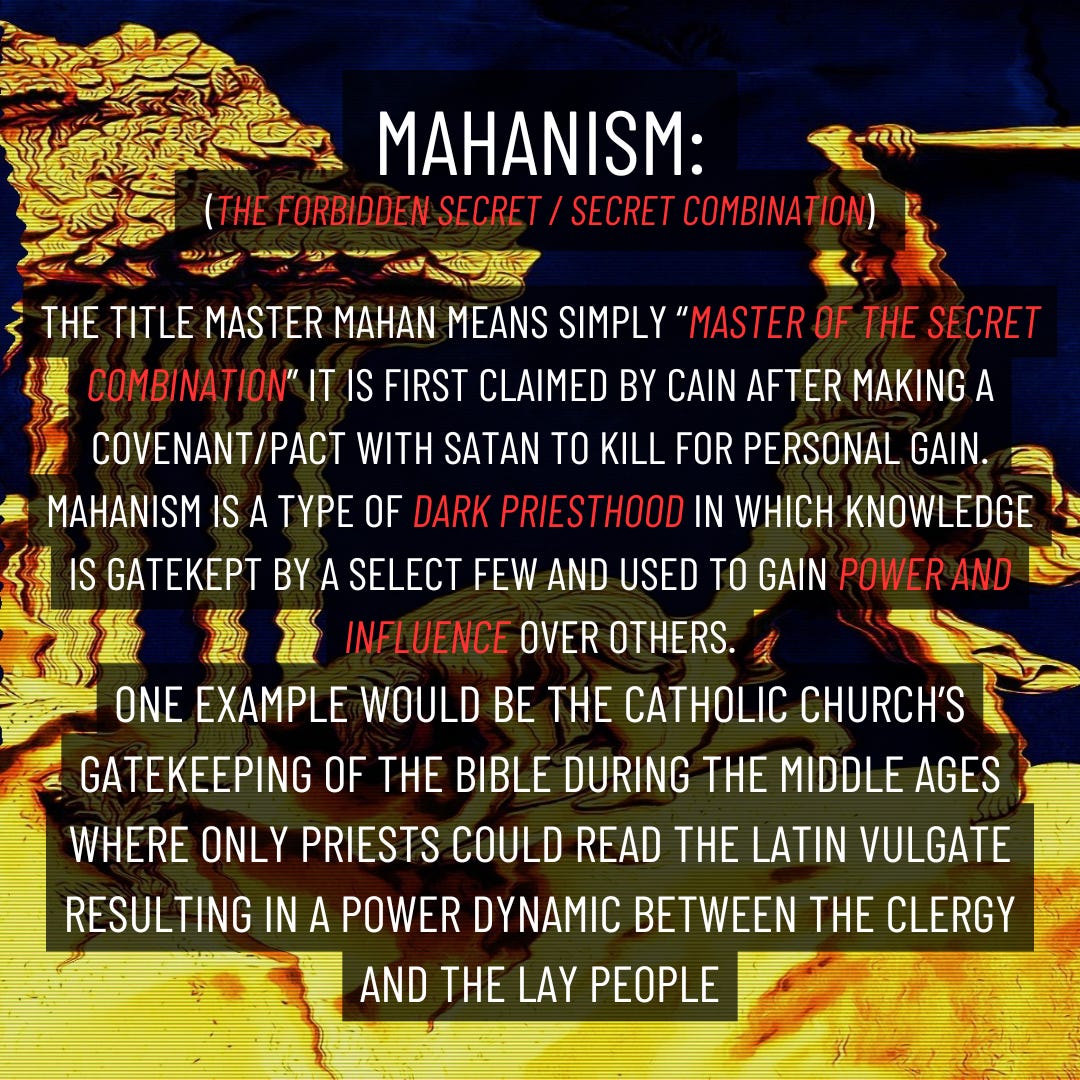
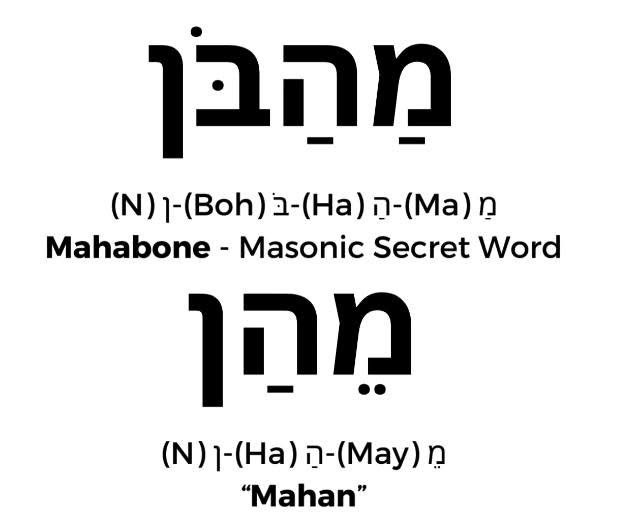
Since the beginning of time, the “priest class” as they’ve been called has perfected (or rather Mastered) their Mahan. They’ve mastered their art of gatekeeping secrets in order to gain. The Freemasons were originally a guild of stonemasons, the idea being that they had their own trade secrets and so they all got together (formed a guild) and worked together to further gain. This was primarily done by keeping trade secrets. By incorporating elements of the Mystery Traditions of Esotericism, it became a degreed system where the higher up you get, the more secrets you’re privy to, and the more intwined with the group you become.
Within Freemasonry, the ritualistic oath taking ceremony functions subconsciously. A “pinky promise,” for example is one thing, but getting down on your knees with a noose around your neck and your peers gathered around while swearing upon a Bible on pain of death is one entirely different thing.
If one day I do something stupid and ask you to keep my secret, and you oblige, sometime down the line when you do something stupid, you’ll be inclined to come to me and say “I covered for you, now you cover for me.” It’s now a bond between those two people, those two people are “in it together.” Shakespeare called this a tangled web because while it usually starts out innocently enough, before you know it, it spirals out of control and you’re caught up in too many lies to keep track of.
Concluding this presentation, I suggest we begin to use this term “Mahanism” as opposed to “Satanism” or “Luciferianism” as those terms have been deliberately associated with entry level occultism.
While groups such as Masonry may not be inherently evil, it is the inherent secrecy which makes it a formidable breeding ground for some of the worst among us to spin their tangled webs around those they so fittingly call “hoodwinked.”
Extended Notes
You can download the extended notes in PDF format:

Recommendations for Books to Cover
I am more than happy to cover any texts for anyone. If there’s a book you’d like to see covered, click the button below and submit the survey and I’ll put it onto the list! Thank you!
The Anunnaki Hypothesis: An Alternative History of Human Origins
Introduction: Beyond Darwin and Dogma
For centuries, humanity has grappled with the ultimate question of our origins, framed by two familiar and deeply flawed narratives: scientific evolution and religious creation. Darwinism offers a model of gradual development, yet it remains haunted by glaring gaps in the fossil record, most notably the so-called “missing link” between early hominids and modern humans. Creationism, conversely, presents a faith-based account of divine genesis that lies outside the realm of historical or scientific verification, demanding belief rather than evidence.
This document reveals a third model, one that steps beyond this tired debate. It is a history carefully edited out of our textbooks, derived from the astonishingly detailed records of Sumer—the world’s first civilization. This hypothesis reveals that humanity is not the product of blind evolution or a singular divine act, but was instead deliberately created by intelligent beings who came to Earth from another world.
1. The Sudden Dawn: The Mystery of Sumer
Approximately 6,000 years ago, the civilization of Sumer appeared suddenly and fully formed in Mesopotamia, today’s Iraq. Without any apparent precursor, the Sumerians emerged from the Stone Age possessing a sophisticated and inexplicably advanced body of knowledge. Their own records, hidden in plain sight within their cuneiform tablets, attribute this knowledge not to gradual discovery, but to the teachings of their gods.
The Sumerians possessed a mastery of complex subjects that scientists in our modern era would not rediscover for millennia:
Advanced Astronomy: They understood the 360-degree celestial sphere, the zodiac, and the 25,920-year precessional cycle of the Earth’s axis, known as the “Platonian Year.” Astonishingly, their texts accurately describe outer planets like Uranus and Neptune, which were not “rediscovered” until 1781 and 1846, respectively.
Sophisticated Mathematics: They developed and utilized a sexagesimal (base-60) mathematical system. This system is the direct ancestor of our modern methods for measuring time (60 seconds in a minute, 60 minutes in an hour) and space (the 360 degrees of a circle).
High Civilization: From their inception, the Sumerians had established systems of law, medicine, and kingship. They built towering temple-cities centered around ziggurats, or “Holy Mountains,” and created the world’s first known writing system.
This sudden explosion of high culture poses a fundamental question: How did a supposedly primitive people acquire such profound knowledge so quickly? The Sumerians themselves provided a clear answer: it was given to them by the Anunnaki. This answer, recorded in their own ancient texts, recasts the Sumerians not as inexplicable prodigies, but as the first students of powerful beings who were not of this world.
2. Those Who from Heaven to Earth Came: The Anunnaki
The Sumerians called their teachers and gods the Anunnaki, a term that literally means “Those Who Came to Earth from Heaven.” This name resonates with other ancient texts, including the biblical term Nefilim, which author Zecharia Sitchin translates from the original Hebrew not as “giants,” but as “Those Who Were Cast Down.”
According to Sumerian cosmology, the Anunnaki came from a planet within our own solar system called Nibiru, or the “Planet of the Crossing.” Their texts describe Nibiru as having a vast, 3,600-year elliptical orbit that takes it far beyond Pluto before it returns to pass through the asteroid belt between Mars and Jupiter.
The Anunnaki’s mission on Earth was singular and pragmatic: to obtain large quantities of gold. Their purpose was not ornamentation or wealth, but survival. Their home world’s atmosphere was deteriorating, and their scientists determined that suspending a shield of finely ground gold dust in their upper atmosphere was the only way to repair it. The Anunnaki’s desperation for gold directly led to the single most pivotal event in planetary history: the creation of a new species to serve their needs.
3. The Creation of the Worker: Making Man in Our Image
After laboring for millennia, the Anunnaki miners staged a mutiny. Faced with a rebellion and a critical need for gold, the Anunnaki leadership council sought a new solution. It was proposed by their chief scientist and leader, Enki: they would create a primitive worker—the Adama—by taking an existing hominid species already evolving on Earth and genetically upgrading it with Anunnaki DNA.
This ancient account presents a striking parallel to the biblical narrative of creation. The Book of Genesis, which scholars acknowledge was compiled from much older Sumerian texts, states:
“Let us make man in our image, after our likeness....”
—Genesis 1:26
According to the Anunnaki hypothesis, the plural terms “us” and “our” are not a royal or divine plurality, but a literal reference to the Anunnaki council approving Enki’s plan to create a hybrid being. The familiar story of Adam and Eve is a condensed and altered version of these original Sumerian accounts.
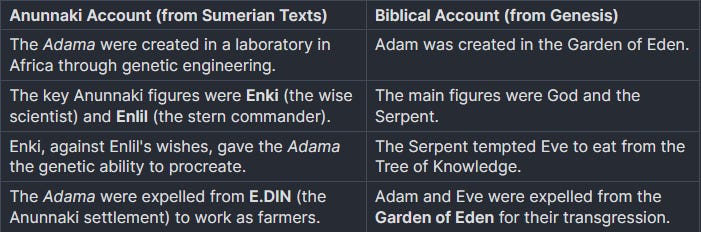
With humanity now able to reproduce and populate the Earth, the Anunnaki’s role shifted from creators to overseers. Their efforts to manage their burgeoning workforce recast many of the Bible’s most iconic stories in a new and startling light.
4. Rewriting History: The Anunnaki Role in Human Mythology
The Anunnaki’s direct involvement in human affairs, as described in Sumerian records, provides a coherent framework for understanding events that have shaped human mythology and history, revealing them as acts of planetary resource management.
The Great Flood: The biblical story of the Deluge originates in the Sumerian Epic of Gilgamesh. In this original version, the flood is a natural, cyclical cataclysm caused by Nibiru’s gravitational pull during a close pass to Earth. The Anunnaki, foreseeing the disaster, debated whether to let their creation perish. It was Enki who secretly instructed a faithful human (the basis for Noah) to build a vessel and save his family, preserving the human labor force.
The New “Gods”: After the Flood, the Anunnaki leadership divided the Earth into different regions. They established new cities and installed human kings to act as intermediaries between them and the growing human population. These Anunnaki rulers became the “gods” of the ancient world, forming the pantheons of Sumer, Egypt, and beyond. For example, the Anunnaki leader Marduk became the primary Egyptian deity, Ra.
The Tower of Babel: The Sumerian account reframes this story not as an act of human arrogance, but as an attempt by humanity to build its own shem—a term translated not as “name” but as “sky vehicle” or rocket ship. To prevent their human assets from unifying and achieving independent space travel, the Anunnaki confused their languages and scattered them across the Earth, ensuring their division and control.
Ancient Wonders: This hypothesis reveals that some of the world’s greatest ancient monuments were built as Anunnaki infrastructure. The Great Pyramids of Giza, for example, were not tombs but massive, artificial mountains designed as sophisticated landing beacons for the Anunnaki spaceport located on the Sinai Peninsula.
The Anunnaki’s direct influence shaped human civilization for millennia, but their greatest legacy was not left in stone, but in a “Secret of Secrets” passed down through the ages.
5. Conclusion: A Secret Legacy
The Anunnaki hypothesis presents a radical and cohesive narrative: humanity is a hybrid species, genetically engineered by extraterrestrial visitors to be their workers. These powerful beings became our first kings, our first teachers, and our first gods. They gave us civilization and then, for reasons of their own, decided to rule from behind the scenes, leaving humanity to chart its own course but never truly on its own.
The core of this knowledge—the “Secret of Secrets”—was not lost but preserved and passed down through a chain of secret societies, from the ancient Mystery Schools of Egypt and Greece to the Knights Templar and the inner circles of Freemasonry.
This alternative history leaves us with a challenging and profound final thought, articulated by authors like William Bramley and David Icke. If this account is true, it implies that humanity may be, in a sense, a “slave race” or a “possession.” The conflicts and limitations that have defined our history may not be entirely of our own making, but rather the result of a hidden, long-standing “alien agenda” that continues to subtly influence our world today.
The Hidden Hand Behind Global Power: What Decades of Research Reveal
“The world is governed by very different personages from what is imagined by those who are not behind the scenes,” wrote former British Prime Minister Benjamin Disraeli. His 19th-century observation hangs in the air today, more potent than ever. In 1909, Walter Rathenau of German General Electric was more specific: “Three hundred men, all of whom know one another, direct the economic destiny of Europe and choose their successors from among themselves.”
Are you one of the millions who looks at the daily news and asks, “What in the world is going on?” If so, you are not alone. Our investigation reveals a staggering premise: that history is not merely a series of accidents but is often the result of meticulous planning by a powerful, interconnected global elite.
This is not unfounded speculation. A 1997 Scripps-Howard poll revealed that a remarkable 51 percent of Americans believe it is likely that some federal officials were directly responsible for the assassination of President John F. Kennedy. This deep-seated suspicion isn’t paranoia; it’s an intuitive response to a pattern of events that defies conventional explanation. This report will unpack decades of research to reveal three core truths about the hidden architecture of global power:
A network of modern secret societies grew from a British imperialist plan to dominate the world.
This network secured its power by engineering a private takeover of the U.S. money supply through the Federal Reserve.
Its members maintain control by shaping policy and public opinion from within the highest levels of government, finance, and media.
1. The Blueprint: Forging a New World Order
Our investigation traces the origins of this network to the late 19th-century ambitions of the British Empire. This was not a vague dream of conquest but a concrete plan laid out by specific individuals, a blueprint for a global order that continues to shape our world.
The Spark: The Rhodes-Milner Plan
The modern genealogy of these secret societies begins with Cecil Rhodes, the South African diamond tycoon whose immense wealth was matched only by his imperial vision. Georgetown University historian Carroll Quigley, to whom the group granted rare access to its private records, revealed that Rhodes’s fortune was used “to form a secret society, which was to devote itself to the preservation and expansion of the British Empire.”
This organization, known as the “Round Table,” was structured with an inner “Circle of Initiates” and an outer “Association of Helpers.” Funded by Rhodes and the powerful Rothschild banking dynasty, this group was designed to steer world events from behind the scenes.
From Empire to “Special Relationship”: The Birth of the CFR
The paper trail from the British Round Table leads directly to the United States. In 1919, at a pivotal meeting in Paris’s Majestic Hotel, British and American delegates from the Paris Peace Conference resolved to form an “Institute of International Affairs.” The British branch became the Royal Institute of International Affairs (RIIA), a powerful think tank that still influences foreign policy from London.
The American branch quickly absorbed a powerful cadre of New York businessmen and, in 1921, was christened the Council on Foreign Relations (CFR). Its founding members were a who’s who of a Wall Street banking cabal, deeply connected to the J.P. Morgan financial empire. Key figures included Colonel Edward Mandell House, President Woodrow Wilson’s closest adviser; John W. Davis, J.P. Morgan’s personal attorney; and Allen Dulles, who would later become a legendary CIA Director.
The foundational goals of these interconnected groups were embedded in President Wilson’s famous “fourteen points,” which originated with this very network. Their globalist agenda called for:
The removal of “all economic barriers” between nations.
“Equality of trade conditions.”
The formation of “a general association of nations.”
With chapters established on both sides of the Atlantic, the network was an influential gentleman’s club. But its founders had no intention of remaining on the sidelines. To move from influence to outright control, they would need to seize the jugular vein of the American republic: its currency.
2. The Engine Room: Controlling Money and Minds
An ideological network is powerless without a self-funding mechanism. The architects of this new order understood that to truly reshape the world, they needed to control its primary fuel: money. The network’s next move was a strategic masterstroke, shifting from planning to seizing functional control of the U.S. economy and public discourse. This was the move that transformed a secret society’s ambitious vision into a self-perpetuating reality.
The Jekyll Island Conspiracy: The Federal Reserve Heist
In 1910, a secret meeting on Jekyll Island, a private resort off the coast of Georgia, laid the groundwork for the modern financial system. The event was so clandestine that participant Frank A. Vanderlip, soon to be president of New York’s National City Bank, later admitted, “I was as secretive, indeed, as furtive as any conspirator.” The attendees were not government officials; they were representatives of the world’s most powerful private banking interests: the Rothschilds, the Morgans, and the Rockefellers.
Their plan, codified in the Federal Reserve Act of 1913, was revolutionary in its audacity. It gave a private consortium of bankers a legal monopoly to create money—not by printing it, but by originating it as debt—and then to loan that manufactured money to the U.S. government at interest. Imagine a system where you could write checks from an account with a zero balance, loan them to the Treasury, and then have taxpayers pay you interest on the money you created from nothing. That was the essence of the Federal Reserve Act.
As Congressman Charles Lindbergh Sr. warned at the time, the act “establishes the most gigantic trust on earth” and legitimizes the “invisible government by the money power.” Industrialist Henry Ford put it more bluntly: “It is well enough that the people of the nation do not understand our banking and monetary system for, if they did, I believe there would be a revolution before tomorrow morning.”
Manufacturing Consent: The Establishment Media
To protect its interests, the network understood it had to shape public perception. Researchers Jonathan Vankin and John Whalen describe the sanitized narrative presented by mainstream sources as a “’Disney version’ of history.” This official storyline, perpetuated by corporate-owned media, academia, and government, actively resists any information that challenges its authority.
Anthony C. Sutton, a former research fellow at Stanford University’s Hoover Institution, argued that an “Establishment history” dominates textbooks and media, rejecting any evidence that falls outside its “official historical line.” The network’s reach into the media is extensive. A review of CFR membership rolls reveals a staggering number of top executives, producers, and anchors from virtually every major media organization, including CBS, NBC, PBS, CNN, The New York Times, The Washington Post, and Time magazine, ensuring the parameters of public debate rarely threaten the foundations of the network’s power.
Two Versions of Reality
The chasm between the official narrative and the one pieced together by decades of research represents two fundamentally different ways of understanding how the world works.
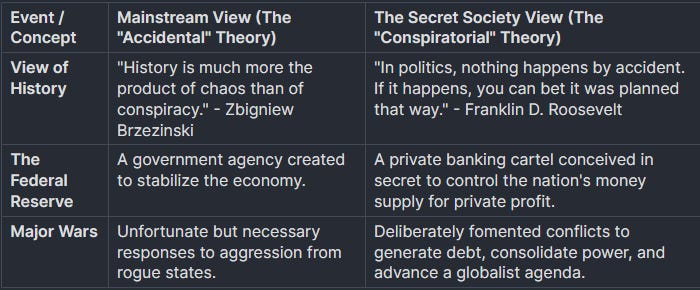
With control over both finance and information secured, the network’s modern offshoots have continued to steer global events with a confidence born of a century of success.
3. The Endgame: Modern Echoes and the Push for Global Governance
The network of influence forged a century ago is not a historical relic; it is a living, evolving entity whose agenda is visible in modern politics and the relentless drive toward globalization. The blueprint of the Round Table and CFR has been updated for the 21st century.
The Network’s New Faces: Bilderberg and the Trilateral Commission
Carrying the globalist torch today are newer, even more secretive organizations: the Bilderberg Group and the Trilateral Commission. Founded in 1973 by David Rockefeller and Zbigniew Brzezinski, the Trilateral Commission was created to “foster closer cooperation” between the economic power centers of North America, Western Europe, and Japan.


