


In this special episode of Cause Before Symptom, Urban takes the guest chair to unpack the dark side of Web3, gamification, and the “Metaverse.” We dive deep into the psychology of control, exploring how B.F. Skinner’s behavioral conditioning (the Skinner Box) is being weaponized through technology to create feedback loops that hack your dopamine and automate human behavior.
META = DEAD (In Hebrew)
מתה
From “play-to-earn” models that turn users into digital serfs to the looming reality of Universal Unified Ledgers and CBDCs, this episode connects the dots between gaming addiction, social engineering, and the infrastructure of the future surveillance state. Learn how “frictionless” living is a trap and what you can do to reclaim your sovereignty.
Kalshi Signs Deal(s) /w News Networks:
How Kalshi’s deal with CNN could change news reporting and audience engagement
Prediction giant Kalshi strikes a new media partnership with CNBC, days after its CNN deal
Kalshi Gains Major Media Foothold With Reported CNN Partnership
Urban & Juxtaposition1 International Appearance on the “Truman+ Show”
View the Notes on Cognitive Matrices
Other Links
You can view this episode on nearly every other platform:

View the Slideshow
You can view the Slideshow that I presented by clicking the image below:

YouTube Video(s) We Watched
Previous Article on Web3
🎰Web3 & Gamification of EVERYTHING

This was my first article on the Web3 & Gamification of everything; it has a lot of information worth checking out.
Article on “GovCorp™” & Platform NRx
The Push for Tokenization, Universal Ledgers, Monarch CEOs, "Platform NRx" & Possible Resistance Methods

Based heavily on the works of Curtis Yarvin & Nick Land.
Article on Nick Land’s Theories (Cybernetics)
Decoding Nick Land's "Cyberpositive AI Invasion"

Nick Land seems to be the "high priest" behind most of this theology of
"Let's just build the tower as fast as possible because once we reach heaven to fight God, there will be no more problems. It doesn't matter how many people have to die, it'll all be worth it for the 'dawn of a new day'"
Welcome to Play-to-Earn: A Beginner’s Guide to Gaming for Real-World Value
Introduction: When Gaming Pays the Bills
What if the countless hours you spent leveling up a character, mastering a new skill, or winning a battle in a video game could translate into real-world, tangible value? This is the core promise of a new paradigm in gaming called Play-to-Earn (P2E). Enabled by blockchain technology, the P2E model allows players to earn cryptocurrency and unique digital assets—known as Non-Fungible Tokens (NFTs)—that have genuine financial worth.
This innovation allows gamers to earn real-world value while enjoying their favorite pastime.
This guide is designed to explain the basics of P2E gaming, how it works, and what makes it different from the games you’re used to. To make these concepts crystal clear, we will use the popular P2E game Axie Infinity as a running example.
Let’s explore the fundamental shift that is turning passive players into active participants in a new digital economy.
The Big Shift: From Playing for Fun to Playing for Value
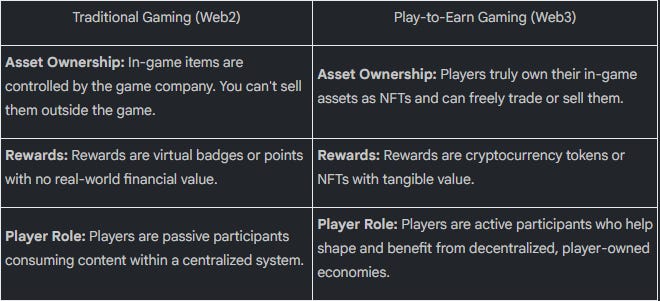
The key difference between traditional (Web2) gaming and Web3 P2E gaming is the shift from a closed ecosystem, where the company owns everything, to an open one where players can earn real financial rewards and truly own their digital assets. Traditional games operate in closed systems, while P2E games are built on open, decentralized platforms where players have true ownership.
The table below breaks down the key differences between these two models.
This revolutionary shift is made possible by a few key technological ingredients.
The Core Ingredients: How P2E Games Work
Blockchain & NFTs: “True Digital Ownership”
P2E games are built on a technology called blockchain. Think of it as a universal, un-hackable scoreboard and inventory list for the entire game world, shared publicly among all players, so everyone can verify who owns what. This secure and transparent digital ledger makes it possible to verify ownership without needing a central authority like a game company.
This technology enables the creation of Non-Fungible Tokens (NFTs). In simple terms, an NFT is a digital certificate of ownership for a unique item. In P2E games, this could be a character, a piece of virtual land, a special weapon, or a piece of art.
The origin of P2E can be traced back to CryptoKitties, a game launched in 2017 on the Ethereum blockchain. It was the first major P2E game that allowed players to collect, breed, and trade unique digital cats, each represented as an NFT. Because these digital cats were NFTs, they held tangible financial value, marking a key milestone in digital asset ownership. This concept of “true ownership” is the foundation of the entire P2E model.
In-Game Tokens: The P2E Economy
In addition to NFTs, P2E games have their own digital currencies, often called “tokens.” Players earn these tokens by completing tasks, winning battles, or contributing to the game’s ecosystem.
Crucially, these tokens have real-world value. They can be traded on cryptocurrency exchanges for other digital currencies or for traditional money like U.S. dollars. This is the mechanism that translates a player’s in-game success and effort into financial gains.
To see how these ingredients come together, let’s examine a perfect case study: Axie Infinity.
Case Study: A Deep Dive into Axie Infinity
What is Axie Infinity?
Axie Infinity, developed by Sky Mavis and launched in 2018, is a flagship P2E game that has been a pioneer in the industry. It is a Pokémon-inspired game where players collect, breed, and battle digital creatures called Axies. Each and every Axie is an NFT, which means players have true ownership of their creatures.
The Key Components of the Axie Economy
The game’s economy is built around three core assets. Understanding their roles is key to understanding how players earn.
Axies (NFTs): These are the digital creatures that players use to battle in teams of three. Because they are NFTs, each Axie has unique traits and can be bought or sold on the game’s marketplace. Players can also breed two Axies to create new, unique offspring, which can then be used in battle or sold to other players.
Smooth Love Potion (SLP): This is the game’s primary earning token. Players earn SLP by winning battles in the game’s Arena mode. SLP is an inflationary “utility” token that is also required to breed new Axies, creating a constant demand for it within the game’s economy.
Axie Infinity Shards (AXS): This is the game’s governance token. Holding AXS gives players a say in the future development of the game, allowing them to vote on important decisions. It is a deflationary “ownership” token designed to be held. Players can also “stake” their AXS tokens to earn regular rewards, similar to earning interest in a savings account. By staking your AXS, you are helping to secure the game’s network and validate transactions, and you are rewarded for providing this valuable service.
This creates a dynamic economy where players earn SLP through daily activity and spend it to create new Axies, while long-term investors hold AXS to influence the game’s future and share in its success.
The “Earn” in Play-to-Earn: How Players Make Money
Players in Axie Infinity can earn real-world value in several primary ways:
Playing the Game: The most direct way to earn is by winning battles in the Arena and completing daily quests. These activities reward players with SLP tokens, which can then be sold on a crypto exchange.
Breeding and Selling: Savvy players can breed new Axies with desirable traits and sell them on the marketplace for a profit. This creates an in-game economy driven by player activity, much like breeding horses or dogs in the real world.
Staking Tokens: Players who hold the AXS governance token can participate in staking to earn additional AXS rewards, providing a form of long-term, passive income.
This model became so popular that by 2021, especially in countries like the Philippines, some players were earning enough to replace their full-time income during the COVID-19 pandemic, highlighting P2E’s potential for global financial impact.
While the potential for earning is exciting, it’s equally important to approach P2E with a clear understanding of the risks involved.
The Reality Check: Rewards vs. Risks
Play-to-Earn can be financially rewarding, but it is not a risk-free endeavor. Newcomers must carefully weigh the potential benefits against the significant challenges before investing their time and money.
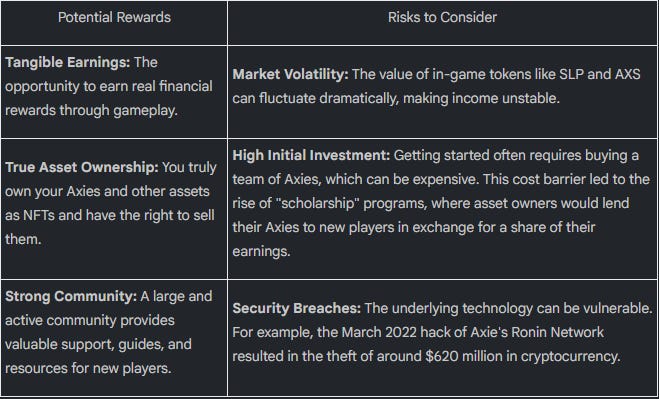
Understanding these risks is the first step toward responsible participation in the exciting but complex future of P2E gaming.
The Bigger Picture: The Future of Play-to-Earn
Play-to-Earn is fundamentally changing how people interact with digital entertainment by connecting it with personal finance and technology. This trend is not going unnoticed. Major global brands like Gucci, Samsung, and Atari have already begun exploring these virtual worlds, signaling a growing interest in the potential of player-owned economies.
As blockchain technology continues to improve, P2E games will likely become more complex, more engaging, and offer even more sophisticated ways for players to earn. P2E represents a significant shift in how we think about gaming, turning it from a simple pastime into a platform for unique financial opportunities.
Key Takeaways for Beginners
If you’re new to the world of Play-to-Earn, here are the three most important concepts to remember:
You Own Your Assets: In P2E games, your in-game items (like characters or land) are NFTs, meaning you have true digital ownership and can sell them for real money.
Gameplay Has Real Value: By playing the game—completing quests, winning battles, or creating assets—you earn in-game tokens (like SLP) that can be traded on crypto exchanges for real-world currency.
Research is Crucial: The potential to earn is real, but so are the risks. The value of your assets and earnings can be volatile, and there is often an initial cost to start playing, so it’s important to understand these factors before you begin.


