



The provided text offers a critical overview of United States foreign and military policy in the post-Cold War era, arguing that the collapse of the Soviet Union initiated a new phase of aggressive American expansionism aimed at global dominance. This strategy involves military encirclement of geopolitical rivals like Russia and China, particularly through NATO expansion and establishing new military bases globally. The source extensively discusses the importance of controlling energy resources and pipelines in regions like Eurasia and Africa as a primary, though often undeclared, objective of U.S. policy. Furthermore, the text details the use of covert methods and non-governmental organizations (NGOs) like the National Endowment for Democracy (NED) and new information technologies to orchestrate “Color Revolutions” and regime change, often referred to as “false flag” operations, in pursuit of these strategic goals. Finally, the source scrutinizes the influence of neo-conservative figures from institutions like the Project for the New American Century (PNAC) on U.S. defense policy, including the development of controversial programs like the “Star Wars” missile defense system, which is argued to be aimed primarily at neutralizing Russia’s nuclear deterrent.
This excerpt details the post-Cold War expansion of US global military and political dominance, arguing that the collapse of the Soviet Union merely shifted American geopolitical focus towards achieving Full Spectrum Dominance over Eurasia and controlling vital energy resources. A central theme is the aggressive NATO expansion to the east and the development of provocative military strategies, such as missile defense systems aimed at encircling Russia and controlling strategic regions like Central Asia, which is considered a prime geopolitical prize. The text also highlights the use of covert regime change techniques, often termed “Color Revolutions,” employed by US-linked organizations like the National Endowment for Democracy (NED) and utilizing new information technologies to manipulate social movements in strategic countries. Furthermore, the source asserts that US foreign policy, particularly under the Bush-Cheney Administration, prioritized control of oil and natural gas fields, citing examples like the Iraq invasion and the conflict in Darfur, which are presented as resource wars designed to counter the growing influence of China and Russia.
See Also
https://docs.urbanodyssey.xyz/biodigital-convergence/full-spectrum.html


![AGE of DECEIT IV: The Eschaton Cipher & the Counterfeit Ledger of Life [Full Documentary]](https://substackcdn.com/image/fetch/$s_!9Bzq!,w_280,h_280,c_fill,f_webp,q_auto:good,fl_progressive:steep,g_auto/https%3A%2F%2Fsubstack-post-media.s3.amazonaws.com%2Fpublic%2Fimages%2Fa12fc5eb-5247-4a2c-a43b-1d584047a751_1456x1048.png)

The Unending Cold War: How Washington Waged a Secret Battle for the Planet
In the crisp November air of 1989, euphoric crowds danced atop the crumbling Berlin Wall, pulling down its hated stones piece by piece. For millions, it was the symphony at the end of history—a new era of freedom, the triumph of the ‘American Way of Life,’ and the definitive end of the conflict that had held the planet hostage. It was a moment of unbridled optimism.
But inside the White House, the reaction was starkly different. President George H.W. Bush, a man forged in the crucible of the National Security State, reacted not with jubilation, but with “panic.” The collapse of the Soviet foe created a crisis of purpose, threatening the very justification for America’s massive arms spending and its sprawling intelligence apparatus. His world was one of secrecy and enemy images, a state within a state whose permanent war machine was woven into the fabric of the American economy.
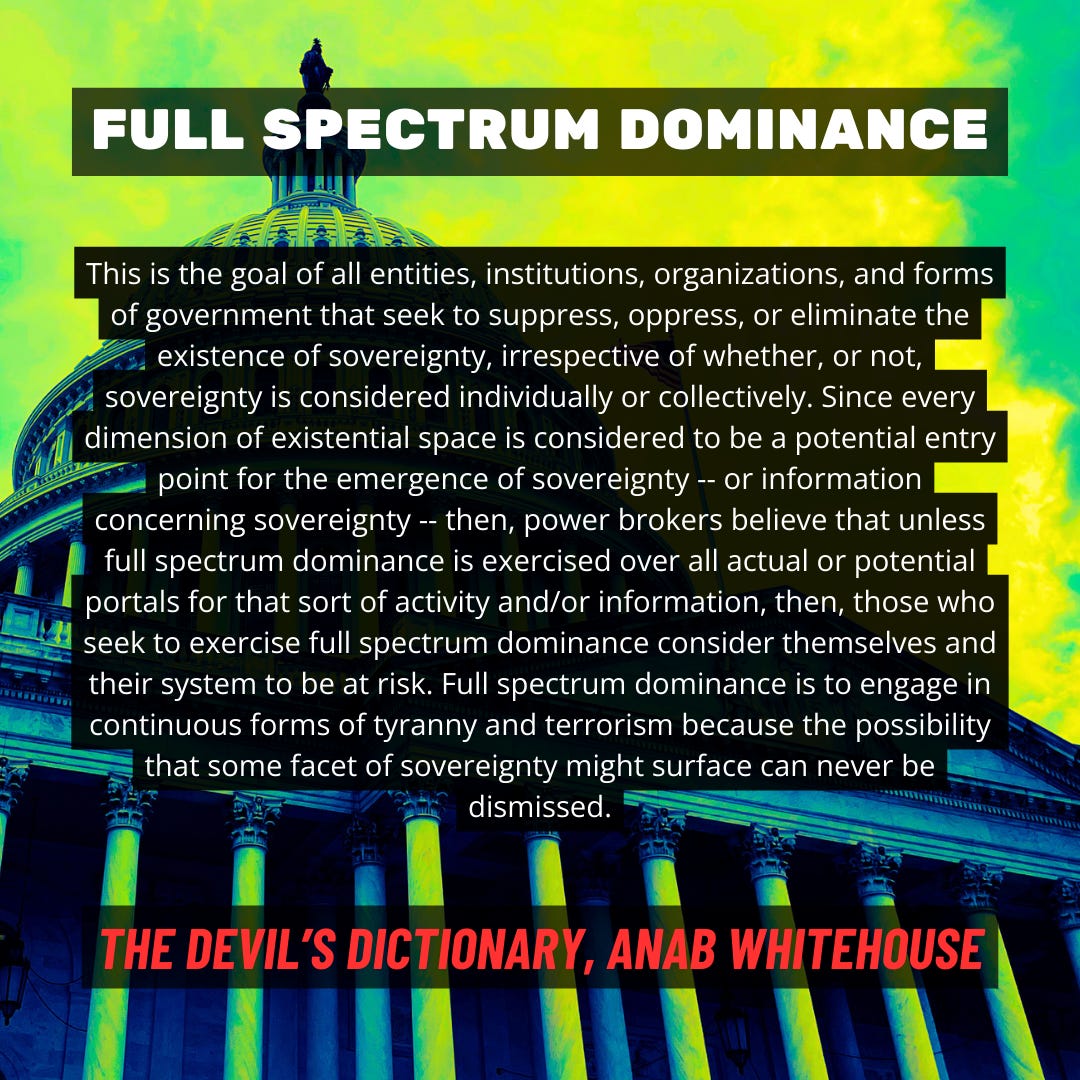
What if the Cold War never truly ended for this powerful faction? What if it simply went underground, trading open confrontation for covert domination? This investigation reveals how Washington pursued a relentless strategy of what the Pentagon itself calls “Full Spectrum Dominance.” Our analysis unpeels this grand, secret strategy through three core revelations: the deliberate breaking of a solemn promise to Russia in order to achieve military encirclement; the engineering of “democratic” coups to control Eurasia’s energy lifelines; and the weaponization of human rights to destabilize its ultimate rivals, Russia and China.
As Allen Weinstein, a founder of the National Endowment for Democracy, once admitted, this shift was a change in tactics, not intent:
“A lot of what we do today was done covertly 25 years ago by the CIA.”
1. Historical Context: A Broken Promise and a New Grand Plan
The collapse of the Soviet Union presented the United States with a profound crisis of purpose. As the sole remaining superpower, Washington stood at a historic crossroads. The path it chose in the early 1990s would not lead to an era of global cooperation, but instead set the stage for a new, undeclared conflict waged through stealth and deception—a conflict driven by a century-old geopolitical obsession.
The Path Not Taken
In the wake of 1989, Washington faced two distinct choices. It could have signaled a new era of genuine international cooperation, dismantling the NATO military machine just as Russia had dissolved the Warsaw Pact. This path could have transformed Eurasia into one of the world’s most prosperous economic zones.
Instead, Washington chose dominance. Driven by the “inner logic” of its global agenda and the powerful interests of its military and energy conglomerates, the United States embarked on a campaign of “stealth, deception, lies and wars to attempt to control the Eurasian Heartland.” This decision was not arbitrary; it was the deliberate application of a grand geopolitical theory. For strategists like Zbigniew Brzezinski, the intellectual heir to British geographer Sir Halford Mackinder, controlling the Eurasian “Heartland”—the vast resource-rich expanse of Russia—was the key to commanding the “World-Island” and, thus, the world. In this cold calculus, America’s allies were not partners, but tools. In his own writings, Brzezinski referred to them bluntly as America’s “vassals,” to be managed and maneuvered to prevent any challenge to US supremacy.
The Original Sin: NATO’s Eastward March
The foundational betrayal of this new era was a broken promise. In return for Moscow allowing a peaceful German reunification and the dissolution of the Warsaw Pact, the George H.W. Bush administration gave Mikhail Gorbachev a “solemn promise” that the United States would not extend NATO eastward. Gorbachev, acting in good faith, trusted this pledge. He apparently forgot to get it in writing.
Washington’s memory proved conveniently short. Both the Bush and Clinton administrations systematically broke the agreement, enticing the newly liberated countries of the former Warsaw Pact, one by one, into a newly enlarged and aggressive NATO. This relentless military encirclement of Russia unfolded over two decades.
1990s: The pledge not to expand is broken as Washington entices former Warsaw Pact countries into the alliance.
2004: Poland, the Czech Republic, Hungary, Estonia, Latvia, Lithuania, Bulgaria, Romania, Slovakia, and Slovenia are all members of NATO.
2008: The George W. Bush administration pressures European allies to admit Georgia and Ukraine, pushing the military alliance to Russia’s very doorstep.
This military encirclement, however, was merely the visible iron cage being constructed around Russia. The true innovation was the invisible war being waged within its borders and those of its neighbors—a war fought not with soldiers, but with students, cell phones, and the seductive language of democracy.
2. Core Intrigue: Engineering Coups and Controlling the Chessboard
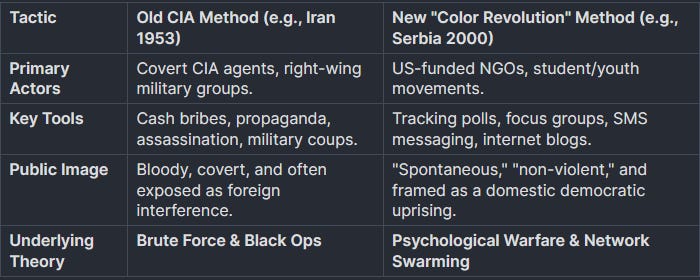
How does a superpower control a continent without appearing to fire a shot? By perfecting a new, dangerously effective template for covert regime change: the “Color Revolution.” This new model of warfare allowed Washington to manipulate political outcomes and control the Eurasian “chessboard”—a term favored by strategist Zbigniew Brzezinski—often without a single overt military action. It was a poll-driven, focus group-tested, and media-savvy method for winning other people’s elections.
The Belgrade Blueprint
Washington first successfully tested this new model in 2000, engineering the overthrow of Serbia’s Slobodan Milosevic. Far from a spontaneous uprising, our investigation reveals it was a meticulously planned operation. The key players were not CIA agents in trench coats but ostensibly private, US-funded Non-Governmental Organizations (NGOs) like the National Endowment for Democracy (NED) and its two main offshoots, the National Democratic Institute (NDI) and the National Republican Institute (IRI).
Armed with millions in US taxpayer dollars, these groups trained and funded a student protest movement called Otpor! (‘Resistance’). They employed modern election campaign techniques, running tracking polls and focus groups to identify Milosevic’s vulnerabilities. The core tactical theory was a concept developed by the RAND Corporation known as “swarming,” which leverages modern technology like cell phones, text messaging, and internet blogs to mobilize decentralized but connected protest groups—like a swarm of bees—that could appear and disappear before state security forces could react.
The contrast with older, cruder methods of regime change is stark:
The Pipeline Wars
With the Belgrade blueprint perfected, Washington deployed it across Eurasia in a series of pipeline wars. Georgia’s 2003 “Rose Revolution” and Ukraine’s 2004 “Orange Revolution” were not simply exercises in democracy promotion. They were direct interventions in energy geopolitics.
The goal in Georgia was to secure a pro-US government that would guarantee the route for the strategic Baku-Tbilisi-Ceyhan (B-T-C) oil pipeline, designed to bring Caspian Sea oil to the West while bypassing Russia. In Ukraine, the objective was to install a government that would pivot toward NATO and give Washington leverage over the critical pipelines carrying Russian natural gas to Europe, thereby isolating and weakening Moscow.
Putin Draws a Line: The Yukos Affair
In 2003, Russian President Vladimir Putin made a decisive countermove. He ordered the spectacular arrest of Mikhail Khodorkovsky, the billionaire oligarch who controlled the giant Yukos Oil company. Western media framed this as an authoritarian crackdown, but behind the scenes, it was Putin blocking what amounted to a US-backed corporate coup d’état.
Shortly before his arrest, Khodorkovsky had met with US Vice President Dick Cheney. Following the meeting, Khodorkovsky began negotiations to sell a 40% stake in Yukos to an American oil major, either ExxonMobil or ChevronTexaco. Such a deal would have given Washington de facto veto power over Russia’s energy strategy. Putin’s move to seize Yukos assets and jail its owner sent a clear message: Russia’s strategic resources were not for sale to hostile foreign powers.
Weaponizing Human Rights: The War for Resources
The evidence points to a chillingly simple logic: where these “democratic” coups proved difficult, Washington was prepared to use a different weapon—the language of human rights—to destabilize nations and block the rise of its ultimate competitor, China. This new front in the covert war was fought over access to the raw materials fueling China’s explosive economic growth.
Myanmar (Burma): The 2007 “Saffron Revolution,” portrayed as a spontaneous uprising of Buddhist monks, was a textbook operation run by the same network of US-funded NGOs (NED, Open Society Institute, Freedom House). The strategic prize was Myanmar’s coastline, which offers China a vital land bridge to the Indian Ocean via oil and gas pipelines, allowing it to bypass the US-patrolled Malacca Strait—a chokepoint through which over 80% of China’s oil imports pass. A pro-US regime in Myanmar would sever this critical energy lifeline.
Sudan (Darfur): The campaign to label the conflict in Darfur a “genocide” began shortly after China’s state oil company was granted major exploration rights in the region, which was found to hold massive new oil reserves. While the humanitarian crisis was real, Washington was the only government to insist on the “genocide” label, a legal pretext for NATO intervention. The goal was transparent: to seize control of China’s crucial African oil source, from which it drew nearly a third of its crude imports, and to install a regime friendly to US energy interests, like those already operating in neighboring Chad.
While Washington perfected these covert tools, it was simultaneously reviving a far older and more dangerous Cold War obsession.
3. Modern Echoes: The End Game of Nuclear Primacy
This grand strategy is not merely a history lesson; it is the hidden logic animating today’s escalating global tensions. From the encirclement of Russia to the containment of China, the historical push for dominance connects directly to the ultimate military objective that underpins modern American foreign policy: the ability to wage and win a nuclear war.
The Empire of Bases
Since the 1999 bombing of Yugoslavia, the Pentagon has engaged in a massive and unprecedented expansion of its global military footprint. This “Empire of Bases” serves as the physical infrastructure for projecting power and completing the military encirclement of Russia and China. Key installations include:
Camp Bondsteel, Kosovo: One of the largest US military bases built since Vietnam, strategically positioned to project air power into the oil-rich Middle East and Caspian Sea region.
Bases in Afghanistan and Iraq: Following the invasions of 2001 and 2003, the U.S. established a network of more than a dozen permanent or “enduring” bases, creating a military presence on the borders of Iran and within striking distance of both Russia and China.
This network forms a forward-deployed offensive capability, designed not for defense but for the rapid projection of overwhelming force across the Eurasian heartland.
The Missing Link to a First Strike
The most provocative element of this strategy is the US Ballistic Missile Defense program. While publicly framed as a shield against “rogue states” like Iran, its true purpose is profoundly offensive. According to Lt. Colonel Robert Bowman, former Director of the US Missile Defense Program, a missile shield provides “the missing link to a First Strike.”
The logic is chillingly simple. A missile shield is not designed to stop a massive, full-scale nuclear assault. It is designed to “mop up” the small, ragged retaliation a rival could mount after suffering a disarming US first strike. By neutralizing an opponent’s ability to retaliate effectively, a missile defense system makes nuclear war “thinkable” for Pentagon planners. It is the key to achieving what they call Nuclear Primacy—the ability to launch a nuclear attack with impunity.
As this undeclared global conflict intensifies, can a multipolar world emerge peacefully, or does Washington’s pursuit of total dominance make a large-scale war inevitable? And how effectively do “human rights” campaigns in places like Tibet and Darfur mask this high-stakes geopolitical battle over resources and power?
Conclusion
The evidence reveals a stark and unsettling picture of the post-Cold War world. What was celebrated as the dawn of a new peace was, for a powerful segment of the US establishment, merely the beginning of a new phase in an unending war for total planetary control.
The Cold War never ended for the US national security state; it evolved into a covert strategy for total global control known as “Full Spectrum Dominance.”
Washington perfected a template for “democratic” coups, using NGOs and modern technology to topple governments and seize control of strategic energy routes, primarily targeting Russia’s sphere of influence.
The US “weaponizes” human rights and democracy campaigns to destabilize resource-rich nations (e.g., Myanmar, Sudan, Tibet) in a direct effort to block China’s economic and geopolitical rise.
The relentless expansion of US military bases and the push for a “missile defense” shield are not for protection; they are offensive tools designed to achieve Nuclear Primacy and the ability to launch a disarming first strike.


