



The source provides an autobiographical account detailing the author’s decades-long commitment to Freemasonry, beginning in his youth as a search for identity and belonging. The narrative describes his experiences advancing through the Blue Lodge, Scottish Rite, and Shrine—including enduring troubling initiation rituals, such as bloody oaths and hazing—and achieving the prestigious 33rd Degree. As his involvement deepened, the author grew increasingly conflicted over Masonic doctrine, noting its syncretistic promotion of all religions, its occult philosophical roots in practices like Kabalah and sun worship, and its inherent contradiction with Christian faith. This profound spiritual crisis culminated in his decisive resignation from all Masonic organizations after concluding that the Craft was a deception that deliberately misled its members on fundamental truths. The text then shifts to an explicit critique, using appendices to contrast core Masonic doctrine (including its views on God, salvation by works, and secrecy) directly against Christian doctrine to support the author’s anti-Masonic ministry.
The excerpts present a compelling autobiographical journey of the author, Tom C. McKenney, detailing his difficult childhood and his subsequent lifelong search for light, fulfillment, and belonging within the ranks of Freemasonry. McKenney describes his rapid ascent through the Blue Lodge, Scottish Rite, and Shrine, undergoing intense rituals marked by blindfolded initiations and bloody oaths, eventually achieving the prestigious 33rd Degree. The core theme of the document is the devastating contradiction McKenney ultimately perceives between the fraternity’s syncretic, works-based theology (which he links to pagan mystery religions) and the exclusive truth of Christianity. The text thus functions as an exposé, revealing how high-ranking Masons allegedly intentionally misled lower members about the deeper, often phallic or pantheistic, nature of their symbols, ultimately serving as a warning against the organization’s “deadly deception.”

See Also
See Also: The Babylon Matrix Wiki


![Magick, Mysticism & Masonry: The Luciferian Secrets of the Illuminati [Doc Marquis, 2010]](https://substackcdn.com/image/fetch/$s_!Htn7!,w_140,h_140,c_fill,f_webp,q_auto:good,fl_progressive:steep,g_auto/https%3A%2F%2Fsubstack-post-media.s3.amazonaws.com%2Fpublic%2Fimages%2Fc0f10f5c-4e10-45f8-864f-d1be42283354_1456x1048.jpeg)


Download Source Text

Free Resources on Freemasonry

Larger Collection of Freemasonic Works (By DM Hutchins) [14 Folders, 549 Files, 2.85GB Total]
Absolutely MASSIVE FREEMASONIC LIBRARY provided by DM Hutchins Research Project

The Architecture of Initiation: An Analysis of Ritual and Symbolism in the Masonic Blue Lodge
1.0 Introduction: The Search for Light
Masonic initiation is a foundational experience for its members, a journey frequently described as a “search for light.” This formative process is not a single event but a carefully architected progression through a series of degrees, each with its own ritualistic and symbolic framework. This white paper conducts a scholarly analysis of the first three degrees of the Masonic “Blue Lodge”—Entered Apprentice, Fellowcraft, and Master Mason—grounded exclusively in the detailed personal account provided in the source text. By examining the candidate’s ceremonial journey, the objective is to illuminate the highly structured path from a state of symbolic “darkness” to one of progressive “light” and obligation. The analysis begins with the candidate’s first encounter with the fraternity’s ritual: the Entered Apprentice degree.
2.0 The First Degree: The Entered Apprentice
The Entered Apprentice degree serves as the candidate’s foundational encounter with Masonic ritual and symbolism. Its strategic importance cannot be overstated, as the ceremony is meticulously designed to establish the core themes of vulnerability, trust, and secrecy that will pervade the subsequent degrees. The initial stages of preparation function as a form of “ritual stripping,” a process designed to place the candidate into a liminal state. From this point, every element of the experience works to remove his former identity and instill a profound sense of dependence on the fraternity that is about to receive him.
2.1 Preparation for Initiation: Symbolic Divestment and Vulnerability
The preparatory steps for the Entered Apprentice degree involve a systematic divestment of the candidate’s personal effects and a symbolic alteration of his physical state. According to the source material, the candidate is placed in the following condition:
Removal of all clothing.
Wearing a “two-piece garment made of thin, white material.”
Being fitted with a single sandal on the right foot, leaving the left foot bare.
Having the left arm and left side of the torso bared.
Being blindfolded with a “hoodwink” and an additional heavy cloth to ensure total darkness.
Having a blue rope, or “cabletow,” tied around the neck.
This state of dress, combined with complete blindness, creates a profound condition of disorientation and establishes the candidate’s reliance on those leading him. The psychological impact of this vulnerability is made explicit in the source account, which notes, “This being in total darkness produced a deep-down feeling of helplessness, and gave rise to thoughts of terrible things that might be done.” This state is not merely one of humility; it is a ritualistic reduction to a tabula rasa—a blank slate upon which the fraternity can inscribe its own symbolic language and moral framework.
2.2 The Ritual of Entry: A Passage from Darkness
The candidate’s entry into the Lodge Hall is a carefully staged ritual that reinforces his status as a seeker. Challenged at the door with the question, “Who comes here?” a prescribed response is given on his behalf: “A poor blind candidate who desires to be brought from darkness into light.”
Upon entry, he is immediately subjected to a physical ordeal that serves as a visceral and unforgettable warning. The purpose of this act is explicitly stated to him:
You are received into this Lodge of Entered Apprentices upon the point of a sharp instrument piercing your naked left breast, which is to teach you as this is an instrument of torture to the flesh, so the remembrance of it be to your mind and conscience, should you ever presume to reveal any of the secrets of Freemasonry unlawfully.
This physical ordeal immediately establishes the gravity of the fraternity’s secrets and the tangible consequences of their betrayal.
2.3 The Oath of Obligation: A Binding Commitment
A central component of the first degree is the oath of obligation, which binds the candidate to the fraternity under a severe penalty. While the core of the oath is a promise of secrecy, its power lies in the graphic and specific consequences the candidate swears to accept for any violation. As described in the source, the penalty for revealing the secrets of an Entered Apprentice is articulated in a binding blood oath:
...binding myself under no less penalty than that of having my throat cut from ear to ear, my tongue tom out by its roots, and buried in the sands of the sea a cable’s length from shore, where the tide ebbs and flows twice in twenty-four hours...
This oath solidifies the solemnity of the commitment, using visceral, symbolic violence to impress upon the candidate the absolute and non-negotiable nature of the fraternity’s demand for secrecy.
2.4 The Revelation: Symbols of a New World
The climax of the Entered Apprentice degree occurs when the candidate, after requesting “Light,” has his hoodwink removed. In a moment of high drama, he is brought from total darkness into a brilliantly lit room, surrounded by his new brethren and confronted with the core symbols of the Lodge.
The Three Great Lights: The Bible, square, and compass are presented as the foundational “great lights of Masonry.”
The Three Lesser Lights: Three candles are explained to represent the sun, the moon, and the Worshipful Master of the Lodge.
The Due-Guard and Sign: The candidate is taught the specific hand positions of the due-guard and the penal sign. The sign, which simulates the oath’s penalty by drawing the hand across the throat, serves as a constant, physical reminder of the sworn consequence, transforming it into a piece of daily symbolic language.
The Secret Grip and Word: He is instructed in the secret grip (pressing the knuckle of the right index finger) and given the secret word, “Boaz.”
The Lambskin Apron: He is presented with a lambskin apron, explained as an “emblem of innocence and the mark of a Mason.”
With these secrets conferred, the candidate has completed his first step. However, the source author’s personal reflection on a minor deception involving pennies during the ritual reveals an early seed of doubt: “I had actually been misled. I wondered if somehow this was an indication of deceptions to come.” This observation foreshadows a central theme of the initiatory journey, setting the stage for his advancement toward further Masonic knowledge.
3.0 The Second Degree: The Fellowcraft
The Fellowcraft degree represents a clear progression in the candidate’s Masonic education, building directly upon the foundational experiences of the first degree. The ritual introduces more complex symbolism and demands a deeper commitment, signaling to the candidate that his journey is one of continuous learning and escalating obligation. The ceremony is designed not as a repetition but as an evolution, reinforcing the idea of a structured, hierarchical path to knowledge.
3.1 A Progressive Preparation
The preparation for the Fellowcraft degree is subtly but significantly altered from that of the Entered Apprentice, symbolizing a progressive, rather than repetitive, journey. The changes in the candidate’s state of dress directly mirror and advance the symbolism of the first degree.
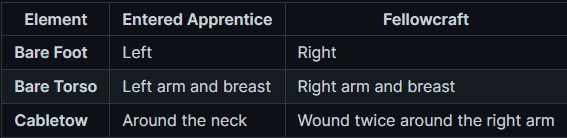
These alterations—shifting the exposure from the left to the right side of the body and moving the cabletow from a symbol of submission (around the neck) to one of being bound to a task (around the arm)—signify that the candidate is advancing to a new stage of Masonic understanding and responsibility.
3.2 The Ritual of Passage and the New Oath
The Fellowcraft initiation continues the pattern of symbolic entry and obligation. The candidate is received on “the angle of a square at your naked right breast” and is introduced to a password, “SHIBBOLETH.” The ceremony culminates in a new oath with a penalty distinct from, and more severe than, the first. The penalty for violating the Fellowcraft obligation is:
...binding myself under no less a penalty than that of having my left breast tom open, my heart plucked out and given to the beasts of the field and fowls of the air as a prey.
This penalty represents a calculated escalation in symbolic violence. Whereas the first degree targeted the organs of speech—the throat and tongue, instruments of revelation—the second targets the heart, the archetypal seat of loyalty and emotion, thereby deepening the gravity of the candidate’s commitment.
3.3 The Introduction of “Further Light”
Upon taking the oath and again requesting “Further light,” the Fellowcraft Mason is introduced to a new layer of symbolic knowledge.
The Altered Compass: The candidate is shown that one point of the compass is now hidden beneath the square. This is explicitly meant to teach him that “there were still more secrets hidden from my view,” reinforcing the theme that Masonic knowledge is revealed in stages and that complete understanding remains elusive.
The New Grips and Word: He is taught a pass grip and a “real grip” of a Fellowcraft, along with the associated secret word, “JACHIN.”
The Letter “G”: He is introduced to the letter “G,” which is explained to have a dual symbolic meaning: it denotes both “Deity” and “Geometry,” linking reverence for a supreme being with the pursuit of rational, scientific knowledge.
Having absorbed these lessons, the Fellowcraft is prepared to advance toward the final and most profound degree of the Blue Lodge.
4.0 The Third Degree: The Master Mason
The Master Mason degree is the culmination of the Blue Lodge journey, representing the symbolic completion of the candidate’s initial search for light. Its strategic importance lies in a unique two-part structure. The ceremony begins with a final oath of obligation, representing the apex of the candidate’s commitment to the fraternity. It then transitions into a complex allegorical drama centered on the themes of loyalty, death, and resurrection, which serves as the foundational myth of the Blue Lodge.
4.1 The Ultimate Obligation
The candidate’s final preparation is the most comprehensive, symbolizing full devotion. Both pant legs are rolled up, both feet are left bare, his torso is naked from the waist up, and the cabletow is wound three times around his body. The subsequent oath contains several promises, including a pledge not to “violate the chastity of a Master Mason’s wife, his mother, sister, or daughter.” The penalty for violating this ultimate obligation is the most severe of the three degrees:
...binding myself under no less a penalty than that of having my body severed in twain, my bowels taken out and burned to ashes, the ashes scattered to the four winds of heaven...
This final blood oath completes the triad of symbolic punishments, extending from the throat (speech) and heart (loyalty) to the entire body, representing a total and final commitment to the fraternity’s laws.
4.2 The Hiramic Legend: A Ritual within a Ritual
Following the oath, the ceremony undergoes a dramatic shift. The candidate is informed, “you are not yet a Master Mason,” and is told he will now represent “our Grand Master Hiram Abiff,” the architect of King Solomon’s Temple. This marks the beginning of an allegorical play in which the candidate is no longer himself but becomes the central figure in the foundational myth of Freemasonry.
4.3 Symbolic Death and Resurrection
The core of the Master Mason degree is the candidate’s personal enactment of the Hiramic Legend. This ritual drama, which illustrates a complex interplay of solemn ceremony and fraternal dark humor, unfolds in a clear chronological sequence.
The Confrontation: The candidate, as Hiram, is accosted by three “ruffians”—Jubela, Jubelo, and Jubelum—who violently demand the “secrets of a Master Mason.”
The Murder: After refusing to reveal the secrets, Hiram is struck with a 24-inch gauge, a square, and finally a setting maul to the forehead. The source text notes that this final blow knocked the author unconscious, adding a crucial footnote: “The man who hit me was an undertaker, and we had many laughs later about his trying to drum up business in the Lodge...”
The Burial: The “ruffians” conceal the body, later moving it to a simulated grave outside the Temple, which they mark with a “sprig of Acacia.”
The Raising: After the body is discovered, attempts are made to raise it from the “grave.” The Entered Apprentice grip fails because, as the drama dictates, “the flesh left the bone.” The Fellowcraft grip likewise fails because “the skin (slipped) away.” This potent symbolism suggests the knowledge of the lower degrees is insufficient to overcome death. The candidate is only successfully raised when the Master uses the “strong grip of the lion’s paw” while positioned on the “five points of fellowship”: “foot to foot, knee to knee, chest to chest, hand to back and mouth to ear.” The Master Mason degree is thus framed as the sole possessor of the power of resurrection within the Blue Lodge system.
4.4 The Final Secrets: The “Lost” Word and Sign of Distress
Upon being “raised,” the new Master Mason receives the final secrets of the Blue Lodge. He is taught that the “Grand Masonic Word” was lost at Hiram’s death. He is therefore given a substitute word, whispered as “Mah-Hah-Bone.” He is also taught the “Grand Hailing Sign of Distress” and its accompanying words: “Oh, Lord my God, is there no help for the widow’s son?” This sign is positioned as the ultimate call for aid between Master Masons, to be used only in cases of “most imminent danger.” The conferral of these final secrets concludes the candidate’s ritualistic progression, transitioning him to a new level of understanding and fellowship.
5.0 Thematic Synthesis of the Initiatory Framework
Synthesizing the descriptions of the three degrees reveals a sophisticated and coherent initiatory framework. The rituals are not arbitrary but are constructed around overarching themes and symbolic structures that guide the candidate through a transformative psychological process, as presented in the source account.
5.1 Progression of Vulnerability and Obligation
The three degrees are built on a deliberate, tiered structure of escalating commitment. This is most evident in the parallel progressions of the candidate’s physical vulnerability and the severity of his oaths. In the first degree, his left side is bared; in the second, his right; in the third, his entire torso. This increasing physical exposure mirrors the escalating symbolic violence of the penalties he swears to uphold: from having his throat cut, to his heart plucked out, to his body severed in two. This architecture creates a progressive binding of the candidate to the fraternity. Each stage demands a greater degree of trust and submission, reinforcing the gravity of his obligations and solidifying his loyalty through a carefully managed intensification of the ritual experience.
5.2 The Duality of Light and Secrecy
A central metaphor of the Masonic journey is the candidate’s passage from darkness to “Light.” The dramatic moment the hoodwink is removed is a powerful symbol of enlightenment. However, this reveal is immediately contrasted with the teaching that true, complete understanding is always further away. The Fellowcraft learns that a point of the compass remains hidden, signifying more secrets yet to be revealed. The Master Mason learns that the true secret word has been lost and he must accept a substitute. This duality cultivates a continuous search for a truth that remains perpetually veiled. The source text, in Appendix B, makes the explicit claim that the Blue Lodge initiate is “intentionally mis-led by false interpretations.” This suggests the ritual framework is designed not to provide final answers but to instill a permanent state of seeking within a system where ultimate truth is reserved for a higher class of adept.
5.3 The Hiramic Legend as Foundational Myth
The Master Mason degree solidifies the Hiramic Legend as the foundational myth of the Blue Lodge. The source material, particularly in Appendix D (”The Legend of Hiram Abiff”), explicitly identifies this Masonic legend as a retelling of the ancient Egyptian myth of Osiris. The significance of this connection cannot be understated. By having the candidate for Master Mason personally enact this death-and-resurrection narrative, the fraternity places an ancient mystery religion at the core of its teachings. The candidate does not simply learn about the myth; he becomes its central character, experiencing a symbolic death for his loyalty and a subsequent rebirth into a higher state of being. This ritual positions the core of Masonic teaching not as a modern ethical system but as a direct continuation of the initiatory traditions of the ancient world.
6.0 Conclusion
The Masonic initiation rituals, as detailed in the source material, constitute a highly structured and psychologically potent system for inducting and binding new members. The journey through the Entered Apprentice, Fellowcraft, and Master Mason degrees is not a collection of disparate ceremonies but a single, cohesive architecture of initiation. Through a deliberate progression of physical vulnerability, binding blood oaths, and layered symbolism, the candidate is guided from a state of ignorance and dependence to one of progressive enlightenment and responsibility. This journey culminates in the personal enactment of the allegorical death and rebirth of Hiram Abiff—a foundational myth identified in the source as a parallel to the ancient mystery of Osiris. By this process, the fraternity guides its candidates on a transformative path designed to instill its core tenets of secrecy, loyalty, and the unending search for esoteric knowledge.


