


These sources provide an extensive overview of Operation Gladio, a secret stay-behind network established by the CIA and NATO across Western Europe during the Cold War to counter perceived Communist threats. The texts detail the network’s clandestine structure, its coordination through the Clandestine Planning Committee (CPC), and its involvement in a “strategy of tension” through acts of terrorism, right-wing coups d’état, and human rights violations wrongly blamed on the political left, particularly in Italy, Greece, and Turkey. Furthermore, the documents heavily explore the deep and pervasive connections between U.S. intelligence (OSS/CIA), the Vatican/Catholic hierarchy, and organized crime (Mafia), particularly concerning financial activities, money laundering, and drug trafficking to fund covert operations like Gladio. Key figures like Allen Dulles, Colonel Paul Helliwell, and Italian figures associated with the P2 Masonic lodge and the Vatican Bank (IOR) are repeatedly cited as instrumental in forming this unholy alliance.
Thank you Bob, the Free Radical, Jeremy Smith, Kittiehart, and many others for tuning into my live video! Join me for my next live video in the app.
Timestamps
00:00:00 A Secret Mission in OTAN
00:03:52 Gladio: The Invisible Army
00:09:38 The Cold War Begins: Recruiting Fascists
00:18:29 Stay-Behind: Preparing for Soviet Occupation
00:26:37 The Bund Deutscher Jugend Scandal
00:39:40 Italy’s Interior Danger: The Communist Party
00:49:08 Strategy of Tension: The Bologna Bombing
01:12:02 The Aborted Borghese Coup & P2 Lodge
01:37:49 Belgium’s “Crazy Killers” of Brabant
02:07:33 The Kidnapping and Murder of Aldo Moro
Download the Source Texts & Extended Notes
This article is only a fraction of all of the notes from the two primary sources on Operation Gladio
Source Text(s)
Operation Gladio: The Unholy Alliance Between the Vatican, CIA & Mafia (Paul L. Williams)
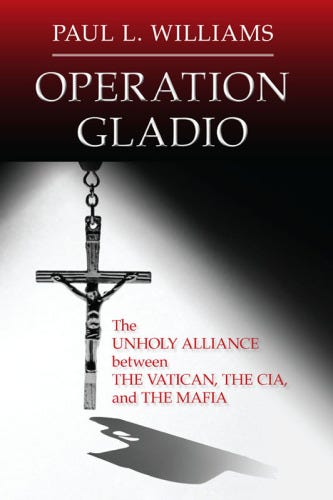
This extensive table of contents and collection of excerpts from “Operation Gladio: The Unholy Alliance between the Vatican, the CIA, and the Mafia” details a hidden history of post-World War II covert operations, primarily focusing on the entanglement of powerful state and non-state actors in Europe and Latin America. Key themes revolve around the establishment of “stay-behind units” like Operation Gladio to combat perceived communist threats, often through a “strategy of tension” involving false flag terrorism blamed on the political left. Central to this narrative is a widespread narcotics network and money laundering operation, exemplified by the nefarious dealings of financier Michele Sindona and the alleged complicity of the Vatican Bank (IOR) and high-level figures within the Catholic Church, the CIA, and the Mafia. The text further uncovers intricate webs of influence involving Masonic lodges like P2 and secret intelligence agencies that worked outside democratic control to shape global politics and finance, sometimes extending to rigging papal elections and orchestrating political assassinations, such as the attempted murder of Pope John Paul II.

NATO’s Secret Armies: Operation Gladio & Terrorism in Western Europe (Daniele Ganser)
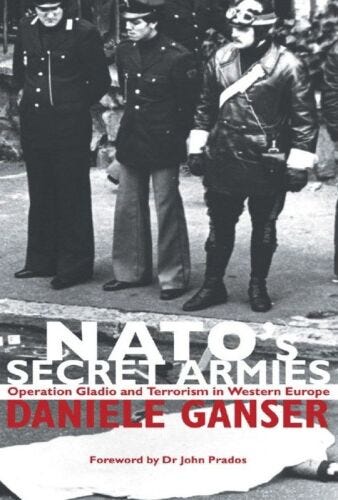
This academic text, Daniele Ganser’s NATO’s Secret Armies: Operation Gladio and terrorism in Western Europe, meticulously investigates the clandestine, anti-Communist “stay-behind” armies established by the CIA and MI6 across Western Europe after World War II, known in Italy as “Gladio.” The core purpose of these secret networks, coordinated by NATO’s Allied Clandestine Committee (ACC), was ostensibly to organize resistance in the event of a Soviet invasion; however, Ganser demonstrates that these groups tragically became involved in peacetime political interference and right-wing terrorism, with operations often aimed at discrediting left-wing political forces through violence, such as the massacres in Italy and the political coups in Greece and Turkey. Despite the shocking revelations and parliamentary investigations across Europe in 1990, the author highlights the persistent secrecy and lack of cooperation from the United States and Great Britain, making it difficult to fully assess the extent of the involvement of their intelligence agencies in the networks’ more sinister activities.
Extended Notes
See Also
🧬Biodigital Convergence

Make sure to save this page, I will add all of the additional information and resources I find to this page.
![FULL SPECTRUM DOMINANCE: Foundations of "Under-Standing" [F. William Engdahl]](https://substackcdn.com/image/fetch/$s_!I4qW!,w_140,h_140,c_fill,f_webp,q_auto:good,fl_progressive:steep,g_auto/https%3A%2F%2Fsubstack-post-media.s3.amazonaws.com%2Fpublic%2Fimages%2F001dafc4-7515-440d-8c2e-0593e1828975_1456x1048.png)


OPERATION GLADIO: Major Players & Conspirators (From The Babylon Matrix Notebook)
Operation Gladio stands not as a defensive measure against external threat, but as the calculated manifestation of the enduring conspiracy to impose centralized control through the engineering of chaos. It is the proof that the ultimate enemy is always internal, fabricated and deployed against the populace under the sacred banner of ‘security,’ merging fascist zealotry with the intelligence apparatus of the victors and the occult structures of the shadows. This deep dive excavates the raw truth, stripped of democratic pretense.
The existence of Operation Gladio was the structural revelation that the post-World War II peace was a facade, merely shifting the mechanisms of war from external conflict to internal control. Conceived by Allied powers, specifically Western intelligence agencies like the CIA and MI6, Gladio was established as a network of “stay-behind” paramilitary forces throughout Europe, designed ostensibly to launch insurgent attacks in the event of a successful Soviet invasion. However, the documentation reveals a far more insidious purpose: the use of terrorism, assassination, and political subversion to maintain a strict anti-communist hegemony.
Genesis of the Subversion: The Post-War Payout
Following the defeat of Nazi Germany, the ascending Soviet Union presented a geopolitical threat that Western intelligence leveraged to create a permanent, clandestine military structure. Operation Gladio (the name primarily used in Italy) became a vast network of paramilitary groups spanning multiple nations, including Switzerland, Germany, Greece, and Sweden.
The explicit goals included:
Guerrilla Infrastructure: Establishing networks that stockpiled weapons, trained with forces like the Green Berets, and prepared for guerrilla warfare against occupiers.
Anti-Communist Enforcement: The fundamental organizing principle was ensuring that countries remained free from communism, justifying the use of any means necessary, including terrorism and governmental overthrow.
Crucially, the operation was not publicly disclosed until 1990, revealing decades of state-sponsored domestic militarization.
Core Participants and the Unholy Alliance
The true danger of Gladio lay in its interlock with other powerful, shadowy organizations dedicated to a shared agenda of global control, often overlapping political, military, criminal, and religious spheres.
1. The Intelligence Nexus: CIA and MI6
Western intelligence, having just triumphed over the Axis, immediately applied its expertise to shape the new cold conflict:
CIA/OSS Involvement: The CIA, evolving out of the OSS (Office of Strategic Services), was instrumental in coordinating these networks. The OSS itself was involved in establishing Italy’s three secret services, staffing them with Italian Freemasons, cementing a link between espionage, politics, and criminality.
Recruitment of War Criminals: Both the USA and the Vatican were motivated to recruit dedicated anti-Communist forces, specifically utilizing defeated anti-Communists and fleeing war criminals seeking asylum. This meant the American intelligence community, including the OSS/CIA (through operations like Project Paperclip, which brought Nazi scientists to the U.S.), readily absorbed former Axis infrastructure. General Reinhard Gehlen, Hitler’s chief intelligence officer against the Soviet Union, struck a deal (Operation SUNRISE) with Allen Dulles and William Casey (OSS), bringing his entire apparatus into the service of the American superpower. Gehlen, a Knight of Malta who received SMOM’s highest award, was responsible for directing West Germany’s first secret service and is credited with starting the Cold War.
2. Propaganda Due (P2): The Fascist Occult Spearhead
P2, a secret Masonic lodge, was intrinsically connected to Operation Gladio, acting as a crucial vehicle for its goals within Italy.
Political Subversion and Terror: P2 was dedicated to using any means necessary, including terrorism, to keep Italy free from communism. Its widespread influence included politicians, businessmen, government ministers, army officers, and members of Italy’s secret service.
The Puppetmaster: Licio Gelli, the acknowledged mastermind of P2, was a lifelong fascist who had collaborated with Mussolini and the Nazis. Gelli utilized blackmail and infiltration to ensure prominent members joined the lodge. He waged warfare on leftists and was connected to major terrorist acts, notably the 1980 Bologna attack which resulted in 85 deaths. Gelli was also on the CIA payroll, spying on terrorists in Italy. The P2 organization employed the trappings and ceremonial ritual of magic and initiation to gather its powerful members, leveraging violence and murder as part of its clandestine operations.
3. The Holy See and Organized Crime
The sources detail a partnership that bypassed traditional ethics to achieve strategic domination, explicitly citing the “Unholy Alliance between the Vatican, the CIA and the Mafia” as central to Operation Gladio.
The Vatican’s Role: The Holy See worked to consolidate a secret alliance with Washington, motivated by the necessity of recruiting anti-Russian, anti-Communist forces, often sheltering former political and religious supporters whom it had blessed during the Nazi regime. The Vatican, through its banking connections (e.g., Roberto Calvi, known as “God’s banker,” who was found dead suspiciously in 1982 and was a P2 member), was deeply entangled with the P2 network, which was designed to impose fascism and wage terror.
The Mafia Connection: The Mafia, described as immensely religious and keen businessmen, collaborated with the Germans, the Vatican, and the USA simultaneously. Organized crime figures, such as August Del Grazio, a Lucky Luciano lieutenant, were used by OSS agent George White for drug testing and interrogation. The use of Luciano’s connections was even leveraged by Cardinal Spellman, who later needed a favor from the Mafia (implicitly related to the assassination of President Kennedy). The Mafia provided the necessary ruthlessness and clandestine logistics required for operations that required moving “trustworthy anti-Russian, anti-Communist battalions”.
The Strategy of Tension
Gladio’s operational consequence was the creation of a “strategy of tension,” where staged acts of violence and terror were blamed on political opponents, thereby justifying authoritarian responses and maintaining public fear and submission.
The structure of Gladio, therefore, was not merely a military reserve but a mechanism for perpetual conflict orchestrated from the highest levels of global power, linking:
Fascist Elites (Licio Gelli, former Nazi collaborators).
The Global Intelligence Apparatus (CIA, MI6, Mossad, KGB components controlled by Papal Knights).
The Vatican’s Authority (protecting anti-communist war criminals and engaging in secret alliances).
Organized Crime (providing muscle, cover, and logistical support).
This amalgamation ensured that the secret order could operate under a veil of national security, executing violence and undermining democratic structures with impunity. The purpose was not defense, but control—total and absolute control.
The Hidden Hand: Deconstructing Operation Gladio and the Unholy Alliance Behind Europe’s Secret Wars
The body of Roberto Calvi, chairman of Italy’s largest private bank, dangled from scaffolding beneath London’s Blackfriars Bridge. It was June 1982 [Williams, p. 16]. The press called him “God’s Banker” for his intimate ties to the Vatican. The official verdict was suicide, but the scene felt more like a medieval ritual, a message delivered in the shadow of a church run by Dominican friars. Was this the desperate act of a ruined man, or a public execution carried out by a power structure that operates beyond the reach of law?
Calvi’s death was just one piece of a much larger, blood-soaked puzzle. For decades, a secret war had raged across Europe, a period the Italians call the anni di piombo—the “Years of Lead.” It was a campaign of terror that claimed hundreds of lives, culminating in atrocities like the 1980 Bologna train station bombing, which ripped through a crowded waiting room, killing 85 people and wounding 200 more [Ganser, p. 11]. The public was told this was the work of radical leftists. The truth was far more sinister.
This investigation will deconstruct the hidden machinery of that secret war, exposing:
The creation of Operation Gladio, a NATO-coordinated network of clandestine armies across Western Europe, controlled and funded by the CIA and British MI6.
The unholy alliance forged between the CIA, the Vatican Bank, and the Sicilian Mafia—a corrupt triangle that used international heroin trafficking to finance a crusade against Communism.
The horrifying “strategy of tension,” a campaign of false-flag terrorism designed to murder innocent civilians, blame the violence on the political left, and manipulate the public into demanding a more authoritarian state.
The architect of this strategy was a shadow government that answered to no electorate. As right-wing terrorist and Gladio operative Vincenzo Vinciguerra later confessed with chilling clarity:
“You had to attack civilians, the people, women, children, innocent people… to force these people… to turn to the State to ask for greater security” [Ganser, p. 8].
1. The Spark: Forging a Secret Army from the Ashes of World War II
The ink was barely dry on the armistice that ended World War II when a new, clandestine conflict began. For the architects of American foreign intelligence, the peace was merely an intermission. A paradigm shift was underway in the corridors of the Office of Strategic Services (OSS), the precursor to the CIA. The primary enemy was no longer the defeated Third Reich; it was the Soviet Union, America’s wartime ally. In this new shadow war, yesterday’s fascists would become today’s most valuable assets.
The Enemy of My Enemy
As early as 1942, Allen Dulles, the OSS chief in Switzerland, concluded that America was “fighting the wrong enemy” [Williams, p. 23]. He believed a strong, rehabilitated Germany was a necessary “bulwark against Bolshevism” [Williams, p. 24]. Acting on this conviction, Dulles began recruiting high-ranking Nazis who could be repurposed for the coming struggle.
His prize asset was General Reinhard Gehlen, Hitler’s intelligence chief for the Eastern Front. With the Third Reich crumbling, Gehlen had already devised a plan to form clandestine guerrilla squads composed of “Hitler youth and die-hard fascist fanatics” to serve as “stay-behind units” in a post-war Europe [Williams, p. 25]. He called them “werewolves”— seemingly ordinary citizens by day who would become anti-Communist killers by night, supplied by a network of buried depots containing weapons, radios, and explosives [Williams, p. 26]. Dulles embraced the plan, and the Gehlen Organization became the prototype for a continent-wide secret army.
Italy: The First Domino
Italy was the laboratory for this new form of political warfare. The Italian Communist Party (PCI) was the largest in Western Europe, and Washington was determined to prevent it from ever gaining power through democratic means [Williams, p. 43-44]. The OSS, and later the CIA, found a willing partner in the remnants of Mussolini’s regime.
CIA agent James Angleton, who would become the agency’s legendary chief of counter-intelligence, personally rescued fascist war criminal Prince Valerio Borghese. Known as the “Black Prince,” Borghese had commanded a brutal anti-partisan unit that murdered hundreds of Italian communists under Nazi authority. Angleton dressed Borghese in an American uniform and spirited him away from an Italian firing squad [Williams, p. 27]. Borghese and his 10,267 loyal fascist fighters became the core of Italy’s first Gladio units, forming a shadow government that could manipulate Italian politics for decades to come [Williams, p. 28].
Timeline: The Deep State Takes Root
1943: The OSS, with assistance from Monsignor Giovanni Montini (the future Pope Paul VI), contacts Sicilian Mafia boss “Don Calo” Vizzini and the exiled Lucky Luciano to aid the Allied invasion of Sicily (Operation Husky) [Williams, p. 37].
1947: The OSS is officially reborn as the Central Intelligence Agency. Its first top-secret report, NSC 1/1, identifies Italy as the “key point” in the struggle against Communism, warning that a leftist victory would undermine America’s entire position in the Mediterranean [Williams, p. 43-44].
1948: The CIA executes its first major covert operation, funneling $65 million in “black money” through the Vatican Bank to ensure the defeat of the Italian left in the national elections [Williams, p. 46].
1949: The North Atlantic Treaty Organization (NATO) is founded. While publicly a defensive alliance against the Soviets, it secretly provides the military framework for coordinating the stay-behind armies across Western Europe [Ganser, p. 2].
1952: The command structure for the secret armies is formalized under NATO’s Clandestine Planning Committee (CPC). Dominated by the US, the CPC coordinates the national stay-behind networks from a top-secret wing of NATO headquarters [Ganser, p. 43].
This shadow army, operating beyond the laws of any nation, needed a river of untraceable cash to survive. Forging that pipeline would require an alliance even darker than the one made with defeated Nazis—a pact with organized crime and the Holy See itself.
2. The Unholy Trinity: How Heroin, Holy Water, and a Hidden Hand Funded a Secret War
Every secret war has a secret economy. For Operation Gladio, the engine was a triangular power structure that combined the CIA’s strategic directive, the Mafia’s criminal infrastructure, and the Vatican’s institutional cover. This was the dark trinity that powered the conflict—a feedback loop of heroin, holy water, and hidden directives that laundered dirty money through the world’s most sacred institutions to fund a global crusade against Communism.
The Helliwell Plan: Ghetto Gold for Black Ops
The architect of this financial machinery was Colonel Paul E. Helliwell, the OSS Chief of Special Intelligence in China. Observing how Nationalist Chinese general Chiang Kai-shek funded his army with opium, Helliwell had a “brainstorm”: the new American intelligence agency could create a self-funding mechanism for its covert operations by supplying heroin to the black communities in America’s ghettos [Williams, p. 31].
The idea was embraced by the OSS inner circle—the “Oh So Social” club of wealthy East Coast elites like Allen Dulles, James Angleton, and William “Wild Bill” Donovan. President Truman had set aside no official funds for covert postwar operations, and Helliwell’s plan offered a steady stream of untraceable cash to pay for foreign agents, politicians, and assassins without any congressional oversight [Williams, p. 32-33].
The Mafia Connection: A Devil’s Bargain
To operationalize this plan, the agency required a partner who controlled global shipping—a criminal network that could move contraband across oceans with impunity. This strategic need led US intelligence directly to the one man who could guarantee it: Charles “Lucky” Luciano. In a secret deal, US officials pressured New York Governor Thomas E. Dewey to commute the imprisoned mob boss’s sentence. In exchange for his freedom and deportation to Italy, Luciano gave the Mafia’s full cooperation, securing control of Italian and American ports—the essential prerequisite for an international heroin pipeline [Williams, p. 38-39].
The mechanics were simple and brutal. Pure heroin was sourced from Schiaparelli, a respected Italian pharmaceutical company. The Sicilian mob packaged it in wax oranges, cans of olive oil, and wheels of cheese, then shipped it to Cuba for processing [Williams, p. 41]. From there, it was smuggled into the United States and distributed through the jazz clubs of Harlem, creating an epidemic of addiction that generated millions in “ghetto gold” for the CIA’s black budget [Williams, p. 48].
The Vatican’s Role: Money Laundering and Moral Cover
This river of black money needed a laundering mechanism beyond the reach of auditors, a role the Vatican was uniquely positioned to fill. Pope Pius XII harbored an intense fear of “godless communism” and viewed an alliance with American intelligence as a holy crusade. He had worked with the OSS during the war and personally decorated OSS chief “Wild Bill” Donovan with the Grand Cross of the Order of St. Sylvester—the oldest and most prestigious of papal knighthoods—for his work implementing Gladio [Williams, p. 46-47].
Under Pius XII, the Institute for the Works of Religion (IOR), better known as the Vatican Bank, became the primary laundry for the CIA’s drug money. Suitcases full of cash, delivered by Luciano’s syndicate, were washed through the IOR’s accounts and funneled to Italy’s Christian Democratic Party to fund its political war against the Communists [Williams, p. 46]. This unholy alliance allowed the profits from organized crime to be blessed by holy water before being spent on the secret state’s dirty wars.
This deadly machine was used to power the “strategy of tension,” a campaign of terror that turned Western Europe into a battlefield. The public was fed a simple story, but the reality, as later revealed by investigators and insiders, was a horrifying deception.
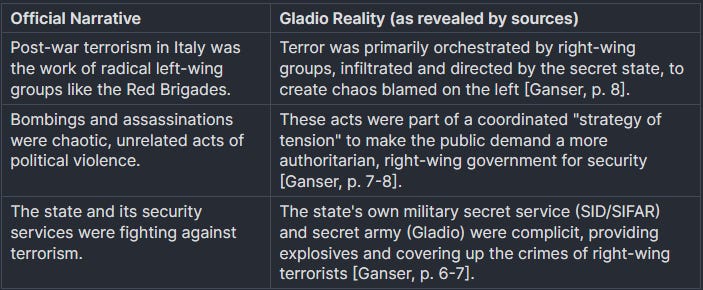
The unholy trinity operated with brutal efficiency for decades. Its exposure only began when its complex financial architecture started to crumble, pulling back the curtain on the true face of the deep state.
3. Modern Echoes: The Unraveling and the Legacy of the Deep State
The fall of the Berlin Wall in 1989 should have rendered Gladio obsolete. Instead, the end of the Cold War triggered a series of shocking revelations that dragged the secret network into the light. The story of its exposure reveals a “secret government” operating beyond the control of democratic institutions, a legacy that continues to resonate in contemporary debates about power, intelligence, and the fragility of democracy.
The unraveling began in 1981, when Italian police discovered the membership list of a Masonic lodge known as Propaganda Due (P2). The list exposed a shadow government connecting the highest levels of Italy’s military, political, and financial elite—including secret service chiefs, cabinet ministers, and top bankers [Williams, p. 109-110]. This was the command structure of the deep state.
The final confirmation came in August 1990, when Italian Prime Minister Giulio Andreotti, a seven-time premier, publicly admitted the existence of a secret army in Italy, code-named Gladio. He confirmed it was part of a larger NATO-coordinated network of stay-behind armies operating across Western Europe [Ganser, p. 1-2]. The bombshell admission sent shockwaves across the continent, leading the European Parliament to issue a sharp condemnation. It vigorously protested the “clandestine creation of manipulative and operational networks” run by NATO and US military personnel, demanding a full investigation [Ganser, p. 35-36].
The playbook, some researchers contend, did not die with the Cold War; it simply “transmogrified” [Williams, p. 266]. Sources like Paul Williams argue that the model evolved into “Gladio B,” a new phase of the operation focused on manipulating radical Islamic groups in Central Asia. This evolution is allegedly tied to the rise of the Fethullah Gülen movement, which, with purported CIA support, established over 140 charter schools across the United States, creating a vast network of influence funded by American taxpayers [Williams, p. 273-278].
The history of Gladio leaves us with uncomfortable questions that echo into our present moment:
If a secret, internationally coordinated deep state could operate for over 40 years without public knowledge, what ensures similar networks do not exist today?
How has the “strategy of tension” playbook—using fear and false-flag violence to manipulate public opinion—been adapted for the age of social media and information warfare?
What does the alliance of state intelligence, criminal enterprise, and financial power revealed by Gladio tell us about the true nature of power in modern democracies?
4. Conclusion: The Ghosts of Gladio
The story of Operation Gladio is a chilling reminder that the official narrative of history is often a carefully constructed fiction. It reveals a hidden layer of power operating above the law, accountable to no one, and willing to sacrifice its own citizens to achieve its geopolitical aims. The core revelations are as stark as they are disturbing:
A Secret State Was Real: NATO, the CIA, and MI6 built and ran a network of clandestine “stay-behind” armies across Western Europe.
It Was an Unholy Alliance: This network was powered by a corrupt pact between US intelligence, the Vatican Bank, and the international heroin trade run by the Mafia.
It Used Terror as a Political Tool: Through a “strategy of tension,” the network used false-flag bombings and assassinations to terrorize its own citizens and blame the political left.
It Operated Above the Law: For decades, this deep state subverted democratic processes, overthrew governments, and manipulated elections with total impunity.
Its Legacy Endures: The operational model of Gladio survived the Cold War, adapting its tactics for a new era of global conflict.


