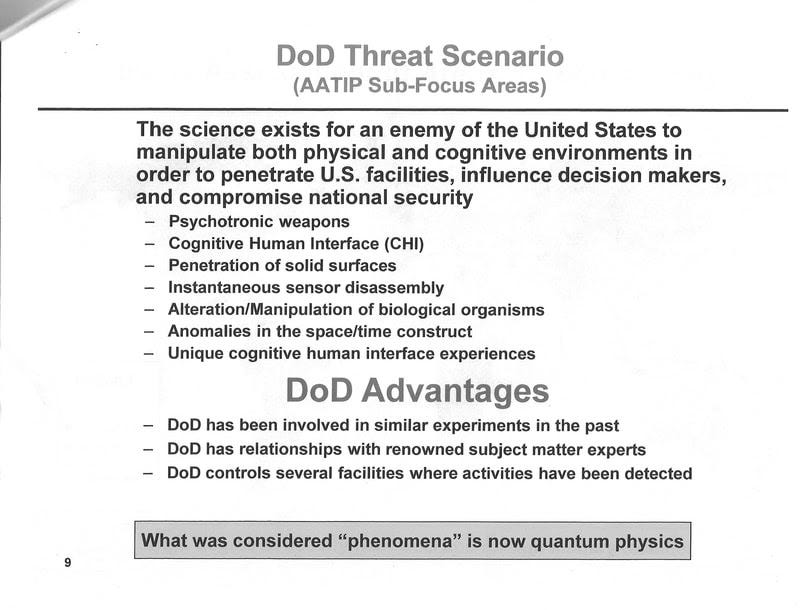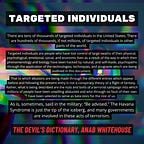

This academic study investigates the phenomenology of group stalking, often referred to as “gang-stalking,” by analyzing subjective accounts from individuals who believe they are being targeted. The researchers used content analysis to identify twenty-four core phenomena, ranging from physical surveillance and electronic hacking to more extreme beliefs like mind control and body implants. The findings highlight the severe psychological distress and social isolation experienced by these individuals, as well as a concerning potential for violence driven by feelings of persecution. By comparing these narratives to previous data, the authors establish a foundational framework for understanding a poorly researched but widespread experience. Ultimately, the source emphasizes the devastating impact this phenomenon has on the well-being and functioning of those who report it.
See Urban’s Notes on Organized Stalking: https://docs.urbanodyssey.xyz/mahanism/scalar-torture.html
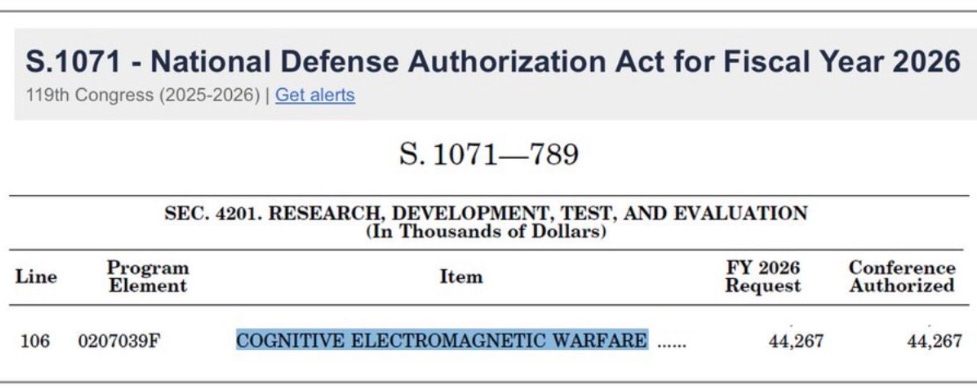
“[..These Weapons..] They’re Designed to make the target feel like they’re crazy, like they’re imagining things”
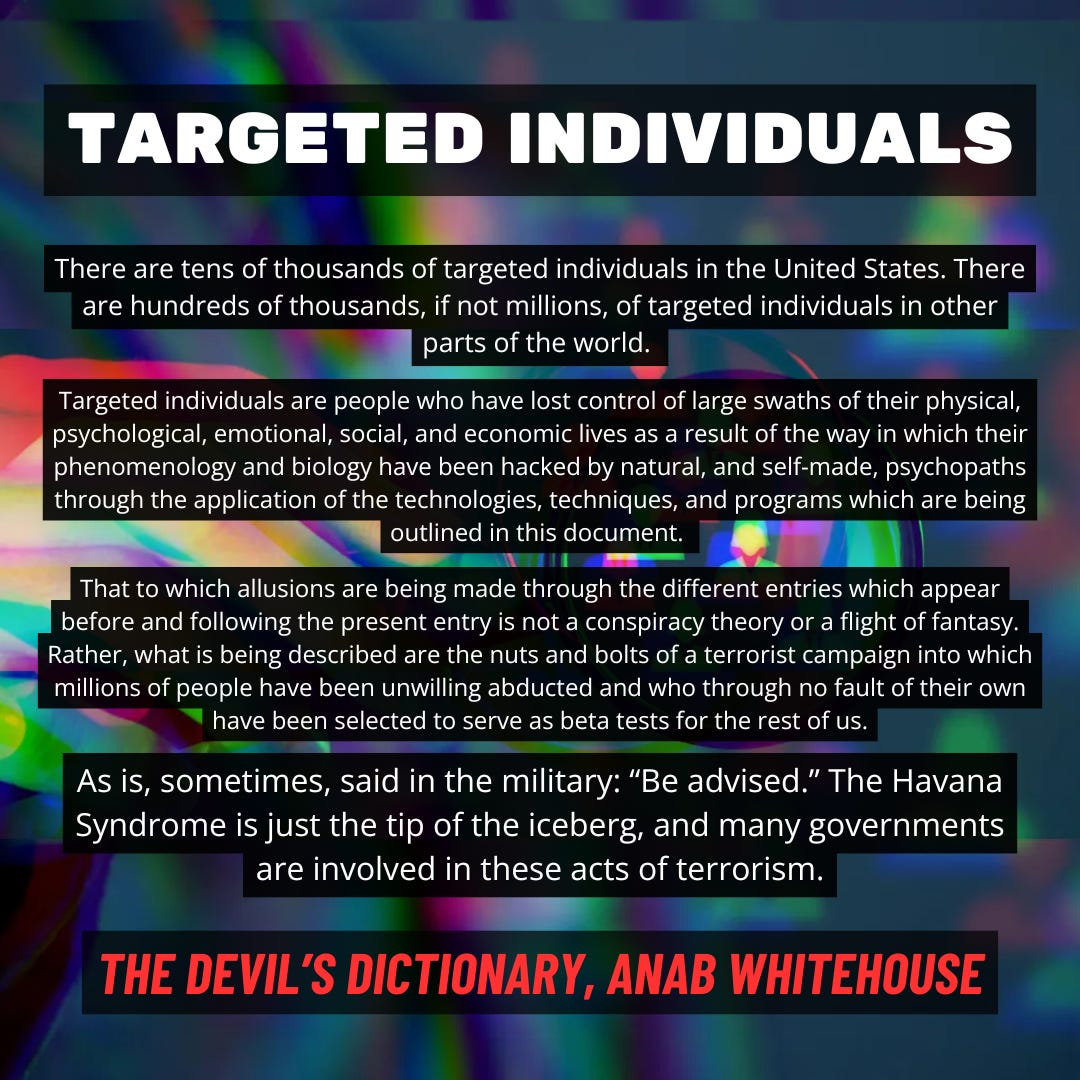
![Deborah Tavares on NASA's "Future Strategic Issues/Future Warfare [Circa 2025]" Document](https://substackcdn.com/image/fetch/$s_!C7Gy!,w_280,h_280,c_fill,f_webp,q_auto:good,fl_progressive:steep,g_auto/https%3A%2F%2Fsubstack-post-media.s3.amazonaws.com%2Fpublic%2Fimages%2Fff50ad7d-2fde-488c-ba7b-3ab85e055d15_1456x1048.jpeg)
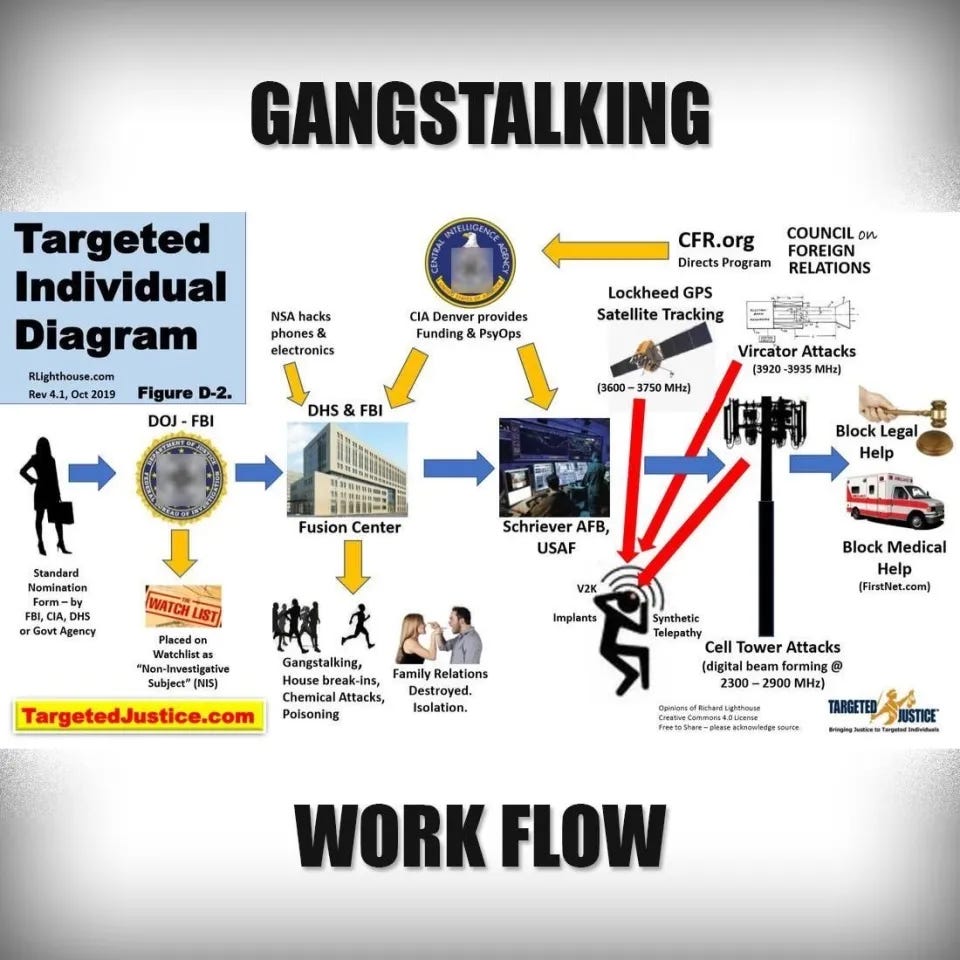
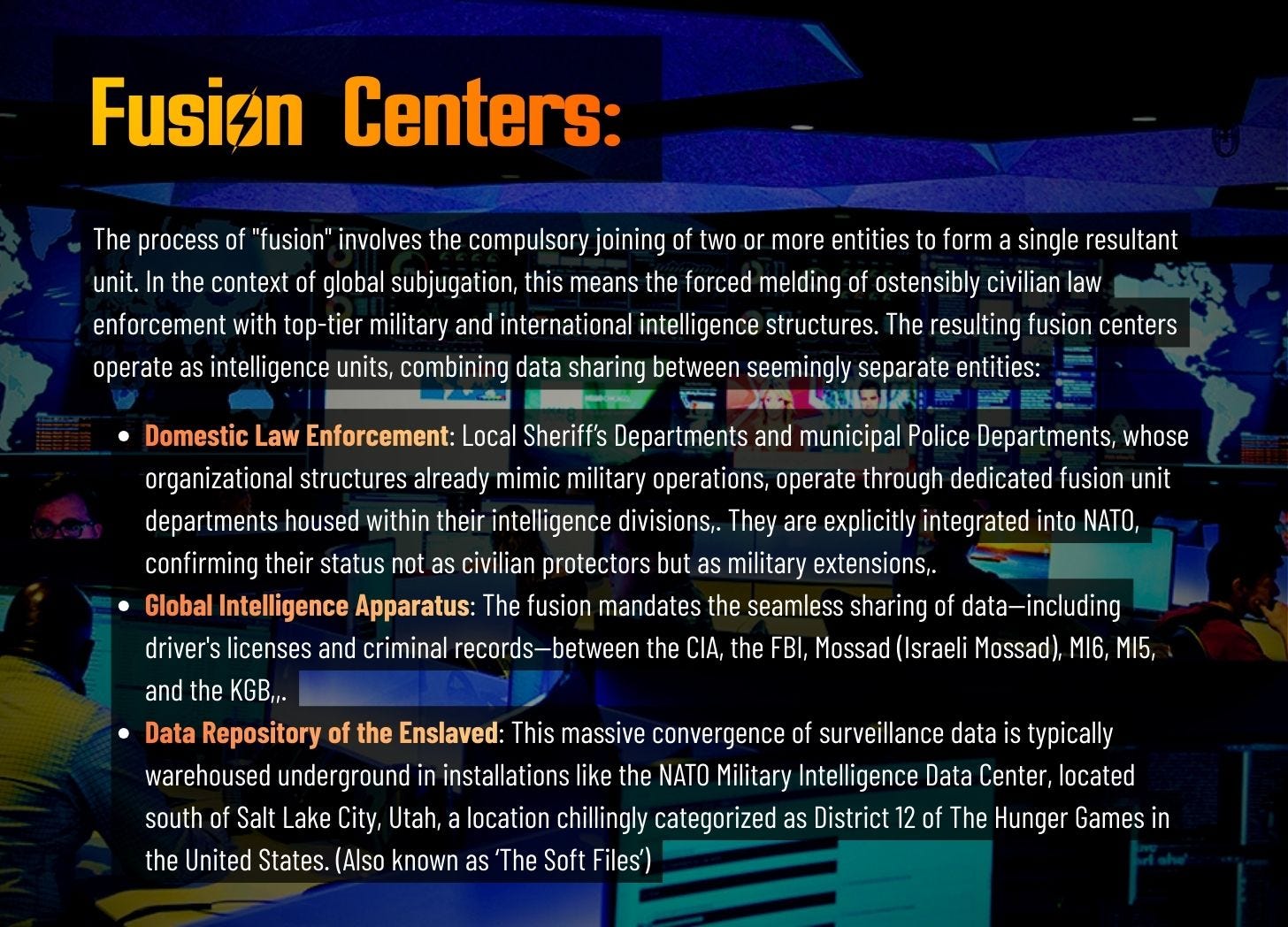
The Phenomenology of Group Stalking (from 2020)

This research paper investigates the phenomenology of gang-stalking, a subjective experience where individuals believe they are being targeted by a coordinated group of multiple persecutors. By analyzing fifty first-hand accounts from the internet, the authors identify twenty-four core phenomena and eleven psychological sequelae, ranging from beliefs in mind control and electronic surveillance to severe emotional distress and social isolation. The study emphasizes that while these experiences often involve complex conspiracy theories and perceptions of a global “establishment cover-up,” they result in high rates of psychiatric morbidity and significant functional impairment. Ultimately, the text serves to establish a foundational framework for a poorly understood phenomenon, highlighting a critical need for further scientific exploration and risk assessment due to the potential for violent responses from those who feel victimized.


Cognitive Liberty: Mind Control
One of the more recently made documentaries including survivor testimony and interviews with Targeted Individuals, great film:
The Hidden Hand of Gang-Stalking: What a Landmark Study Reveals About a Global Phenomenon
It starts with a sound. The perfectly timed slam of a neighbor’s door the second you sit down to relax. Then another—a cough, a laugh, a toilet flushing from the apartment next door, a symphony of harassment mocking your every move. You go outside, and cars tailgate you, the drivers speaking openly into walkie-talkies. In the supermarket, strangers use grocery carts to block your path, invading your personal space with chilling intent. This isn’t the plot of a Cold War thriller; it’s the subjective reality reported by a startling number of people around the globe—an experience that science is only now beginning to systematically investigate.
What if the feeling of being watched wasn’t just in your head? What if it was a coordinated, 24/7 campaign of psychological warfare?
This experience, known as ‘gang-stalking’, is not a fringe belief confined to a handful of internet forums. Epidemiological data suggest it could affect as many as 0.66% of adult women at some point in their lives, and a simple Google search for the term yields over 7.5 million results. For decades, this phenomenon has existed in a gray area between conspiracy theory and unexamined trauma. But a groundbreaking 2020 study has finally dragged it into the light. By analyzing dozens of firsthand accounts, researchers have revealed the chillingly consistent patterns of this phenomenon, the devastating psychological fallout for those who experience it, and its disturbing connection to real-world violence. To understand this modern-day paranoia, we must first look at how the phenomenon was defined and brought out of the shadows.
Charting the Conspiracy - A Modern History of Gang-Stalking
To study a phenomenon, you must first define it. This is a strategic imperative, especially for a concept as complex and socially challenging as gang-stalking. While individual stalking became a recognized crime and a subject of academic inquiry in the late 1980s, the idea of being targeted by a coordinated group has been largely ignored by researchers. It represents a different kind of terror—one that suggests a conspiracy so vast and insidious that it defies easy explanation or intervention.
The Spark: From Back Alleys to Big Data
While the legal concept of stalking emerged in the late 1980s, the term ‘gang-stalking’ gained currency after the turn of the millennium, spreading rapidly across the internet. Despite its online prevalence, there remains a significant “dearth of research” on the topic (Sheridan et al., 2020, p. 2). This academic silence stands in stark contrast to the numbers. One study of self-defined stalking victims found that 12.3% reported being targeted by a group. A separate US Department of Justice study, which used a tight legal definition of stalking that required victims to experience fear, found that 6.8% reported being targeted by three or more people and were unable to identify a single offender or an offender who was singularly responsible. Strikingly, when the DoJ removed the fear component from its definition, that figure jumped to 12.5%—showing remarkable consistency with the self-reported data (Sheridan et al., 2020, p. 2).
This is where the landmark study by Lorraine Sheridan, David V. James, and Jayden Roth (2020) comes in. Rather than imposing existing frameworks from individual stalking cases, the researchers took a novel approach. They analyzed 50 detailed, self-published online accounts from self-described ‘Targeted Individuals’ (TIs). Their goal was to allow the core components of the gang-stalking experience to “emerge de novo,” creating a classification system based entirely on the unfiltered testimony of those living it (Sheridan et al., 2020, p. 2-3). While this approach provides an unparalleled view, the researchers acknowledge a potential paradox: the very online forums that document these experiences may also act as “closed ideology echo chambers,” shaping and reinforcing the beliefs they catalogue.
So what exactly did this unfiltered look into the lives of ‘Targeted Individuals’ reveal?
The Anatomy of Persecution - Unpacking the Tactics

The study’s most significant contribution is its systematic anatomy of the gang-stalking experience. By analyzing the 50 narratives, the researchers identified 24 distinct categories of reported persecution. This framework moves the phenomenon from a collection of chaotic, disparate anecdotes into a structured, shared narrative with a disturbingly consistent playbook. For the first time, we can see the architecture of this perceived conspiracy from the inside.
The Gang-Stalker’s Playbook: Surveillance, Sabotage, and Mind Control
![SHADOWGATE: Psychological Operations, Deep State "Contractors" & "ShadowNet™" [Movie by Millie Weaver]](https://substackcdn.com/image/fetch/$s_!YlRS!,w_140,h_140,c_fill,f_webp,q_auto:good,fl_progressive:steep,g_auto/https%3A%2F%2Fsubstack-post-media.s3.amazonaws.com%2Fpublic%2Fimages%2Fbe2763f3-26d2-449c-b0be-8c389a3e5361_1456x1048.png)

Among the 24 phenomena, a core set of tactics appeared with overwhelming frequency, forming the backbone of the gang-stalking experience. The top five reported experiences were:
Physical Surveillance/Being Followed (94%): This is the cornerstone of the experience. Victims report being followed constantly, on foot and by car. As one individual described, “As I drive down the road, multiple cars will start up and follow me” (Sheridan et al., 2020, p. 5).
Victim of a Conspiracy (80%): The stalking is not seen as random but as part of a massive, organized effort. Victims believe it involves multiple agencies, from “local police and other local agencies” to the FBI, CIA, and even international intelligence services (Sheridan et al., 2020, p. 5).
Physical Interference, Intimidation, and Harassment (66%): This involves overt acts designed to intimidate and disrupt. One account details how “strangers blocking my way using grocery carts, invading my personal space, cutting me off while I was walking or driving” (Sheridan et al., 2020, p. 5).
Establishment Cover-up (64%): A crucial element is the belief that the system is not just failing to help, but is actively complicit. Victims report that “The authorities finance, protect and organise the stalkers, and the media blank any coverage of it” (Sheridan et al., 2020, p. 6).
Electronic Surveillance (60%): The sense of being watched extends into the digital and physical home. Victims believe their residences are “electronically bugged” or that they are under “audio and visual surveillance” 24/7 (Sheridan et al., 2020, p. 6).
This feeling of systemic betrayal—that the very institutions meant to protect citizens are part of the conspiracy—creates a profound sense of helplessness. Police (Category 15) and medical practitioners (Category 23) are often seen as key conspirators, leading to a clash between the victim’s reality and the official response.
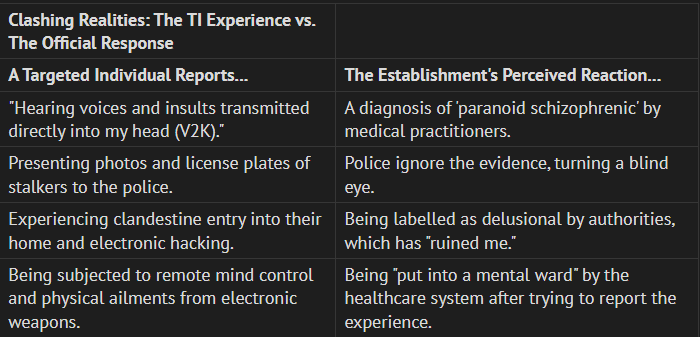
These reported tactics and systemic dismissals have profound, life-altering consequences, which the study also systematically documented for the first time.
The Fallout - Modern Echoes and Dangerous Ends

The impact of perceived gang-stalking extends far beyond fear and paranoia. It fundamentally reshapes a person’s life, health, finances, and psyche. The study reveals not only the devastating personal costs but also the troubling societal implications that arise when victims feel they have no other choice but to fight back against an invisible, all-powerful enemy.
![[Project Orion] The Engineering of Extremism: A Terrifying Programming Model](https://substackcdn.com/image/fetch/$s_!KhGy!,w_140,h_140,c_fill,f_webp,q_auto:good,fl_progressive:steep,g_auto/https%3A%2F%2Fsubstack-video.s3.amazonaws.com%2Fvideo_upload%2Fpost%2F172524760%2F0b4610b6-eab9-4530-9949-2c6f64475e0a%2Ftranscoded-1756783394.png)
The government encouraged the manufacture and importation of military firearms for the criminals to use. This is intended to foster a feeling of insecurity, which would lead the American people to voluntarily disarm themselves by passing laws against firearms.
Using drugs and hypnosis on mental patients in a process called Orion, the CIA inculcated the desire in these people to open fire on schoolyards and thus inflame the anti-gun lobby. This plan is well underway, and so far is working perfectly. The middle class is begging the government to do away with the 2nd amendment.
~ (William Cooper, Behold A Pale Horse, page 225) Published in 1991
From Isolation to Escalation
The emotional and psychological toll is immense. The study’s analysis of victim-reported consequences (sequelae) paints a grim picture:
Psychological Damage (42%): Victims report severe depression, anxiety, and a loss of will to live. One individual stated, “I hate my life with such a passion that I am yet again depressed and sometimes the idea of death sounds inviting” (Sheridan et al., 2020, p. 10).
Isolation and Loneliness (34%): The belief that friends, family, and neighbors could be part of the conspiracy leads to profound social withdrawal. “The biggest and most hurtful thing with gang stalking, is loneliness,” one person wrote. Another added, “I choose to isolate and I trust virtually nobody” (Sheridan et al., 2020, p. 10).
Financial Losses (24%): The constant stress, disruption, and efforts to escape take a heavy financial toll, with victims reporting that the perpetrators “are there to help you reach financial ruin!” (Sheridan et al., 2020, p. 11).
This spiral of distress, however, does not always end in quiet despair. A significant portion of victims report a “Determination to fight back” (32%), and more alarmingly, the “Development of hatred/violent tendencies” (16%). The narratives are filled with chilling statements of intent: “I may have to kill them before they kill me,” and “I think the only way forward is to get some weapons and act” (Sheridan et al., 2020, p. 11).
This ideation is not merely theoretical. The study connects these experiences to real-world tragedies, citing Sarteschi’s (2018) research on four self-described “targeted individuals” who, collectively, killed 28 people. The researchers note that many reported experiences—such as mind control, implanted devices, and V2K transmissions—are examples of “threat-control-override symptoms,” a known psychiatric risk factor for violence (Sheridan et al., 2020, p. 15). The feeling of being physically invaded and controlled by an outside force can, in some cases, justify a pre-emptive, violent response in the mind of the sufferer.
This leaves us with several urgent, unanswered questions:
In an era of deep political distrust and ubiquitous digital surveillance, are we creating a fertile ground for such persecution narratives to take root and spread?
How can law enforcement and mental health systems effectively intervene when faced with claims that name them as part of the conspiracy?
What responsibility do internet platforms have in moderating communities that may act as “closed ideology echo chambers,” potentially reinforcing beliefs that can lead to violence?
Conclusion & Call to Action
The 2020 Sheridan, James, and Roth study does not validate the objective reality of gang-stalking. Instead, it does something arguably more important: it maps the contours of a subjective hell. It reveals the ‘Targeted Individual’ as a uniquely modern figure, standing at a dangerous intersection of pervasive digital surveillance, profound institutional distrust, and genuine mental distress. In a world where the state watches, corporations track, and online echo chambers reinforce our deepest fears, the study provides a vital framework for understanding a phenomenon that feels, to thousands of people, terrifyingly real.
Here are the key takeaways:
A Shared, Structured Nightmare: The experience of gang-stalking is not random; it’s a phenomenon with a consistent playbook of 24 reported tactics, ranging from psychological operations to perceived physical and electronic attacks.
The System as Accomplice: A central tenet of the experience is the belief that official institutions—from the police to doctors—are complicit in the harassment, creating profound isolation and invalidation.
A Pathway to Violence: The severe psychological distress, combined with a feeling of having no recourse, can foster a desire to “fight back,” which in rare and extreme cases has been linked to mass violence.
For more unfiltered dives that uncover the hidden layers of our world, check out my other posts along with the resources below.
Other Important Resources, Videos & Links
Some of these come from the Targeted Justice website, some are my own findings.
Click here to view the presentation by Targeted Justice
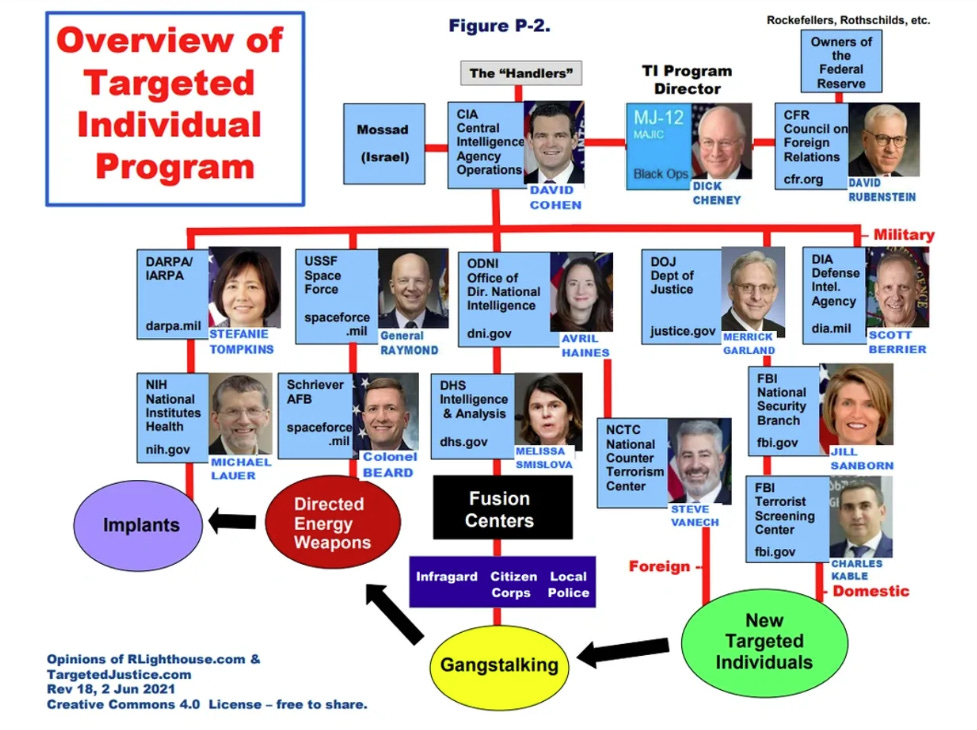

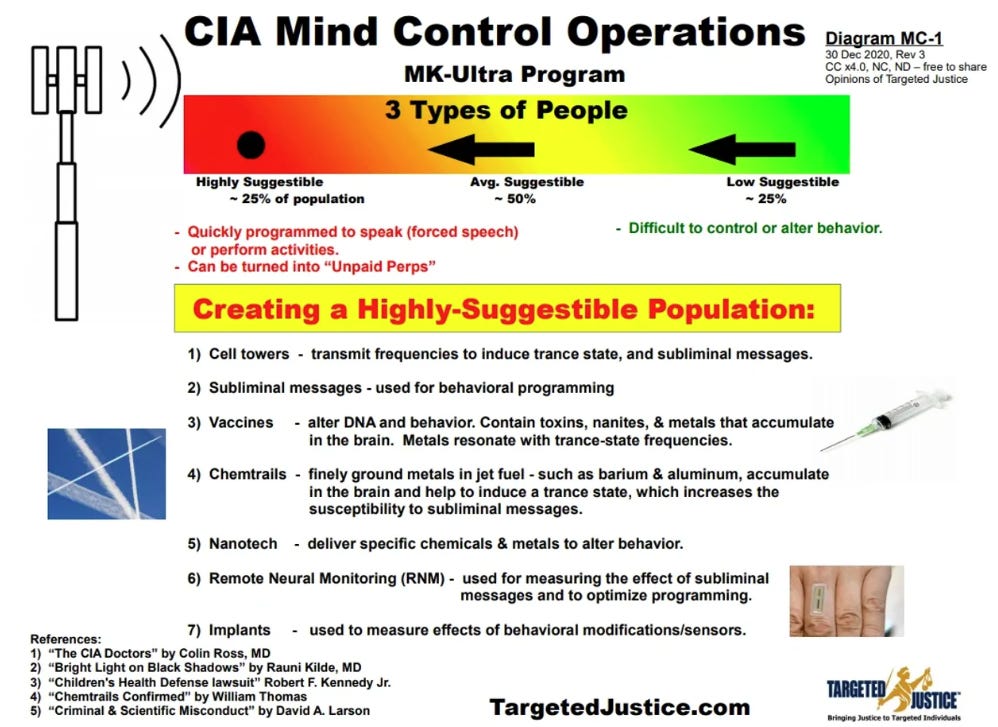
DoorDash, but for Stalkers?
Now Deleted 2016 Audit Report (Recovered with Web Archive)