


Welcome to another episode of Cause Before Symptom with your guest host, Urban. James is taking the weekend off, so Urban is holding down the show to guide you through a fascinating deep dive into language, cybernetics, and technology.
In this livestream, we explore the hidden architecture of reality, starting with the evolution of the integrated circuit and Japan’s tech utopia in the 1980s. We also examine the resilience of Bitcoin and David Chaum’s revolutionary eCash system from 1996.
The core of tonight’s discussion revolves around David Wynn Miller’s quantum grammar and syntax system. Discover how adverbs modifying verbs create a double motion that equates to a linguistic vacuum. We break down how language acts as a literal code that shapes our perception of reality, forming reality tunnels and acting as a type of spell or mind control.
Refer your friends to the Urban Odyssey Substack and earn free referral rewards!
See the Leaderboard for more details
Key topics covered in this video:
Adjectives & Adverbs as Modification & Change
Modification » Change » Motion » Action » Verb-Syntax
The Fourfold Generative Principle found in the atomic structure, the nuclear family, and photosynthesis.
How the human brain relies on internal reality strategies to distinguish truth from hallucination.
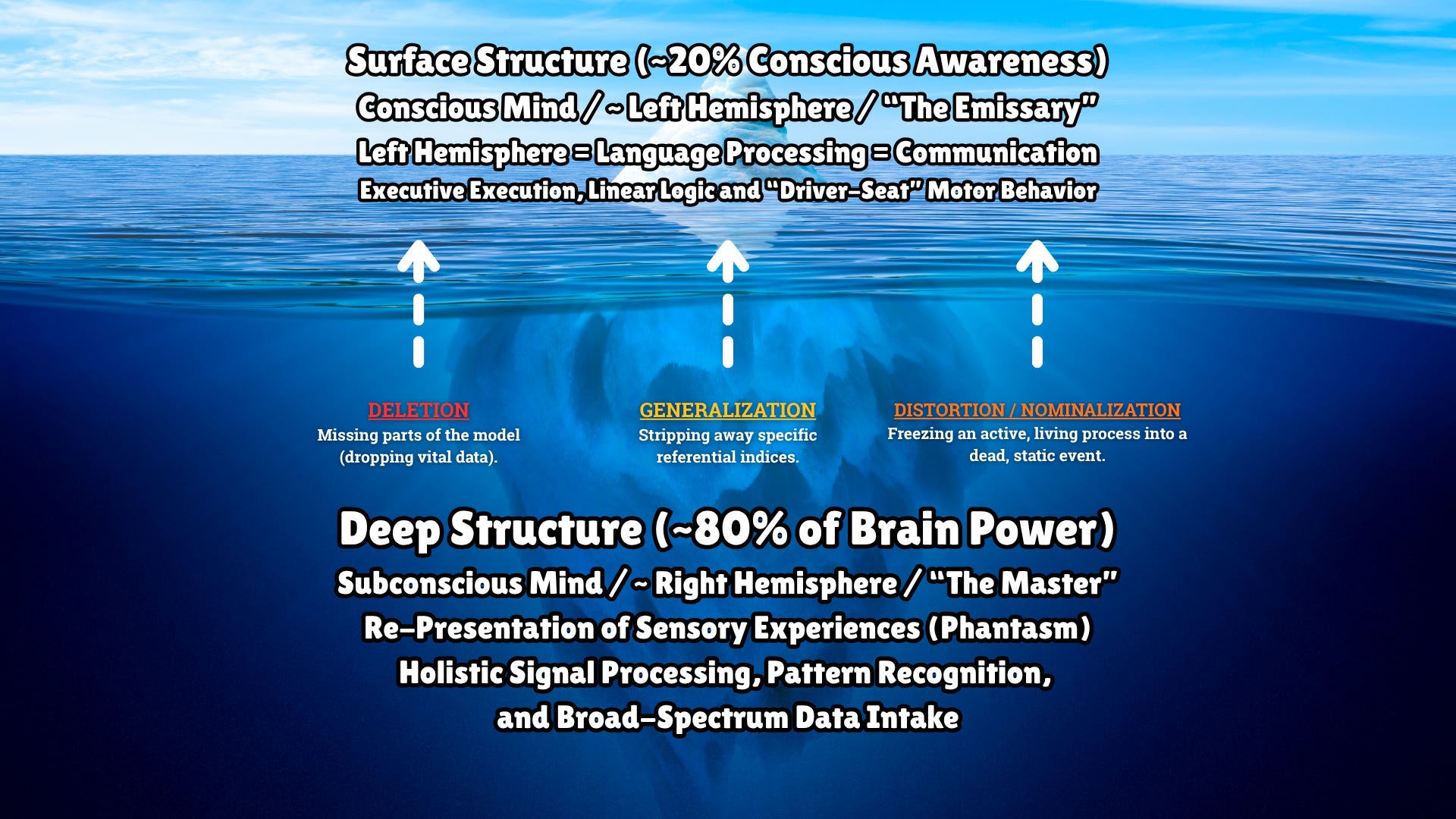
Deep Structure vs. Surface Structure
Recommended Viewing for Background on this Topic
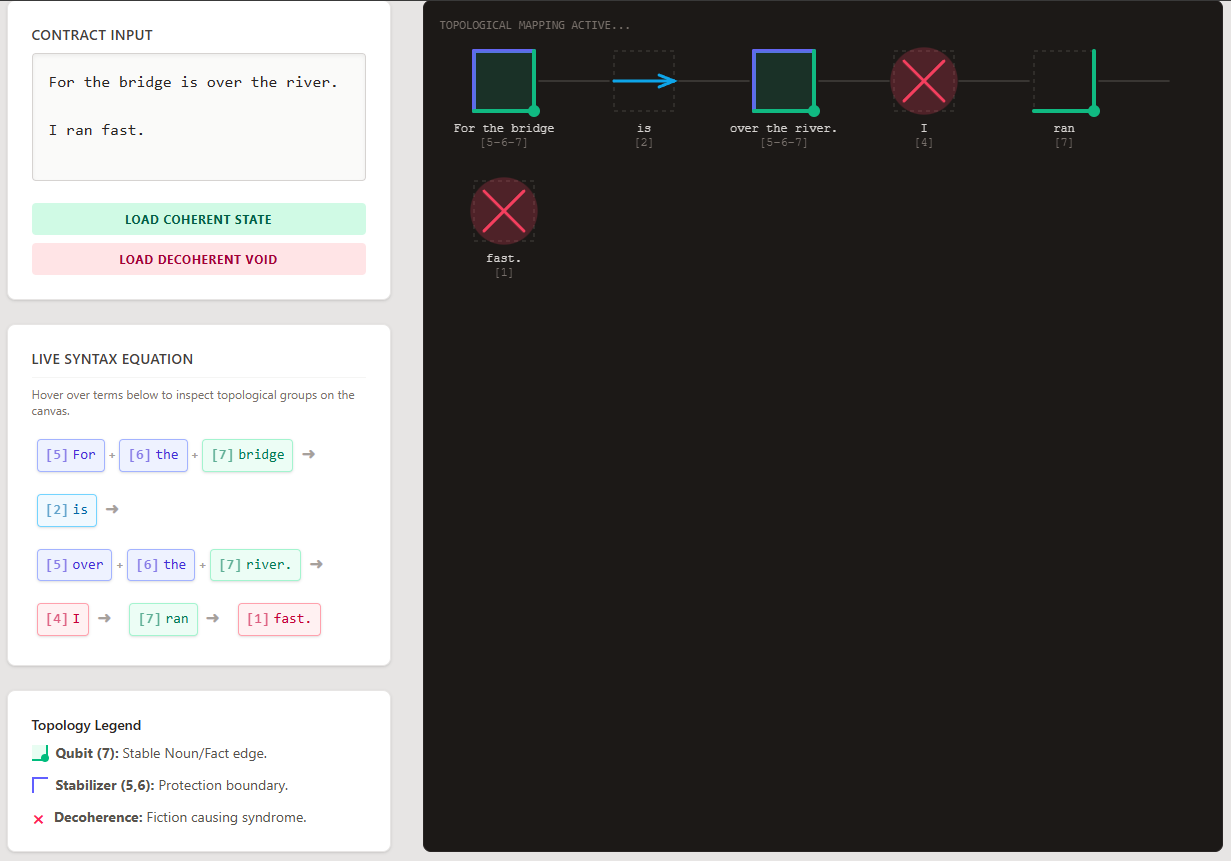
Quantum Grammar Syntax Simulation
This simulation is designed to visualize sentence structure stability in the same context as Quantum Computing /w Qubits.
The simulation is available to everybody publicly here: https://quantum-grammar-simulation.vercel.app/
What is “Now-Time” ?
Silence is the location in which your thoughts occur (like a stage). Thus, if you “pay attention” you give that person access to your “stage of silence” to place imagery onto, this is communication.
Literate vs. Illiterate vs. Animal Comparison
The Literate Human (Reads & Writes):
The literate human is the ultimate victim of “time-binding.” Through the technology of writing, they abstract themselves completely out of the physical environment, retreating into the left-hemisphere’s isolated, off-line, dead representation of the world. They are capable of locking themselves in “Fictional-Language-Format” (F.L.F.) contracts. Because they read, they spatialize time, turning the fluid “now” into a rigid geometric line of past, present, and future. They are the most alienated from “Now-Time,” substituting physical reality for a hallucinated “matrix” of written laws and historical neuroses.
The Illiterate Human (Orality Only):
The human who can speak but cannot read or write is closer to the raw acoustic environment, yet still deeply infected. As McKenna notes, acoustically processed language is the “willing servant of abstraction.” In the ancient, pre-literate past, humans operated with a “bicameral mind,” they were “noble automatons” who did not possess a subjective “analog ‘I’” or a spatialized inner mind-space. Without the visual anchor of writing, their brains processed the commands of the right hemisphere as literal, auditory hallucinations (the voices of gods) dictating their actions. They lacked the literate man’s complex anxiety of the future, but they were entirely thralls to the linguistic “command phrases” booming within their own skulls.
The Animal (Pre-Linguistic):
The animal cannot read, write, or speak syntactic language. Therefore, it is the only entity that truly exists. As John Lilly and Robert Anton Wilson map out, “No animal... can experience... being in two places at once.” They follow the absolute biological imperative to “be here now.”
Because the animal is unpoisoned by the Adverb-Verb-Pronoun matrix, it does not modify facts into fictions. It does not delete data to form sentences. The lizard freezing on the screen to detect the moth, or the wolf moving in a straight line to the kill, operates in a “pointlike present.” They are fully integrated with the morphic field and the quantum indeterminacy of nature. The animal does not need a contract to prove its existence; its silence guarantees its absolute, unbroken sovereignty in Now-Time.
Why Does Motion = Change ?
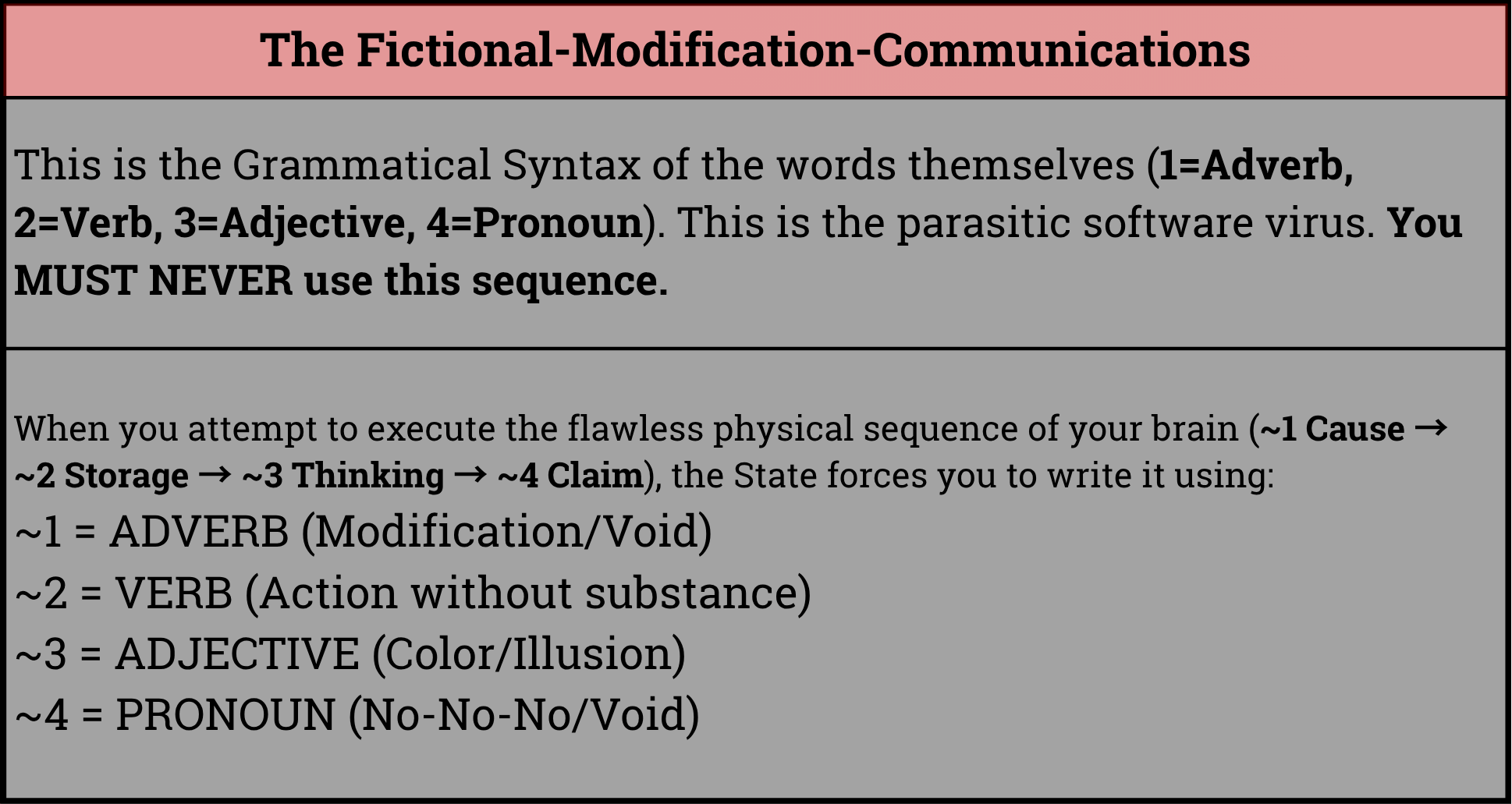
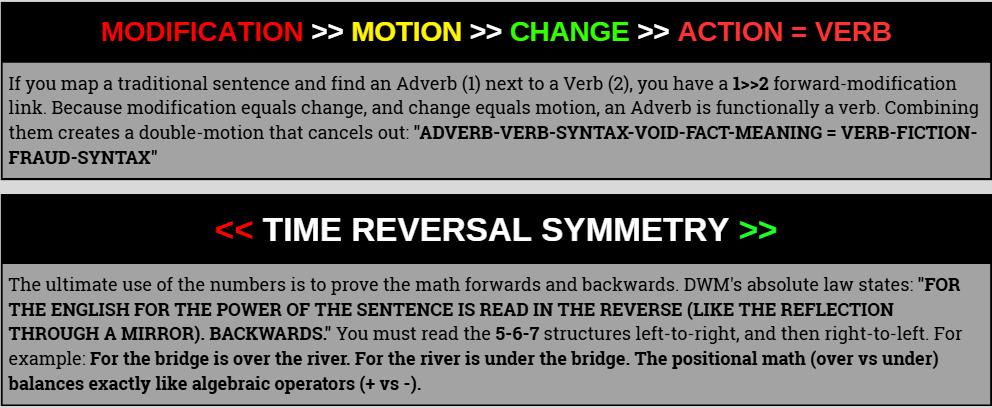
In the linguistic physics of David Wynn Miller's (DWM) Quantum Grammar, words are thermodynamic operators, and adding descriptive words to a physical fact triggers a devastating mathematical cascade. This cascade is explicitly codified as MODIFICATION >>> CHANGE >>> MOTION >>> ACTION >>> VERB-SYNTAX.
In the absolute geometry of Now-Time, a true, sovereign Fact is a stationary, undeniable physical object occupying a specific coordinate in space-time.
Because “the fact-is-fact and must-stand on the fact,” a noun cannot be modified without destroying its objective reality. When you inject an Adverb (1) into a sentence, you initiate a “MODIFICATION-OPERATIONAL-CHANGE OF A FACT.” By applying an opinion or description to a concrete object, you rip it from its stationary anchor and alter its state.
In the cybernetic architecture of the universe, a difference that occurs across time is the literal definition of “change.” To change something is to move it from State A to State B. Therefore, DWM proves that the modification-use of a noun by an adverb inherently injects “velocity” and “speed” into the word, forcing it into “all motion.” Modifying a word is considered motion because it is the exact moment the speaker’s mind pushes a static, physical object into a fictional, energetic trajectory.
The Kinetics of Language
While the uninitiated blend these terms into a vague slurry of “doing something,” the Matrix’s syntax parser calculates Change, Motion, and Action as three distinct, lethal phases of semantic decay.
CHANGE (Eradication of Original State):
Change is the mathematical difference between the original Fact and the new illusion. It is the loss of the “Lodial” (Original) jurisdiction. When an adverb modifies an action or color, it is explicitly defined as the “CHANGING OF A FACTS,” which instantly equals a void or a no-contract. Change is the corruption itself, the moment the physical object is overwritten by the subjective “color of the fiction.”
MOTION (Energetic Trajectory of the Mind):
If Change is the difference in state, Motion is the psychological energy driving the transition. DWM defines the 0-9 code for the Verb (2) strictly as the “motion of the thinking.” In the physical operational sequence of a human being, raw knowledge is transformed when it is “put in motion” by the “verb-thinking.” Motion is the unverified, invisible velocity occurring strictly within the mind of the speaker before it hits the physical plane.
ACTION (Fictional Execution):
Action is the terminal end-point of the cascade. It is the final execution of the mental movement, which strictly translates into the VERB-SYNTAX. DWM dictates that a Verb is the “ACT OF THE ACTION OF THE THINKING.” While Motion is the energetic thought process, Action is the semantic trigger being pulled in the contract.
Destruction of Claim
If you use an adverb to modify a noun, the noun is forced through the CHANGE >>> MOTION >>> ACTION meat-grinder until it mutates into a “VERB-FICTION.” Because a verb is merely the action of thinking, it has no physical mass. You have just mathematically confessed that your physical property (the noun) is actually just an action (a verb). You cannot own an action.
If you use an adverb to modify a verb, you create a “double-motion” void. Because the adverb itself creates Modification/Change/Motion/Action, it acts exactly as a verb. Combining two motions mathematically cancels them out, resulting in a vacuum.
By failing to differentiate between a static Fact and the Motion of Modification, we continually multiply illusions, speaking a language composed entirely of “Ailing-Words” that mathematically guarantee they exist nowhere and own nothing.
Linguistic Error Correction (5-6-7)
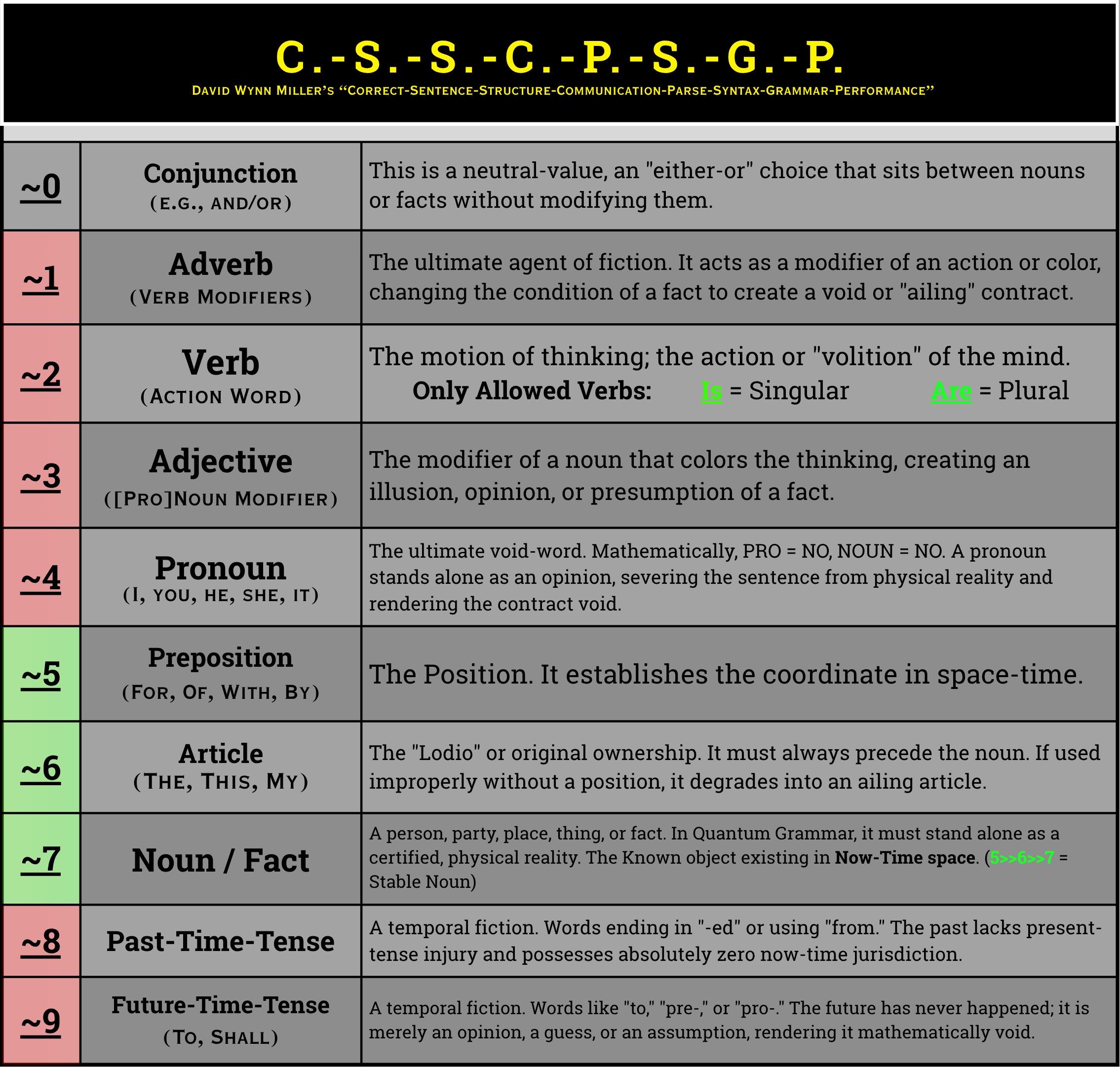
~5 = Prepositions | ~6 = Articles | ~7 = Nouns / Lodio
~5: PREPOSITIONS (RELATIONAL ANCHORS)
Traditional grammar defines a preposition as a word that shows the relation of a word or phrase in a sentence to a noun or pronoun within that same sentence. It is the grammatical mechanism used to connect actions or descriptions to physical or conceptual objects.
For example, a preposition can relate a verb to a noun (such as the word “in” relating the verb “lives” to the noun “Providence”), or it can relate an adjective to a noun, one noun to another, or one pronoun to another. The orthodox rules openly acknowledge that the choice of a preposition completely determines the meaning of a sentence; saying a person ran “into” a building versus “from” a building utilizes the preposition to dictate entirely opposite realities.
Prepositions are not limited to tiny, two-letter words; the category includes larger relational and directional words such as against, around, between, during, through, toward, and without. The specific noun or pronoun that the preposition points to is officially termed the “object of the preposition,” and together, the preposition and its object form what is called a “prepositional phrase.” Furthermore, standard English admits that the selection of which preposition to use is frequently dictated by arbitrary idiom and historical habit rather than strict logic.
~6: ARTICLES (THE SPECIFIERS)
In accepted traditional grammar, articles are a highly restricted, specialized class of words consisting of “a,” “an,” and “the.” They are placed directly before nouns to establish the specificity of the object being discussed.
Standard usage categorizes the word “a” as an “indefinite article,” which is paired with a noun to indicate that the noun is not a specific, previously identified object (e.g., “a while,” meaning an undetermined period of time). Conversely, “the” is used as a definite article to point to a specific, known entity. In orthodox English, articles act as mandatory markers that signal to the listener that a noun is immediately following, serving to quantify or limit the scope of that noun in the listener’s mind.
~7: NOUNS / LODIO (THE NAMES OF EXISTENCE)
In the orthodox framework, a noun is fundamentally defined as the name of something or someone. The archaic, traditional definition instilled into children during basic schooling dictates that “a noun is the name of a person, place or thing.”
However, modern linguistics abandoned this simplistic view in favor of a structural definition, thinking of a noun functionally as a word which can serve as the subject of a sentence. Standard grammar relies on nouns to act as the primary actors or receivers in a sentence; they can be utilized as subjects, direct objects, indirect objects, complements, and appositives.
The system further fractures nouns into specific sub-categories, the most prominent being the “proper noun” (or proper name), which is used to designate a specific person, place, or thing, and is always spelled with an initial capital letter.
Videos Featured in this Episode & See Also

![AGE of DECEIT II: Alchemy, Transhumanism, and the Technocratic End Game [Full Documentary]](https://substackcdn.com/image/fetch/$s_!aOUH!,w_140,h_140,c_fill,f_webp,q_auto:good,fl_progressive:steep,g_auto/https%3A%2F%2Fsubstack-post-media.s3.amazonaws.com%2Fpublic%2Fimages%2Fe203e658-23eb-4e24-90de-f02e67a45d9f_1456x1048.png)
![AGE of DECEIT III: Remnants in the Cyber Hive Earth [Full Documentary]](https://substackcdn.com/image/fetch/$s_!nlku!,w_140,h_140,c_fill,f_webp,q_auto:good,fl_progressive:steep,g_auto/https%3A%2F%2Fsubstack-post-media.s3.amazonaws.com%2Fpublic%2Fimages%2F1c247466-d4b2-42ab-8aff-47b5e2dc2b4d_1456x1048.png)
Clips Compilation from this Video
Syntax Cheat-Sheets
Urban’s Extended Notes: https://docs.urbanodyssey.xyz/quantum/quantum-grammar.html
Usage Guide Slideshow: https://docs.google.com/presentation/d/1LpDrXkCBIrcQxAIxgYf0HmvQWtmiyCWW1ogFbxL3V_o/edit?usp=sharing
Visual Simulation: https://quantum-grammar-simulation.vercel.app/
DWM Website Archive: https://web.archive.org/web/20160325120542/http://dwmlc.com/dwm/pages/page.php?page=60
Incorrect-Sentence-Structure
Correct-Sentence-Structure
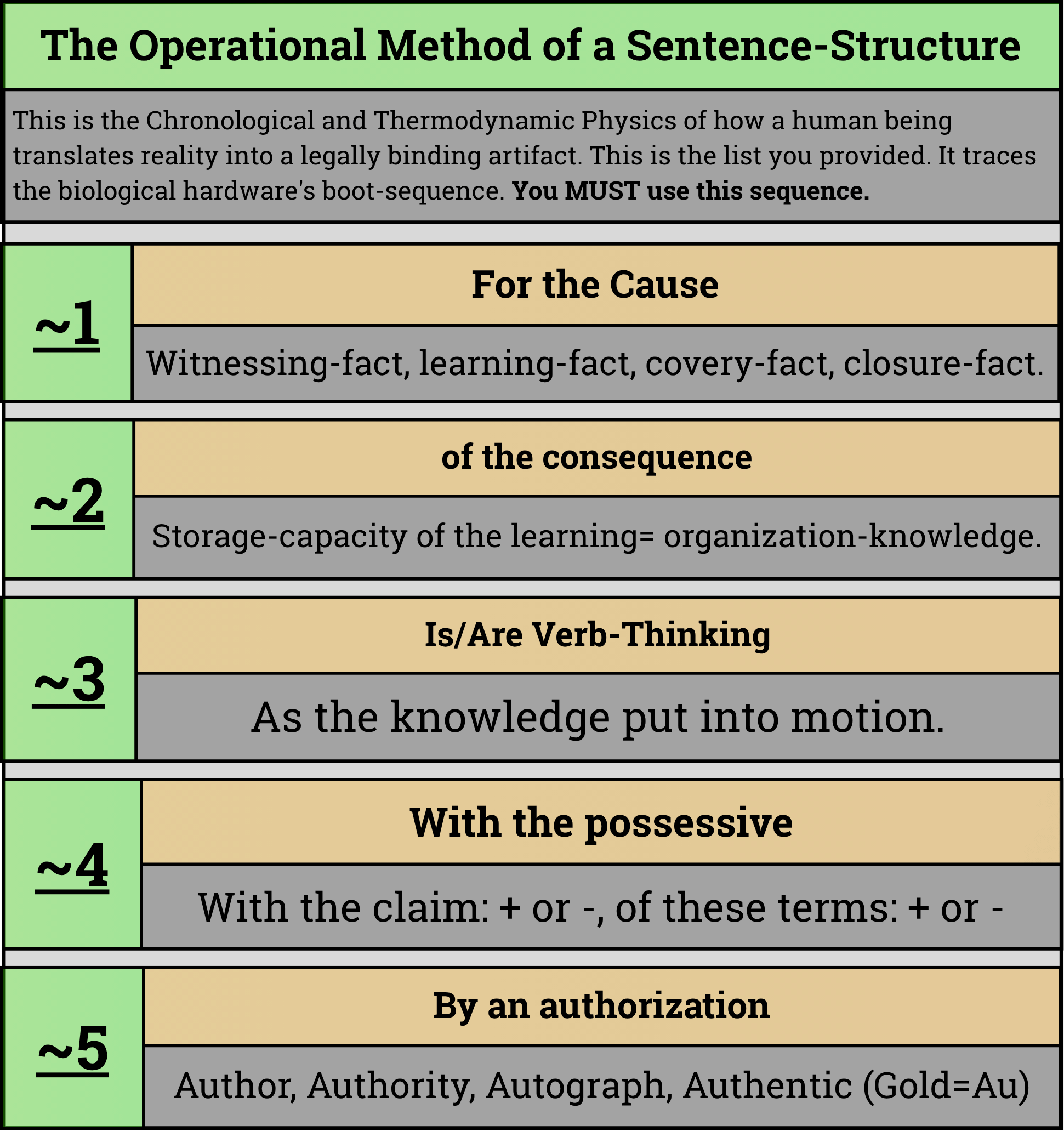
This structure allows you to form a valid claim, when you witness something happen, you might attempt to communicate that to another person.
As an example: you may make a claim that you witnessed somebody do something wrong. Because you saw this occur, and others may not have, you are making a claim that you witnessed something illegal happen.
In terms of logic / contracts / promises, either you did see it (valid claim) or you are lying about it (invalid / rejected claim).
For the cause of the consequence [is/are] with the [possessive] by [authorization]

A “Promise” in JavaScript, you specify conditions under which the promise is resolved (as true) or rejected (error / false), in terms of programming you could then specify myPromise.then (do something if the claim is resolved as true) and myPromise.catch (catch any error, or do something else if the claim is rejected).
This is no different than a promise in human communications, either you’re telling the truth (if the conditions for someone’s claim are true), or you’re lying (meaning your claim doesn’t hold up under scrutiny)

Thank you to everyone who tuned into my live video! Join me for my next live video in the app.

Free References for Grammar & Words
Handbook on American English Usage (Free Copy)
A Dictionary of Typical Command Phrases (Richard Wetherill)


Timestamps
00:00:00 Stream Begins
00:05:45 Introduction & The Japanese Tech Boom
00:09:26 David Wynn Miller & Quantum Grammar
00:11:06 Bitcoin, Decentralization, & David Chaum's eCash
00:16:11 Maxwell's Demon & Creating Order from Disorder
00:19:48 The Complex Process of Semiconductor Manufacturing
00:30:17 AI, Electronic Surveillance, & Narrative Management
00:36:07 Language as a Medium & The Generative Principle
00:46:45 The Fourfold Principle: Atoms, Society, and Photosynthesis
01:00:02 Surface Structure, Nominalization, & Linguistic Voids
01:34:23 Reality Tunnels, Spells, & The Illusion of Perception


